
Eleven Days: The Natural-Gas Buffer at the Center of Taiwan's Power Account
The natural gas that supported 47.7% of generation in 2025 has a safety stock of only about 11 days. With semiconductor- and AI-related industries expanding and nuclear power's share down to 1.1% — this is Taiwan's most fragile power account, laid out in full.
Article contents01 / 08
- Taiwan's strategic oil reserve is about 150 days, but the natural gas that supported 47.7% of generation in 2025 has a safety stock of only about 11 days, is heavily import-dependent, and draws roughly 30% from Qatar's Ras Laffan facility — this is the most fragile link in Taiwan's energy security.
- Supply is concentrated in natural gas (47.7% of 2025 generation, with nuclear down to 1.1%), while demand is being driven by expansion across the semiconductor- and AI-related industries. The government's latest estimate puts the 2026–2029 night-time reserve margin, in sequence, at 12.8%, 12.5%, 8.0%, and 7.1%; the government-approved target for a reasonable reserve margin is 15%. This is not a daily short-term dispatch indicator, and that target is not a regulatory threshold for daily dispatch either.
- As a doomsday narrative, "Taiwan is running out of power" is exaggerated; as a warning sign of structural fragility, it is real. The no-regret investments that hold regardless of whether you favor or oppose nuclear power are: building up the strategic LNG reserve, diversifying gas sources, and strengthening grid resilience.
“Eleven Days: The Natural-Gas Buffer at the Center of Taiwan's Power Account” reports that Natural Gas Safety Stock Is About 11 Days(11 days)。 Target: 14 days [2]。
“Eleven Days: The Natural-Gas Buffer at the Center of Taiwan's Power Account” reports that 2025 Generation Mix: Natural Gas Is Nearly Half(47.7%)。 Full-year actuals from the Energy Administration [12]。
“Eleven Days: The Natural-Gas Buffer at the Center of Taiwan's Power Account” reports that AI Data Centers Set to Grow Several-Fold Within Years(6.5x)。 National Science and Technology Council estimates roughly 6.5x by 2029 [7]。
“Eleven Days: The Natural-Gas Buffer at the Center of Taiwan's Power Account” reports that About 30% of LNG Comes From Qatar。 Per AmCham's accounting [2]。
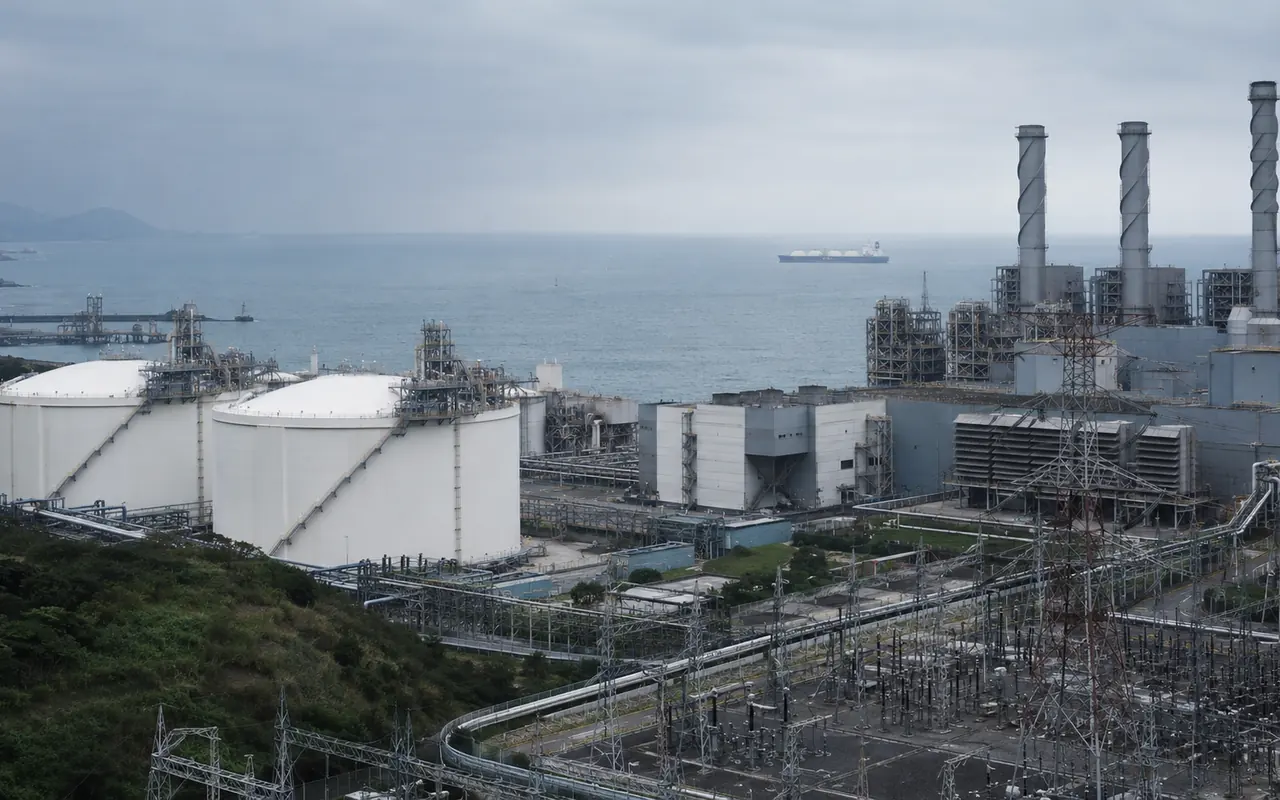
Start by remembering two numbers. Taiwan's strategic oil reserve is about 150 days. The natural gas that supported 47.7% of generation in 2025 has a safety stock of only about 11 days [2][12]. 150 against 11 — that gap is, in effect, a whole breach in the island's energy security. Lay out an island that depends heavily on imports and has bet its most advanced industries on a single power grid, and the first thing that should send a chill down your spine is not the price of electricity, and not AI — it's this gas pipeline that can only hold out for about 11 days.
Taiwan depends on imports for 95% of its energy, and its dependence on imported oil and gas exceeds 99% [2]. That part isn't news. What is news: after Nuclear Three's Unit 2 shut down in May 2025, nuclear power's share of full-year generation fell to 1.1%, while natural gas rose to 47.7% [12]. At the same time, TSMC's advanced processes and rapidly growing AI data centers are together pushing future demand higher. On one side, supply is concentrated and the buffer is thin; on the other, demand is bigger and can tolerate even less of a single second's slip. This report, written from Taiwan's own vantage point, opens this "power account" page by page — not to spread panic, but to see clearly just how far, or how close, so-called "power shortage" really is.
Two Numbers: 150 and 11
The most basic measure of energy security is simple: how many days can you hold out after supply is cut off? Taiwan does well on oil — a strategic reserve of about 150 days, enough to ride out a crisis of moderate scale [2]. The problem is natural gas. The liquefied natural gas (LNG) Taiwan uses for power generation is 100% imported [1], and its safety stock is only about 11 days. By comparison, Japan and South Korea — similarly import-dependent — hold reserves of roughly 14 to 20 days [3].
“Eleven Days: The Natural-Gas Buffer at the Center of Taiwan's Power Account” reports that Natural Gas Safety Stock Is About 11 Days(11 days)。 Target: 14 days [2]。
Why is gas so hard to stockpile? Because LNG has to be kept liquid at an ultra-low minus 162 degrees Celsius, which makes storage expensive and tank capacity limited. Taiwan's three receiving terminals are running close to full, expansion work is moving slowly, and the government's plan to raise the safety stock from about 11 days to 14 days is targeted for 2027 [2]. Even if everything goes smoothly, it will still take Taiwan another year or two to catch up to the lower end of Japan and South Korea's range.
Even more critical is how concentrated the source is. According to an accounting by the American Chamber of Commerce in Taipei (AmCham), about 30% of Taiwan's LNG comes from Qatar's Ras Laffan facility [2]. When Middle East tensions escalated in 2025, the Strait of Hormuz grew tense, and Iran at one point struck Ras Laffan, that war thousands of miles away directly tested Taiwan's energy resilience [10]. A single missile fired on the other side of the planet can make Taiwan's power supply shudder — that is the true weight carried by the number "11 days."
“Eleven Days: The Natural-Gas Buffer at the Center of Taiwan's Power Account” reports that About 30% of LNG Comes From Qatar。 Per AmCham's accounting [2]。
Translated into plain terms, "11 days" means this: in the worst-case scenario, from the moment LNG carriers stop docking, Taiwan would have only about 11 days to negotiate, to reallocate supply, to find alternatives, or to absorb the consequences as gas-fired power plants shut down one after another. Oil's 150-day buffer allows a calm response to a crisis; natural gas's 11 days leaves almost no room for error. Energy security has an iron rule: the strength of a chain is set by its weakest link. In Taiwan's chain, the weakest link is jammed right at these 11 days.
Oil can last 150 days; natural gas can last only 11. In energy security, it's usually the shortest segment that determines the strength of the entire chain.
Natural Gas Rules This Grid
Zoom in on the generation mix, and you'll see the biggest "engine swap" Taiwan has made in years. The Ministry of Economic Affairs' Energy Administration reports these full-year 2025 actuals: natural gas 47.7%, coal 35.3%, renewables 13.3%, nuclear 1.1% [12]. An earlier version of this report mistakenly presented a prior policy target or estimate as the full-year actual figure; that has now been corrected. Taiwan's electricity is still a grid dominated by natural gas — but not the 52% figure the earlier version stated.
“Eleven Days: The Natural-Gas Buffer at the Center of Taiwan's Power Account” reports that 2025 Generation Mix: Natural Gas Is Nearly Half(47.7%)。 Full-year actuals from the Energy Administration [12]。
This shift isn't without logic. Compared with coal, natural gas burns cleaner and is more flexible to dispatch, which suits it well to pairing with intermittent renewables. The problem is the share: when a fuel that is heavily import-dependent accounts for nearly half of generation, and its safety stock is only about 11 days, the resilience of the entire grid ends up tied to a comparatively short supply chain. Energy security has an old rule of thumb — diversity is itself a form of insurance. With nuclear power's share reduced, Taiwan's generation structure remains highly dependent on imported fossil fuels [12].
Renewable energy was originally expected to carry a lot of the weight. The Tsai administration once set a "5-3-2" target — 50% natural gas, 30% coal, 20% renewables — but the renewables leg has clearly fallen behind [4], and the 20% target has been pushed back repeatedly, now to the end of 2026 [5]. Solar and offshore wind are the main pillars, but their weather-dependent nature makes the grid even more reliant on natural gas that can be dispatched on demand to fill the gaps. That creates a loop: the more the grid relies on renewables, the more it relies on gas-fired dispatch to balance them; and the more it relies on gas, the more critical that 11-day buffer becomes.
Two Monsters Devouring Electricity
Supply is already tight enough, and demand keeps accelerating. People often ask: "Is TSMC an electricity-eating monster? Will AI collapse the grid?" A reality check from our technology expert reminds us to split this question into two separate monsters — a "present-tense" one and a "future-tense" one — and not conflate them.
The present-tense monster is semiconductors. Total national electricity consumption in 2025 was about 282.7 billion kWh, of which semiconductor manufacturing accounted for roughly 42.38 billion kWh in electricity sold — nearly 15% of national consumption [6] (a single-source figure; medium confidence; compare this against the publicly cited estimate that TSMC alone accounts for about 8%, with the difference reflecting whether the scope is "semiconductor manufacturing" or "the electronics industry as a whole"). Counting the entire electronics and electrical-equipment manufacturing sector pushes the figure to about 24%. This is a real, present-tense heavy user of electricity, and one that keeps growing as advanced-process capacity expands.
The future-tense monster is AI data centers. Their appetite today is actually still small: electricity use rose from about 730 million kWh in 2021 to about 1.5 billion kWh in 2025, only around 0.5% of the national total [6]. But the growth curve is steep — the National Science and Technology Council estimates that by 2029, AI data centers nationwide could reach a scale of about 450MW, versus roughly 36 facilities today with a combined load of about 60MW, a roughly 6.5-fold increase within a few years [7]. Taipower separately estimates that, factoring in expansion across the semiconductor- and AI-related supply chain, new electricity demand will exceed 5GW by 2030 — and that figure is not AI data centers' demand alone [12].
“Eleven Days: The Natural-Gas Buffer at the Center of Taiwan's Power Account” reports that AI Data Centers Set to Grow Several-Fold Within Years(6.5x)。 National Science and Technology Council estimates roughly 6.5x by 2029 [7]。
Being clear about these two monsters matters: treating "AI alone will collapse the grid" as a present-tense fact is an exaggeration; ignoring the new demand from the entire semiconductor- and AI-related supply chain is negligence. And for the semiconductor industry, the real pain point isn't even "total volume" — it's "quality." Advanced processes cannot tolerate even a momentary power blip; the yield loss from a single micro-outage far exceeds the cost of a rate hike. Stability matters more than sheer quantity.
The Night-Time Reserve Margin: A Thin Buffer in Long-Term Planning
So, does Taiwan actually have "enough electricity"? Two indicators have to be separated first. The "operating reserve margin" measures short-term dispatchable resources against each day's instantaneous peak; Taipower displays it with a traffic-light system, and in 2025 it stayed above 10% on 342 days [12]. The "reserve margin" is a long-term planning indicator measured on an annual basis, calculated from net peak capacity against peak load. The two cannot be used interchangeably.
The worrying signal is in the long-term night-time planning numbers: the Ministry of Economic Affairs' latest estimate puts the 2026–2029 night-time reserve margin, in sequence, at 12.8%, 12.5%, 8.0%, and 7.1%, recovering to 15.2% in 2030 [12]. The government-approved target for a reasonable reserve margin is 15%. This is not the statutory threshold for the daily operating reserve margin. The judgment that holds up is this: the night-time long-term supply margin over the next four years is thin, and 2028 and 2029 in particular will need close monitoring of unit-commissioning progress, demand-side management, and actual load.
One thing has to be honestly flagged: the "day-by-day light-status" tallies circulating online are mostly compiled by online communities and belong to the level of public-sentiment observation — they are not enough on their own to support a conclusion of "power rationing is imminent" (observation; low confidence). The judgment that holds up is: Taiwan's ordinary supply margin is systematically thinning, not on the verge of collapse. That distinction is the single most important line this report has to hold.
The Kilowatt-Hour Politics Decides
Another page in the power account is price. In Taiwan, electricity prices have never been purely an economic question — they are just as much a political one. In April 2024, electricity rates rose by an average of about 11%; industrial users saw an average hike of 12.7%, with extra-high-voltage heavy users such as semiconductor makers seeing increases above 15%, and some large users facing hikes of 15% to 25% depending on scale [8]. Household users consuming under 700 kWh, by contrast, saw increases of only 3% to 5% — the political allocation of "industry carries more, households pay less" is spelled out plainly.
By the first half of 2025, weighing tariff shifts, geopolitical risk, and price stability, the government simply froze electricity rates, holding them at NT$2.77 per kWh for households and NT$4.27 per kWh for industry [5]. The freeze gave households and businesses a sigh of relief, but the cost was booked onto Taipower's own ledger: from 2022 to 2024, Taipower sold electricity below cost, and by the end of 2024 its accumulated losses exceeded NT$420 billion, with a debt ratio above 90% [5]. So-called cheap electricity was, in effect, quietly absorbed by the state-owned utility's balance sheet.
The picture improved somewhat in 2025 — Taipower ended a three-year losing streak and is estimated to have earned more than NT$60 billion for the full year [5] — but that owes more to a combination of policy pricing and falling fuel costs than to any structural fix. Our economics expert's reality check matters here: for industry, even after the increases, Taiwan's electricity prices remain relatively competitive; what truly unsettles investors isn't the current absolute price level, but uncertainty — will there be rationing, will there be a sudden sharp hike. A stable expectation is sometimes worth more than a cheap price.
Hidden in here is a linkage that's easy to overlook: 47.7% of Taiwan's generation in 2025 came from natural gas, and international gas prices swing sharply with geopolitical conditions [12]. When fuel costs spike, either the cost gets passed through into electricity rates, hitting manufacturing costs and consumer prices, or Taipower absorbs it, piling up more losses and debt at the state utility. This transmission chain — "import dependence → fuel-price volatility → either electricity rates or the treasury pays" — is the hidden bill for having natural gas so concentrated in the generation structure. The 11-day stockpile problem, in the end, also gets booked back into the cost of every kilowatt-hour, in the form of price.
After Going Non-Nuclear: Two Accounts Collide
All of this pressure ultimately converges on the same dispute: the "nuclear-free homeland." On May 17, 2025, Nuclear Three's Unit 2 shut down, and Taiwan officially entered its "nuclear-free homeland" era [7]. But the story didn't end there — on May 13 of the same year, the Legislative Yuan passed, in its third reading, an amendment to the Nuclear Reactor Facilities Regulation Act extending nuclear plant operating licenses to 60 years, effectively laying the legal groundwork for a "life extension" [7]. In the August 23 referendum on extending Nuclear Three's operation, more than 4.34 million votes were cast in favor, far outnumbering the roughly 1.51 million against — yet it failed because turnout didn't clear the 5-million-vote approval threshold [8]. Public opinion reads as "not opposed, but not yet urgent enough to insist on it." Then in March 2026, the Lai Ching-te administration announced that Nuclear Two and Nuclear Three both now meet the conditions for restart [7] — the period at the end of "non-nuclear" has been turned back into a question mark.
Around this question mark, our team's two red teams went several genuine rounds of head-to-head confrontation. The power-shortage-risk camp (favoring a nuclear restart) argues: saying "the power shortage is exaggerated" is naïve — the real question isn't whether supply is adequate under normal conditions, it's whether the system can hold up under a blockade or wartime conditions. LNG is heavily import-dependent, its safety stock is only about 11 days, roughly 30% comes from Ras Laffan, and it shudders the moment something happens in the Middle East; betting the power supply on a gas source with such a short buffer is a national-security-level risk, and restarting nuclear power and building up reserves is exactly how you de-risk it. The stable-supply camp (no restart needed) pushes back: talking about a "blockade cutting off gas" as though it will happen tomorrow is selling a low-probability, high-impact scenario as though it were the present tense; on most days in 2025 the daily operating reserve margin stayed at green, and the real problem is structural concentration, not an outage tomorrow — equating "energy security" directly with "restarting nuclear power" is a conceptual sleight of hand, because nuclear waste, earthquakes, and nuclear plants themselves are equally high-value fixed targets under a blockade [12].
Our military expert weighs the scenarios more precisely: a full maritime blockade is a high-cost, all-in confrontation — low probability, extremely severe consequences. What's more likely is a "gray zone" — exercises, inspections, soaring insurance and shipping costs that make LNG carriers "afraid to come, or slow to arrive" [11]. In that scenario, an 11-day stockpile means only 11 days of decision-making time, which is too short. Concentrated receiving terminals and large power plants are themselves high-value targets; energy resilience — diversification, stockpiling, black-start capability — is itself part of deterrence.
How Close Is Taiwan Really to a Power Shortage?
So, back to the original question: how far is Taiwan really from a power shortage? Our neutral synthesizer's even-handed convergence is this: as a doomsday narrative, "Taiwan is running out of power" is exaggerated; as a warning sign of structural fragility, it is real. What should anchor the discussion isn't "will the power go out tomorrow," but two objective facts: first, natural gas accounted for 47.7% of generation in 2025, meaning supply is concentrated; second, the LNG buffer is only about 11 days. The real bottleneck is supply resilience and power quality, not the current absolute electricity price — for the semiconductor industry, a momentary blackout is far more lethal than a rate hike.
As for whether nuclear power should be restarted, that is a genuine divide mixing "values plus evidence": the evidence side argues over whether the daily operating reserve and the long-term night-time reserve margin are each adequate, and whether the demand projections are accurate; the values side argues over whether to accept nuclear risk and nuclear waste, and whether safety or de-risking should come first. This kind of divide cannot be fully resolved by any single spreadsheet, and it shouldn't be packaged by either camp as the one and only solution.
But beyond all this opposition, there is common ground that holds regardless of which side you're on: build up the strategic reserve, diversify gas sources, and strengthen grid resilience. Whether you favor nuclear power or oppose it, raising the LNG safety stock above 11 days, diversifying gas sources away from sole reliance on Ras Laffan, and making the grid more able to withstand sudden swings are all no-regret investments. What Taiwan should really be arguing about may not be the yes-or-no question of "nuclear power or not," but the applied question of "how do we stop these 11 days from being our lifeline's weak point."
Three Stances: Building Up a Buffer Around the Eleven Days
From Taiwan's own vantage point, our team has converged on three stances (decision-oriented, not investment advice).
For the state, the task is to elevate "energy security" to the same strategic tier as semiconductors: accelerate raising the LNG safety stock from 11 days to above 14, diversify away from sole dependence on Qatar, push forward receiving-terminal expansion, and strengthen grid resilience and black-start capability. As for nuclear power, rather than getting stuck on the yes-or-no question, it's better to first fully carry out the work — diversification, stockpiling, resilience — that holds regardless of which side you're on. After all, the policy guarantee of "stable supply through 2034" rests on a whole chain of projections — the sooner that buffer gets built up, the sturdier that guarantee becomes.
For industry intermediaries (startup and industry federations, industry alliances), the task is to turn "power resilience" into a cluster-wide shared issue: help member companies map out their real needs for power quality (zero-tolerance for interruption), push joint procurement of backup power and energy storage, use collective bargaining power to spread backup costs that no single company could bear alone, and build "electricity-price uncertainty" into risk communication around investment and site selection — turning vague anxiety into manageable numbers.
For SMEs, the most practical piece of advice is this: first figure out exactly how afraid your business really is of "a one-second outage" versus "a 10% rate hike." Businesses running precision processes that fear any interruption should prioritize evaluating uninterruptible power and local energy storage; those sensitive to electricity prices with thin margins should treat energy conservation and efficiency as everyday operations, not something they passively absorb only after a price hike hits. In this power account defined by 11 days, recognizing which box you fall into is the first step toward buying yourself a buffer.
Eleven days is the shortest segment in Taiwan's energy security, and also this island's most honest power account. Understanding it isn't about panic — it's about acting now, before those 11 days are ever truly put to the test, and building them up, one day at a time.
Sources
- Energy Administration, Ministry of Economic Affairs — Report on National Electricity Resource Supply and Demand, 2025
- Global Taiwan Institute — Losing the Buffer: Energy Mix Diversity and Taiwan's Security
- AmCham Taiwan Business TOPICS — Energy Security Returns to the Forefront
- S&P Global — Taiwan vulnerable to LNG supply risks in a maritime blockade
- Atlantic Council — The Iran war tests Taiwan's energy resilience
- FDD — Maritime Protection of Taiwan's Energy Vulnerability
- Environmental Information Center (e-info) — Executive Yuan announces 2025 generation mix
- The Reporter — Taipower's debt ratio exceeds 90%; electricity rates frozen in the first half of 2025
- TechNews — A rundown of Taiwan's electricity demand: from data centers to the electronics industry
- TechNews — Taiwan's AI electricity use to surge 6.5-fold by 2029
- Anue (cnYES) — Average electricity rates rise 11% starting in April
- Taipei Times — Ministry's energy forecast too rosy
The December 4 Vote: If the IMO's Net-Zero Framework Passes, Which Bill Does Taiwan's Shipping Industry and Kaohsiung Port Pay First?
The IMO did not adopt the Net-Zero Framework in 2025, and December 4, 2026 is only the scheduled date for resuming the extraordinary session — contingent on confirmation by MEPC 85. Taiwan has no vote at the IMO, yet it will still feel the outcome through flag-state and port-state enforcement, fuel procurement, freight rates, and shipper contracts. What Taiwan should pay first is not an as-yet-undetermined carbon price, but three preparation costs: data, a fuel evidence chain, and contract transparency.
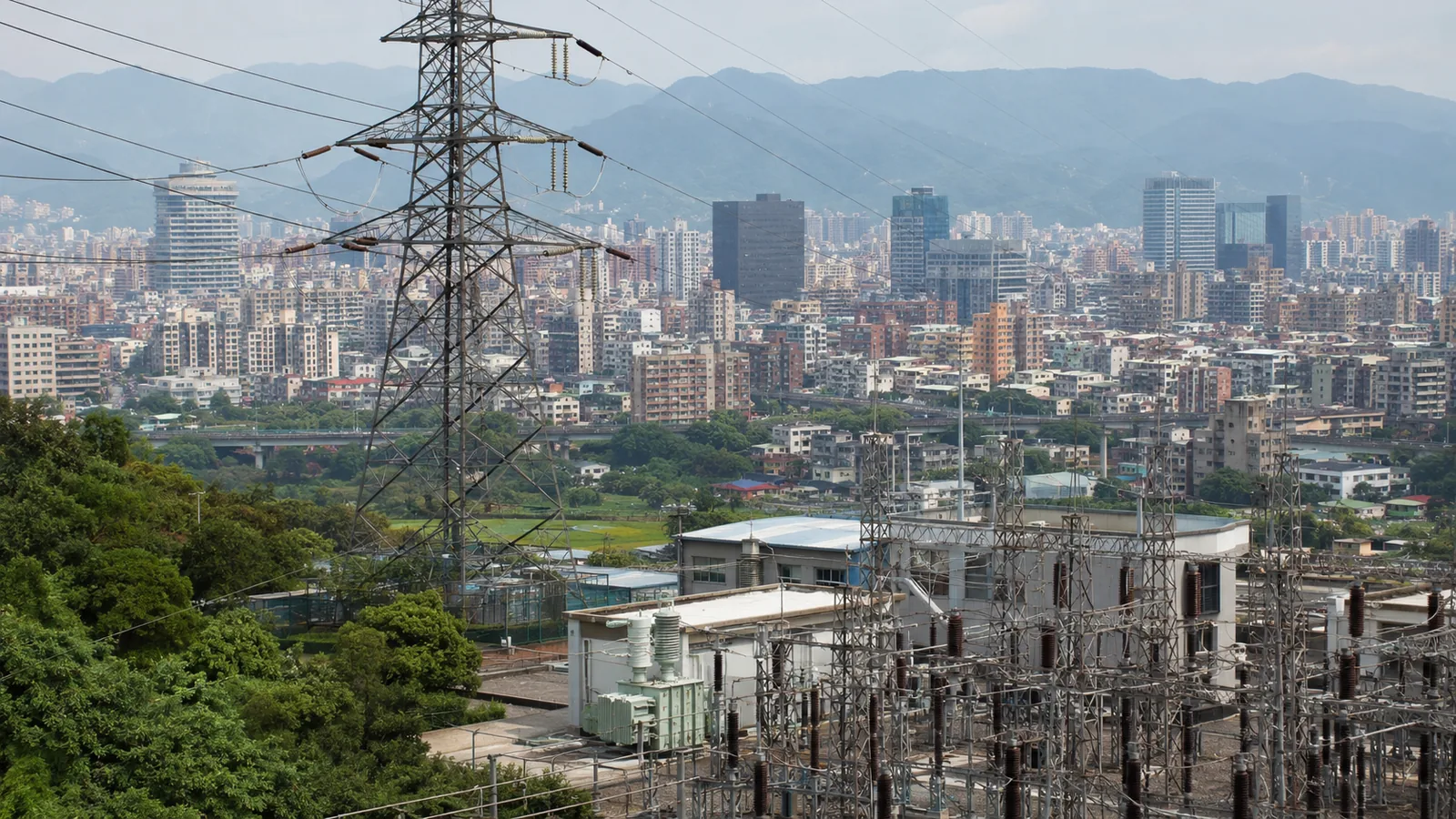
Not Just a Power Shortage: Taiwan's AI Data Centers Still Have to Clear Siting, Grid Interconnection and Equipment
Taiwan's data-center constraint is not a binary choice between 'not enough electricity' and 'not enough parts.' Official data confirm that new applications above 5MW north of Taoyuan were once suspended from acceptance, that new or expanded facilities above 5MW must pass an energy-use review, and that the National Science and Technology Council is planning a 120MW Shalun computing center to come online in 2029; equipment lead times still have to be confirmed project by project with named suppliers.