
Is Beijing Building Its Own AI Wall? China Is Reportedly Weighing Limits on Models, Data and Chip Technology — Taiwan Should Not Rush to Score It as a Win
China's regulators are reported to be discussing restrictions on overseas access to its most advanced AI models. The policy options under discussion may also touch training data and chip design. As of 23 July, there is no formal rule, threshold or effective date. What actually needs preparing for is not a guess about when Beijing will shut the door, but pulling apart model weights, APIs, data and foundry manufacturing so there is room to substitute under different policy scenarios.

Article contents01 / 11
- As of 23 July 2026, China restricting advanced AI models, data, or offshore chip fabrication remains at the deliberation or media-reported-option stage; it cannot be written as an enacted ban.
- China's existing export-control legal framework provides tools that could cover technology, services and data, but whether AI models are actually placed on a control list, and how "frontier capability" would be defined, remain the decisive questions for market impact.
- Taiwan should not bet on an uncertain policy as a single clear win or loss, but instead manage it through a software bill of materials, a second model, version archiving and tiered management of foundry customers — preserving the ability to reverse course.
Start with the most important — and least sensational — conclusion: as of 23 July 2026, no formal rule banning the export of China's most advanced AI models appears in any published regulation or control list.
In early July, Reuters reported, citing three sources with knowledge of the matter, that Chinese regulators had met with companies including Alibaba, ByteDance and Zhipu to discuss the possibility of restricting overseas access to the country's most advanced AI models, with the scope potentially touching both closed models and open-weight versions. [1] In late July, a follow-up report from the Financial Times widened the possible scope to training data, model weights and advanced chips designed by Chinese companies, even mentioning restrictions on foreign foundries taking on the manufacture of certain Chinese designs; Reuters, in relaying that report, stated explicitly that it could not independently verify it. [2][12]
As of 23 July 2026, there is no public formal list, technical threshold, list of covered countries, or effective date — and it is not known whether the policy will ultimately be implemented at all. Reuters' earlier report likewise noted that the scope under discussion remains in flux, may apply only to future models, and that when — or even whether — it will be implemented is unclear. [1]
So this article is not here to announce that "Beijing is banning AI too," and it certainly cannot treat an option that has not even become policy as an automatic win or loss for TSMC. China's own public policy stance as of 17 July still champions open source, model sharing and cross-border cooperation, while also stressing security governance. [17][18] Anonymous sources suggest Beijing may be carving out exceptions for frontier or sensitive capabilities, but the official open-door line and these reported options have not yet been reconciled into a single formal rule. What is genuinely worth watching is this still-undefined tension: will model weights, training data, chip designs and talent-holding companies end up being carved out into a narrower security perimeter, separate from the broader push for open cooperation?
If that path becomes real, what Taiwan will need to manage is not just chip exports, but the entire AI technology supply chain.
I. Draw the Line First: Confirmed, Reported, and Still Unknown
Three things are confirmed.
First, Reuters reported on 7 July, citing three anonymous sources, that Chinese regulators had discussed policy options to restrict overseas access to the country's most advanced models with major AI companies; the regulators and the companies involved have not publicly confirmed the content of those meetings. [1] Second, China's existing export-control legal framework provides a potential entry point covering goods, technology, services and related technical data that meet the definition of dual-use items or are formally placed on a control list. [3][4] Third, China has already built specific management and enforcement arrangements for dual-use items related to strategic minerals, technology transfers and transactions involving controlled lists — but these measures cannot be directly extrapolated to mean that AI models in general are already subject to equivalent controls. [6]
What has been reported, but not yet confirmed by any official document, includes: restrictions on moving training data overseas, restrictions on foreign users downloading the weights of the most advanced models, review of foreign acquisitions of Chinese AI companies, and restrictions on foreign foundries manufacturing certain advanced designs on behalf of Chinese companies. [1][2]
What remains unknown is even larger. What counts as "most advanced"? Is it judged by parameter count, training compute, specific capabilities, or military application? Will already-public weights be applied retroactively? Does ordinary enterprise use via an API count as an export? How would open-source communities' overseas mirrors be handled? Is Taiwan's chip foundry sector actually within the scope of the rules?
Separating these three layers is the only way to avoid two symmetrical mistakes. One is to declare a total blockade the moment an anonymous source appears; the other is to assume, because there has been no announcement, that companies need not prepare at all.
II. What Tools Does China Already Have? Having a Tool Is Not the Same as Using It
China's Regulations on the Export Control of Dual-Use Items, which took effect at the end of 2024, define dual-use items as goods, technology and services that have civilian, military, or military-potential-enhancing uses, and bring related technical data within scope as well. [3] The regulations' understanding of "export" also goes beyond a single shipment leaving the country — it includes transfers from within China to outside China, and the provision of controlled items by Chinese citizens or legal persons to foreign organizations or individuals. [3]
The system has three main tools. Regulators can draft and adjust control lists; items, technologies and services not on the list can also be placed under time-limited temporary controls after approval; and prohibitions or restrictions can be applied to specific items, destination countries, organizations or individuals. [3] Exporters are, in principle, required to apply for licences based on the list, temporary controls, and the end user and end use; the Ministry of Commerce also provides a dual-use items list database for reference. [11]
China additionally maintains a Catalogue of Technologies Prohibited or Restricted from Export, used to manage the cross-border transfer of specific technologies; the current version consists of the 2023 catalogue plus a 2025 adjustment. [14][15] A 2026 Catalogue for the Administration of Import and Export Licences for Dual-Use Items and Technologies lists the current scope of licensing management. [5]
Looked at from the legal structure, if Beijing decides to formally classify certain model weights, training techniques, data-processing methods or chip designs as dual-use items, there is no shortage of institutional entry points to do so. But another brake needs to be applied here: a legal entry point does not mean AI models are already on the list today; and the fact that the government can impose temporary controls does not mean it will. The existing list carries its own exceptions for software and technology in the public domain and for basic research, and there is still no formal rule defining what class of object an ordinary open model's weights actually are — software, technical data, a service, or something else. [16]
This is not merely a semantic scruple. A company's compliance costs and commercial exposure depend on how a formal rule ultimately defines the covered item, the capability threshold, the covered parties and the exceptions. Without those, it is not possible to size the market, let alone predict any single foundry's order book.
III. Why Would Beijing Consider Controlling Models, Not Just Chips?
For most of the past decade, the main image of the tech war has been the United States blocking advanced chips and manufacturing equipment from reaching China. That logic treats compute as the bottleneck: without enough advanced chips, it becomes harder to train and deploy frontier models — and the repeated adjustments to Nvidia's chip licences are a concrete example of how this competition has worked its way into corporate products and transactions. [13]
As model capability has advanced quickly, a different kind of risk has surfaced. Model weights themselves can be downloaded, fine-tuned and deployed on different hardware; high-quality training data, model architecture and post-training methods can also shorten how long it takes a competitor to catch up. A system with strong coding, cybersecurity, biological or military-analysis capability could potentially be used directly by an adversary, without that adversary having to first acquire all the data and talent needed to develop the model itself.
Reuters reported that China's internal discussions include treating the leak or theft of proprietary AI technology with greater severity, and restricting who is allowed to invest in domestic AI startups. [1] The report also tied this policy anxiety directly to U.S. models with advanced cybersecurity capability: from Beijing's vantage point, a model that can discover or exploit software vulnerabilities is not merely a commercial tool — it could also become an offensive or defensive asset. [1]
This security logic is not unique to China. When the U.S. Department of Commerce promoted full-stack AI exports, it bundled hardware, data, models, cybersecurity, applications and compute into a single program, and required proposals to align with national-security and foreign-policy goals. [9] China's Ministry of Commerce has previously criticized the United States for tying AI chips, model parameters and long-arm jurisdiction together, [10] which also reflects the fact that Beijing has long treated this kind of policy as an instrument of national competition. Both sides differ in their institutions and transparency, but the shared trend is this: models are moving from being ordinary software to being a category of controlled object requiring a judgment about "who can access it, and what can they do with it."
IV. Beijing's Biggest Dilemma: Closing Off Is Safer, But Opening Up Is What Builds an Ecosystem
If security alone is the lens, restricting the outflow of frontier models is intuitive. If industrial competition is the lens, the picture is exactly reversed.
A key reason Chinese models have been able to gain ground quickly among global developers and enterprise customers in recent years is cost and open weights. Users can download them, deploy them locally, fine-tune them, and avoid total dependence on the large U.S. platforms. Reuters noted that after DeepSeek R1, Chinese models made clear overseas progress on the strength of lower cost and improving capability. [1]
The public policy line China's government released on 17 July also puts open source, model sharing, cross-border data spaces and international cooperation at the core of its policy, while retaining language on security governance. [17][18] This is an important counterweight to the anonymously sourced reports of deliberation: at least at the public level, Beijing has not yet turned toward "closing everything down."
A June 2026 arXiv preprint, not yet peer-reviewed, further argues that U.S. restrictions on chips and computing infrastructure, while raising the cost of AI development in China, have also unintentionally increased the strategic value to China of promoting open, locally adaptable models; the paper reports that Chinese developers' participation on open-model platforms has risen, and that models have spread through research and open-source communities. [7] This is the authors' own research argument, not an official statistic, and it cannot alone prove causation — but it does point to Beijing's policy paradox: the more it worries about technology being taken, the more it wants to tighten controls; the more it wants Chinese standards, tools and ecosystems to expand globally, the more it needs developers to actually be able to get hold of them.
So the most likely policy outcome may not be "all Chinese models banned from overseas use across the board." A signed expert roundtable article published on the website of the Intellectual Property Court of the Supreme People's Court proposes a tiered governance approach: basic open-source tools would be subject to filing requirements, more advanced technology would undergo security review, and only the most sensitive frontier models would be restricted from public release or limited to domestic use. [8] This is scholarly and legislative-proposal-level expert opinion — it is not a court judgment, a judicial interpretation, a regulator's draft, or formal policy.
This is still not a formal rule, but it fits the dilemma far better than "total blockade": preserve most of the open ecosystem, and concentrate controls on a narrow slice of the most sensitive future capability. What companies genuinely need to track, then, is not "will Chinese models stay open source" but where the dividing line gets drawn, who is responsible for making that determination, and whether a version update could suddenly cross it.
V. Model Controls Are Not One Switch — They Are Five Different Pipelines
News coverage often writes "restricting AI technology exports" as if it were a single switch. In practice, there are at least five distinct pipelines.
Model weights are downloadable files that can be self-deployed. If weights can no longer be provided overseas, existing users may still hold an older version, but cannot legally obtain new versions, patches, or stronger capability.
API services let a user send a request to a supplier's server without downloading any weights. Controls here can target accounts, regions, end use, or specific capabilities; if the service stops, an application built on it may fail immediately.
Training and fine-tuning data involve cross-border data flows, personal information, trade secrets and national security. Even if the model itself remains usable, an inability to move data across borders would still change where deployment happens and how partnerships are structured.
Methods and talent include training techniques, code, technical documentation, joint research and mergers and acquisitions. China's existing control system already understands "provision" and "transfer" as extending well beyond physical goods, [3][6] so collaborative research and investment could face review even earlier than a model download would.
Chip design and manufacturing form a separate chain altogether. AI chips designed by Chinese companies may require offshore foundry manufacturing; if a rule restricts handing designs or technology to a foreign fab for manufacturing, what is affected is the design files, process collaboration and foundry relationship — not the same thing as "China banning the export of a finished chip."
These five pipelines run on different timescales and have different substitutes. Collapsing them into a single phrase leaves a company unable to tell whether it should be backing up weights, switching APIs, relocating data, or rebuilding its chip supply chain.
VI. Will TSMC Benefit or Get Hurt? There Is No Single Answer Right Now
The market is quick to compress this whole topic into one line: "China is restricting AI technology — doesn't that benefit TSMC again?"
If China genuinely restricts its domestic companies from handing advanced chip designs to offshore foundries such as TSMC for manufacturing, the direct effect could be that TSMC loses some Chinese design customers — not that it benefits. [2] Chinese design companies would then have to shift to domestic manufacturing, lower their specifications, delay their products, or apply for licences. The actual impact depends on which designs get listed, the process-node threshold, customer concentration, and any transition period.
But an opposite effect could occur at the same time. If governments and companies in third countries worry about the continuity of supply from Chinese models and chip technology, demand for trusted alternatives from the United States, Taiwan and elsewhere could rise; Taiwanese server, chip and systems-integration companies might pick up replacement orders. This is an indirect effect, and it would have to pass through price, performance, export licensing and customers' political choices — it will not compensate one-for-one.
A third outcome is also possible: Beijing controls only the most sensitive future models and does not restrict most commercial open models or offshore foundry work at all. In that case, market impact might fall mainly on a handful of frontier projects and legal compliance work, rather than on overall semiconductor revenue.
So, before a formal rule appears, calling the impact on TSMC a win or a loss is premature. The most professional answer is a decision tree of scenarios, not a single arrow on a stock chart.
VII. The First Shock to Taiwanese Companies May Not Be a Missing Model — It May Be "Update Uncertainty"
For Taiwanese companies that have already adopted Chinese open models, the reasons may include cost, Chinese-language capability, the ability to deploy locally, and the convenience of fine-tuning against internal data; there is currently no public survey that can quantify the scale or motivation of Taiwan's adoption. If future restrictions apply only to the most frontier versions, a company's existing weights would not necessarily disappear overnight.
The real trouble is the life cycle.
Once a model is in production, it still needs security patches, framework updates, licence confirmation, performance tuning and migration to new versions. If the next version suddenly falls under a control, a company could be stuck on an old one; if a download source or mirror is restricted, proving the supply-chain provenance becomes difficult; and if a model is already deeply embedded in customer service, documentation, R&D and security workflows, replacing it is not simply a matter of swapping an API endpoint.
This is also why "wait and switch once the ban lands" is not good enough. A company needs to know which model and which version it is using, where it was downloaded from, what the licence terms are, whether it has been modified, what data it was fine-tuned on, which region it runs in, and what plugins and downstream applications depend on it. Taken together, this information is an AI software bill of materials.
Without that inventory, when the policy changes, a company cannot even scope out what it is exposed to.
VIII. Red-Team Clash: Is Security Regulation Justified, or Self-Sabotage?
From the perspective of Chinese policymakers, a frontier model could be both a commercial product and a national-security capability at once. If a foreign government, military body or security team can download it, fine-tune it and use it against Chinese interests, Beijing adopting security review is not without internal logic. The United States is using similarly framed national-security language to manage chips, models and end use; demanding that China do no managing of its own at all carries an obvious double standard.
But the Eastern perspective raises its own objection here too. What has let Chinese models challenge American platforms is precisely their openness, low cost and local deployability. If the rules are vague, apply retroactively to existing versions, or subject even ordinary commercial models to heavy review, overseas developers will simply switch to more predictable alternatives — and China would end up weakening its own ecosystem and standard-setting influence with its own hands.
From a Western perspective, this episode also proves that "open models have no geopolitics" is an illusion. As long as a model is capable enough, its country of origin can change the terms of access on security grounds; an adopter with no alternative exposes its critical workflows to policy swings.
The blind spot in the Western red team's own case is treating any Chinese security rule as automatically equivalent to a total blockade. The United States is likewise weighing open innovation against capability controls, and its own export policy can shift suddenly too. For Taiwanese companies, the real risk is not choosing to trust only China or only the United States — it is treating any single country's models, cloud and policy as permanently fixed.
IX. What Taiwan Should Do Now: Don't Jump the Gun, But Pave the Exit Route First
At the national level, a dynamic monitoring table should be built, with columns separating China's formal regulations, policy consultations, media reports and corporate measures. As long as there is no official document, a deliberation should not be upgraded to a ban; the moment an announcement does appear, it should immediately be checked against item definitions, covered countries, end use, transition period and extraterritorial reach.
Taiwan also needs to incorporate AI models into its supply-chain-risk vocabulary. Existing high-tech goods management is still built mainly around physical equipment and chips, but actual corporate dependence has already extended to weights, APIs, data and update services. The government could provide a minimum inventory template covering model provenance, licensing, security and cross-border data — rather than waiting for a crisis to send out a questionnaire.
Large companies and industry intermediaries should require critical systems to maintain an AI bill of materials, and write model-switching into their business-continuity plans. For every high-importance application, they should, at minimum, be able to answer: can prompts, vector databases and fine-tuning results be exported? Has a second model passed basic testing? If the API is cut off, how many days would it take to switch? Can existing weights be archived and rebuilt under lawful licence?
The semiconductor industry should manage its Chinese customers in tiers. Design origin, legal ownership, end use, process node and the flow of technical documentation could all affect future compliance. There is no need to assume today that every Chinese design is at risk — but companies should be able to quickly identify which projects might fall within scope once a formal rule appears.
SMEs' most practical move is not to switch models entirely right away, but to preserve reversibility: archive currently, lawfully deployable versions and licensing documents; decouple your own data, prompts and workflows from any single model's format; run a core task through a second model every quarter; and write into contracts how service termination, data export, version updates and regulatory change will be handled.
This work looks conservative, but it also improves day-to-day engineering quality regardless. Even if Beijing ultimately introduces no new controls at all, the same preparation still pays off if a model vendor goes out of business, changes its pricing, changes its licence, or stops maintaining a model.
X. Three Scenarios, Three Different Responses
Scenario one: no formal new rule. The policy consultation never becomes a control regime, or only strengthens anti-leak and investment-review measures. Companies would not need to replace their current models, but should keep their inventory work and continue monitoring.
Scenario two: only the most frontier future models are controlled. Most general-purpose open models remain usable; the strongest new versions require security review or face restrictions on overseas download. Taiwanese companies' main risk is an upgrade interruption; the strategy is to extend the life of the current version, test alternative models, and avoid having critical workflows depend on a single future version.
Scenario three: the scope extends to data, investment and offshore chip manufacturing. This is the only scenario that would simultaneously hit cloud, models, cross-border R&D and foundry manufacturing at once. Companies would need legal interpretation, customer tiering, technical-data segregation and formal licensing — no longer just an IT department swapping models.
The three scenarios cannot be handled with the same single action. What is most valuable to prepare right now is a body of information that lets a company choose its path quickly once the rules are revealed — not a bet placed on the most dramatic version of events.
Final Judgment: The AI Iron Curtain Has Not Fallen, But the Supply Chain Has Gained Another Layer
Whether Beijing will actually restrict the most advanced models, data, or offshore chip manufacturing remains an open question. The official public line still encourages open-source cooperation, while anonymous sources suggest a possible carve-out for sensitive capability; the formal boundary between the two has not been published. [1][17][18] The existing reporting is enough to constitute a warning — it is not enough to constitute an announcement. Any claim that writes this as "China has already banned it" or "TSMC will inevitably benefit" is running ahead of the evidence.
Even so, this discussion has already changed how companies should think about AI. A model is not an ordinary component that belongs to you forever once downloaded from the internet; weights, APIs, data, updates, licensing, talent and chip manufacturing can each, separately, be affected by a different country's security rules.
Taiwan previously learned discipline around origin, end use and second-sourcing in its chip supply chain. The next step is to move that same discipline to the model layer: know what you're using, know where the data lives, know who can update it, know when it might be cut off, and know how to switch.
The most mature response is not to predict whether Beijing will close a door. It is to make sure that even if any one door suddenly narrows, a company still knows which other path remains open to it.
Sources
- Reuters — Beijing is looking at curbing overseas access to China's top AI models, sources say
- Reuters — China considers tighter export controls on AI models and chips, FT reports
- China Ministry of Commerce Export Control Information Website — Regulations of the People's Republic of China on the Export Control of Dual-Use Items
- China Ministry of Commerce — Full Text of the Export Control Law of the People's Republic of China
- China Ministry of Commerce — Announcement of the 2026 Catalogue for the Administration of Import and Export Licences for Dual-Use Items and Technologies
- China Ministry of Commerce Export Control Information Website — On Handling Reports of Dual-Use Item Export Control Violations Involving Strategic Minerals
- arXiv — U.S. Policies Unintentionally Accelerated China's Open AI Ecosystems
- Intellectual Property Court of the Supreme People's Court — Legal Responses to Open-Source Governance in the AI Era (Part 2)
- U.S. International Trade Administration — Commerce Statement on the American AI Exports Program
- China Ministry of Commerce — Spokesperson's Remarks on the United States' AI Export Control Measures
- China Ministry of Commerce Export Control Information Website — Dual-Use Items Export Control List Database
- Financial Times — China weighs tighter export controls on AI models and chips
- AP — How Nvidia's chips became central to the U.S.-China trade war
- China Ministry of Science and Technology — Announcement of the 2023 Catalogue of Technologies Prohibited or Restricted from Export
- China Ministry of Commerce Export Control Information Website — 2025 Adjustment to the Catalogue of Technologies Prohibited or Restricted from Export
- China Ministry of Commerce Export Control Information Website — FAQ on the Dual-Use Items Export Control List
- Ministry of Foreign Affairs of the People's Republic of China — Xi Jinping's Keynote Speech at the Opening Ceremony of the 2026 World Artificial Intelligence Conference
- National Development and Reform Commission of China — Action Plan for AI Cooperation and Development
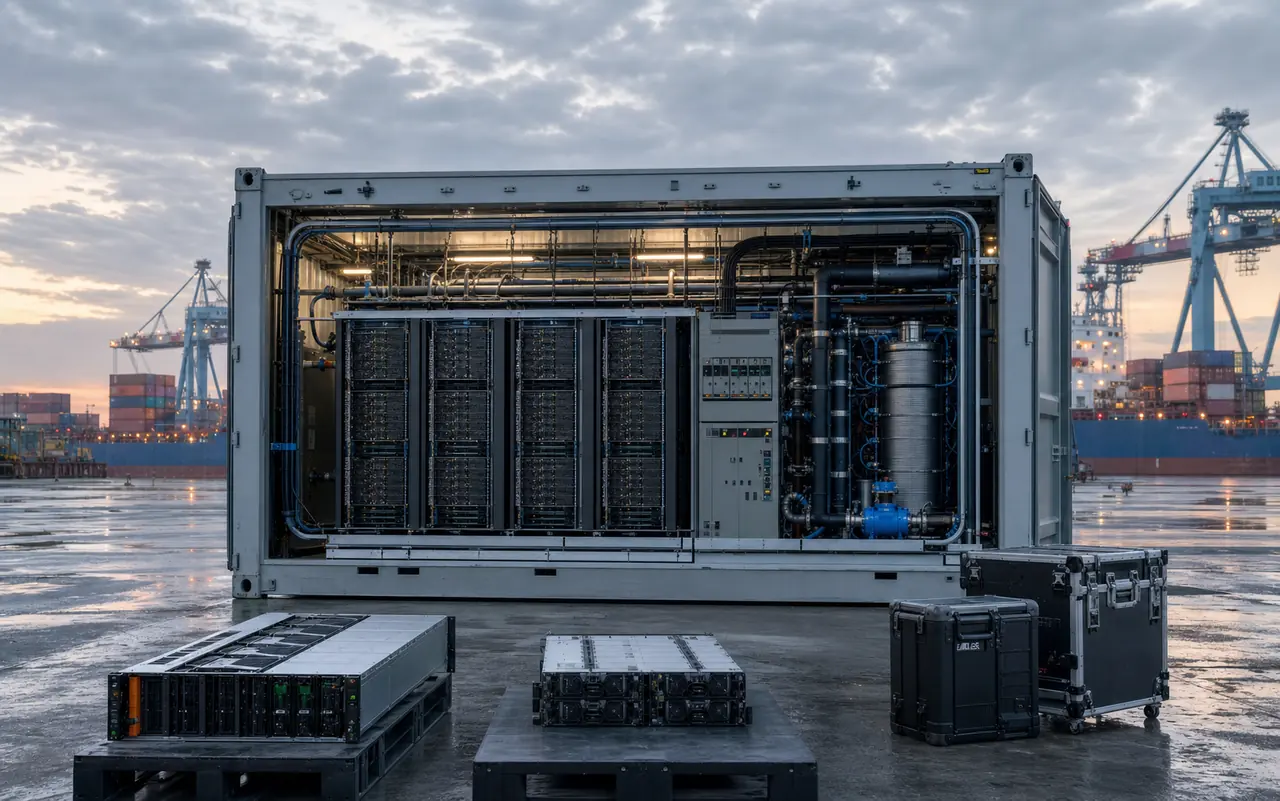
AI Is No Longer Just Chips: Washington Received 78 "Full-Stack Export" Applications — Will Taiwan Be a Core Partner or Just the Contract Manufacturer?
The U.S. Department of Commerce has received 78 full-stack AI export proposals. The unit of competition has shifted from a single chip or a single server to a complete package of hardware, data, models, cybersecurity, financing and industry applications. Taiwan's hardware edge still matters, but without a seat at the customer interface, in-field integration and long-term operations, the busiest player in the room will not necessarily capture the most value.

The Submarine Cable in the Sky: When the Line Is Cut, Who Keeps Taiwan Connected to the World
A submarine cable can be severed by a single ship dragging its anchor — so what is the backup? Low-earth-orbit satellites are Taiwan's last lifeline when the lines go dead. But should this line in the sky be woven by Taiwan itself, or rented from someone else? When Ukraine's drone boats lost contact and ran aground because of one decision by Elon Musk, Taiwan learned: true sovereignty is not about whether you have a satellite — it is about who holds the switch.