
The Equipment Bind: Taiwan's Dependence on ASML, KLA, and Applied Materials
Taiwan makes more than 92% of the world's most advanced chips, but the EUV machines, etch tools, and metrology systems that make it possible come almost entirely from the Netherlands and the United States — down to the remote shutdown button, which is also held by someone else. That dependence is Taiwan's talisman, and the least-discussed blade hanging over the silicon shield.
Article contents01 / 09
- Global semiconductor equipment billings reached $117.1 billion in 2024, with Taiwan accounting for roughly $16.6 billion (14%); TSMC's 2025 capital expenditure came in at approximately $40.9 billion in actual terms (original guidance was $38-42 billion), about 70% of which goes to advanced-process equipment procurement.
- ASML is the world's sole maker of EUV lithography systems and has more than 1,600 engineers stationed in Taiwan; TSMC has historically accounted for more than 30% of ASML's annual sales, a share that fell to roughly 15% (about EUR 4.2-4.4 billion) in 2024.
- The Netherlands expanded export controls targeting China in September 2024, with Taiwan fully exempt; but ASML has already built a remote shutdown function into TSMC's EUV machines, and the power to activate it rests with the Netherlands and the United States, not Taiwan.
“The Equipment Bind: Taiwan's Dependence on ASML, KLA, and Applied Materials” reports that Taiwan's 2024 Equipment Purchases($16.6 billion)。 About 14% of the global $117.1 billion equipment market [1]。
“The Equipment Bind: Taiwan's Dependence on ASML, KLA, and Applied Materials” reports that TSMC's Annual Capex Trend ($ billion)(TSMC Capital Expenditure)。 Expansion trajectory 2024-2026; 70% goes to advanced-process equipment [5]。
“The Equipment Bind: Taiwan's Dependence on ASML, KLA, and Applied Materials” reports that Major Equipment Makers' Taiwan Business ($ billion, 2024)(Equipment Makers' Taiwan Revenue)。 ASML converted from euros; Applied Materials FY2024, Lam Research FY2024 [3][4]。
“The Equipment Bind: Taiwan's Dependence on ASML, KLA, and Applied Materials” reports that ASML's On-Site Engineers in Taiwan(ASML: 1,600+)。 Mainly stationed across TSMC's fabs, providing EUV maintenance and calibration。
One Machine, Taiwan's Most Advanced Capacity
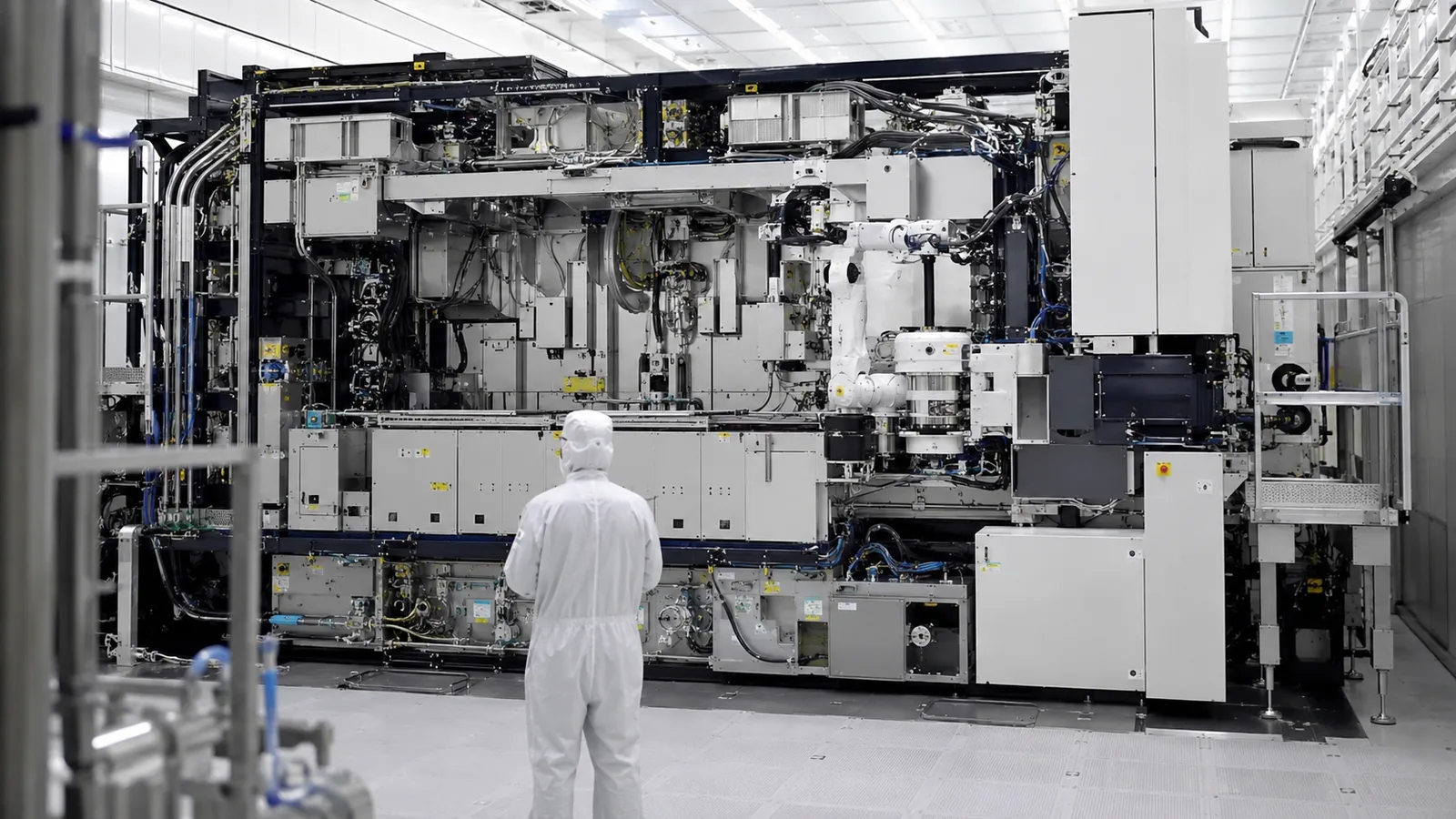
In the clean rooms of Taiwan's most advanced fabs, EUV (extreme ultraviolet) lithography machines must run continuously. Roughly the size of a city bus and considered one of the most complex machines humanity has ever built, this equipment is an irreplaceable tool for processes at 7nm and below.
“The Equipment Bind: Taiwan's Dependence on ASML, KLA, and Applied Materials” reports that Taiwan's 2024 Equipment Purchases($16.6 billion)。 About 14% of the global $117.1 billion equipment market [1]。
The machine costs $350 million. It comes from the small Dutch city of Veldhoven, made by a company called ASML — and no other company on Earth can make one. The engineers who maintain it, calibrate it, and update its software number more than 1,600 in Taiwan alone, and their employer is ASML, not TSMC.
Taiwan is the heart of global semiconductor manufacturing. TSMC alone produces more than 90% of the world's most advanced chips, from iPhone processors to the GPUs inside AI servers — without Taiwan, there is no modern computing world. Yet what drives that heartbeat is an external battery, and the switch on that battery is not in Taiwan's hands.
That is the equipment bind: Taiwan's most critical production capability rests on deep dependence on four Western equipment makers — ASML, Applied Materials, Lam Research, and KLA. That dependence has made Taiwan an irreplaceable manufacturing base, and it has left behind a structural vulnerability that is rarely discussed.
1. Scale First: Who Depends on Whom?
“The Equipment Bind: Taiwan's Dependence on ASML, KLA, and Applied Materials” reports that TSMC's Annual Capex Trend ($ billion)(TSMC Capital Expenditure)。 Expansion trajectory 2024-2026; 70% goes to advanced-process equipment [5]。
To understand how deep the equipment dependence runs, start with scale.
According to a 2025 report from SEMI (the International Semiconductor Equipment and Materials Institute), global semiconductor equipment billings reached $117.1 billion in 2024, up about 10% from $106.3 billion in 2023 [1]. That is a staggering figure — the world spends more than $100 billion a year on the machines that make chips.
Taiwan is the market's third-largest buyer, with roughly $16.6 billion in purchases in 2024, about 14% of the global market [1]. China (about 42%) and South Korea (about 18%) rank ahead of it, but that ranking is misleading: much of China's buying was a rush to stockpile before export controls tightened, and it was concentrated in lower-tier mature-node equipment; Taiwan's purchases, by contrast, are heavily concentrated in the most advanced nodes, so each dollar spent carries far more technological weight and strategic significance than China's.
TSMC alone underpins the bulk of Taiwan's equipment purchases. For 2025, TSMC's capital expenditure came in at approximately $40.9 billion in actual terms (initial 2025 guidance was $38 to $42 billion; 2024 came in at about $29.8 billion), with about 70% of that original guidance — $26.6 to $29.4 billion — earmarked for advanced semiconductor manufacturing technology, in other words, high-end equipment purchases [5]. Guidance for 2026 rises further, to $52 to $56 billion; if it comes true, it would be TSMC's largest equipment-buying year in its history.
TSMC is spending money. Most of what it spends flows to the Netherlands and the United States.
2. ASML: The Weight of a Monopoly
“The Equipment Bind: Taiwan's Dependence on ASML, KLA, and Applied Materials” reports that Major Equipment Makers' Taiwan Business ($ billion, 2024)(Equipment Makers' Taiwan Revenue)。 ASML converted from euros; Applied Materials FY2024, Lam Research FY2024 [3][4]。
In the world of semiconductor equipment, one name occupies a position all its own: ASML.
ASML is the world's only company capable of manufacturing EUV (extreme ultraviolet) lithography systems. EUV is the indispensable tool for making advanced chips at 7nm and below — there is no substitute, no competitor, and no way around it. For TSMC to produce 3nm, 2nm, or even 1.4nm chips, it must use ASML's EUV machines. Full stop. TSMC's cumulative investment in EUV-related equipment already exceeds $12.3 billion; according to mid-2024 industry estimates, TSMC had originally planned to order roughly 35 more EUV machines in 2025, though the actual delivery figures still need to be verified against the latest financial or earnings-call disclosures [9].
In 2024, ASML's total annual revenue was EUR 28.3 billion (about $30.9 billion) [2]. Taiwan accounted for about 15% of that, roughly EUR 4.2 to 4.4 billion [8]. That share looks modest, but there is important context: in 2024, China — rushing to stockpile DUV machines before Dutch export controls fully took effect — briefly accounted for about 36% of ASML's total revenue, compressing Taiwan's relative share. Historically, Taiwan's share has at times exceeded 30%, making it one of ASML's most important customer bases worldwide [8].
ASML's presence in Taiwan is not simply about "selling machines." More than 1,600 ASML engineers are stationed in Taiwan, mostly serving TSMC's various fabs. These engineers handle the day-to-day maintenance of EUV machines, part replacement, software updates, and optical-system calibration. EUV machines require extraordinarily frequent maintenance — they are among the most complex pieces of industrial equipment humanity has ever built, and need continuous original-manufacturer support to run reliably.
In May 2024, Bloomberg revealed a fact that had long gone undiscussed in public: ASML has built a remote shutdown capability — a so-called "kill switch" — into the EUV equipment at TSMC [6]. According to that reporting, ASML can remotely disable a machine during a routine software update. The feature was designed in response to requests from the U.S. and Dutch governments, to ensure that, in a scenario where China seized Taiwan by force, the world's most advanced chipmaking equipment would not fall into Chinese hands.
ASML did not deny the report, and TSMC confirmed that the company "has the means to disable its tools."
The existence of the kill switch reveals a deeper political-economic reality: the final say over Taiwan's most critical production tool does not rest with Taiwan itself.
3. Applied Materials, Lam Research, KLA: The Silent Dependency Chain
Beyond EUV, Taiwan's dependence on other equipment makers runs just as deep — it simply draws less media attention.
Applied Materials is the world's largest semiconductor equipment company by total revenue, with products spanning nearly every process-equipment category: chemical vapor deposition (CVD), physical vapor deposition (PVD), ion implantation, etch, and chemical mechanical polishing (CMP). In fiscal year 2024 (ended October 2024), Applied Materials posted total revenue of $27.3 billion [3]. Taiwan accounted for about $4.01 billion (15%) of that [3].
Lam Research specializes in plasma etch and thin-film deposition, holding a critical equipment position in both memory (DRAM, NAND) and advanced logic processes. The numbers tell the story of Taiwan's growing weight: in fiscal year 2024, Lam Research's Taiwan business was about $1.67 billion; but in fiscal year 2025, as TSMC's 2nm capacity expanded sharply, Taiwan's business more than doubled in a single year to $3.45 billion, 19% of total revenue — growth of 106% [4].
KLA Corporation dominates the global market for process control and defect inspection; the yield management of Taiwan's advanced fabs depends heavily on KLA's optical metrology equipment. KLA's total fiscal 2024 revenue was about $9.81 billion, with Taiwan estimated to account for 15 to 20% of that (observation; medium confidence) — KLA's equipment is not quite as irreplaceable as EUV, but on advanced-node yield optimization, the recipe databases and historical calibration baselines accumulated in KLA's tools are hidden assets that are difficult to replace in the short term.
These four companies — ASML, Applied Materials, Lam Research, and KLA — together with Japan's Tokyo Electron (TEL), make up the core equipment-supplier ecosystem of Taiwan's fabs. No Taiwanese domestic company has been able to insert itself into this system at the advanced-node level.
“The Equipment Bind: Taiwan's Dependence on ASML, KLA, and Applied Materials” reports that ASML's On-Site Engineers in Taiwan(ASML: 1,600+)。 Mainly stationed across TSMC's fabs, providing EUV maintenance and calibration。
4. Two Edges: The Double-Sided Effect of Export Controls
On September 1, 2023, the Dutch government implemented new export-control rules requiring ASML to obtain a license before exporting certain models of immersion DUV lithography systems to China — and the Dutch government did not intend to grant that license [10]. In September 2024, the Netherlands further brought two DUV immersion lithography systems — the TWINSCAN NXT:1970i and 1980i — under its export-licensing regime (the more advanced NXT:2000i and later models were already covered); the control logic extended to a next tier of DUV equipment, rather than adding deposition or cleaning tools [10].
Dutch Minister for Foreign Trade Reinette Klever said in a statement that "the security risks that come with technological progress are especially pronounced in the current geopolitical context." Government officials and industry insiders alike understood the subtext: China was trying to use this equipment to advance military-related semiconductor research, and the Dutch government did not want to be an accomplice to that process.
In the short term, this set of export controls is an objective tailwind for Taiwan: advanced Western equipment keeps flowing to Taiwan while being blocked at China's door. As a result, Taiwan is likely to maintain a technology lead of five to ten process generations over China for years to come.
ASML itself has acknowledged that, because of export controls, China's share of its business — briefly inflated to 36% in 2024 by the stockpiling rush — is projected to fall back to about 20% in 2025 [2]. That decline means part of the business ASML loses in China will flow back toward expanding capacity in Taiwan, South Korea, and the United States.
But export controls have another side. Even as the Netherlands tightens controls on China, the control framework itself clearly demonstrates a logic: once the Dutch government judges that a political situation requires it, the same control logic can be pointed in any direction. The kill switch is simply the instrumental embodiment of that logic — it protects Western strategic interests, and those interests currently overlap heavily with Taiwan's, but that overlap is not naturally or permanently identical to Taiwan's own national interest.
5. The Vulnerability Timeline: How Long Could Taiwan Hold Out Without Equipment Support?
This is the question this article most needs to confront directly, and the one least discussed in public.
Suppose a conflict scenario cut off Western equipment makers' engineers from entering Taiwan, and parts could no longer be delivered — how long could Taiwan's fabs hold out?
Based on existing technical analysis, the rough timeline looks like this (observation; medium confidence):
Months 1-3: Limited impact overall. TSMC holds a certain level of spare-parts inventory, and its engineers have already received a degree of local training. EUV machines can still operate normally during this window.
Months 3-6: Pressure begins to surface. Consumption of EUV light-source consumables (the tin plasma source) accelerates, and some precision optical components enter their maintenance cycle. If ASML software-update licenses lapse, some functions could become restricted (observation; medium confidence).
Months 6-12: Visible impact. EUV machine utilization rates decline and production tempo slows. Even if the machines keep running, without ASML engineers to perform original-manufacturer calibration, yields will gradually erode.
Months 12-18: Serious damage. Some EUV machines drop out of production because major overhauls cannot be completed. Overall advanced-process capacity could shrink by 20 to 40% (observation; low confidence, highly dependent on the specific scenario).
Dependence on Applied Materials' and Lam Research's equipment is somewhat less acute — these machines have longer maintenance cycles, and TSMC's engineers have internalized part of the relevant process know-how — but key proprietary consumables and custom parts remain equally irreplaceable.
The key takeaway of this timeline is this: Taiwan's window of resistance at the equipment level is shorter than most people expect. Once a physical conflict or full blockade begins, Taiwan's advanced-process capacity would not vanish instantly — it would erode slowly over one to two years — but that pace alone is already enough to inflict unbearable damage on the global tech supply chain.
6. Mutual Lock-In: The Equipment Makers Cannot Afford to Leave Either
Analyzing Taiwan's vulnerability should not ignore a symmetrical structure: the equipment makers are equally dependent on Taiwan.
Taiwan is one of ASML's most important customer bases historically, at times accounting for more than 30% of its annual sales. Applied Materials' Taiwan business makes up 15% of its global revenue. Lam Research's Taiwan business reached 19% of revenue in fiscal 2025, growing 106% in a single year.
For these companies, losing Taiwan would mean not just losing a major customer, but losing their largest proving ground for cutting-edge technology — Taiwan's fabs serve as the technology frontier test bed for this equipment; without feedback from TSMC's use, the equipment makers' own pace of technological iteration would slow as well.
This mutual lock-in creates a stable equilibrium not unlike "mutual assured loss": Taiwan cannot easily abandon its dependence on the equipment makers, and the equipment makers cannot easily abandon Taiwan as their most important high-end customer. Either side "breaking the chain" would impose a cost neither can easily bear.
But this equilibrium has a fundamental asymmetry: if the equipment makers lose Taiwan, they lose revenue and the pace of technological iteration; if Taiwan's fabs lose their equipment, they lose production capability itself. Revenue can be made up elsewhere; replacing production capability requires decades of technological accumulation. That asymmetry is the core of Taiwan's equipment-dependence problem.
7. Taiwan's Vantage Point: Three Layers of Impact — State, Industry, SMEs
The State's View: Diplomacy Must Fill the Structural Gap
Taiwan's national strategy on semiconductor equipment currently has a clear gap: its diplomatic framework is not explicit enough.
Taiwan's substantive dependence relationship with the Netherlands and the United States on equipment supply has no corresponding formal treaty or diplomatic-guarantee framework. Unlike a military alliance (the U.S.-Japan security treaty) or a trade agreement (the EU's GDPR), it rests on a fragile consensus built on the temporarily high overlap of interests among the parties. ASML's kill switch order makes this problem starkest: the final power to disable Taiwan's most critical production tool sits in someone else's hands.
Core action for the state: Taiwan's government should actively work, through trade negotiations, technology diplomacy, and strategic dialogue, to embed "Taiwan's continued access to advanced semiconductor equipment" into the bilateral framework with the Netherlands, the United States, and Japan — moving it from an implicit community of interest to an explicit policy commitment.
Industry's View: Spare Parts, Localization, Technical Terms
For fabs such as TSMC, UMC, and PSMC, the response strategy to equipment dependence needs to advance on three fronts:
Deepening spare-parts inventory: Raise the on-hand inventory level of critical consumables and spare parts, especially high-wear components such as EUV light sources and mirrors. This requires negotiating more favorable spare-parts agreements with equipment makers, and may involve setting up joint spare-parts warehouses in Taiwan.
Local repair capability: TSMC's engineers should more actively pursue the systematic internalization of equipment-repair technology, seeking fuller repair authorization. The joint service contracts that ASML currently extends to some major customers should be expanded in scope, increasing the categories of faults Taiwanese engineers can handle independently.
Technology licensing terms: In the next round of equipment-procurement negotiations, Taiwan's fabs should press harder for access to more open source code or offline-operation permissions, reducing dependence on continuous network connectivity and remote license renewal.
SMEs' View: The Spreading Chain of Indirect Impact
Taiwan's SMEs have limited direct contact with the semiconductor equipment issue — equipment is the business of the big fabs; SMEs work in packaging and testing, substrates, passive components, and precision parts. But that sense of "distance" is a dangerous illusion.
If TSMC's advanced-process capacity shrinks by 30 to 40% because of equipment problems, the effects will not stop at TSMC's gate. Chip shortages will spread down the supply chain: no chips → modules cannot be assembled → shipments cannot go out → customers switch orders (or, if there is no time to switch, production stops). Taiwan's power-management IC design houses, automotive semiconductor distributors, and electronics contract manufacturers all sit along this chain of spread.
Core recommendation for SMEs: Electronics-manufacturing SMEs should begin building scenario stress tests for chip inventory, assessing how resilient their own order books would be if Taiwan's advanced-process capacity fell by 30% for six months. This is, in effect, ordinary supply-chain risk management.
8. That Switch — Whose Hand Is on It?
Back to the machine at the start of this article.
It works ceaselessly under the clean-room lights, precisely projecting extreme-ultraviolet photons onto silicon wafers, etching the finest structures human civilization has ever produced at the nanometer scale. Its utilization rate directly determines TSMC's yields, and indirectly determines the supply tempo of the entire global tech industry.
But ten thousand kilometers away from the fabs in Tainan, in the Netherlands, there is a button that can silence it.
ASML says that button exists to protect Taiwan — if China invades by force, the machines will stop working, denying an aggressor any real benefit from seizing TSMC. There is logic to this: the kill switch genuinely strengthens deterrence, turning the calculation that "taking Taiwan equals gaining its fabs" into a fallacy.
But the same logic also means: Taiwan itself has no final say over the fate of this machine.
This is not an accusation against ASML or the Dutch government — under the current configuration, the high overlap between Taiwan's interests and the West's is real, and the continued stability of equipment supply is also a fact. The problem is that this overlap is interest-driven, not institutionally guaranteed; it is a product of the current situation, not a permanent commitment.
What Taiwan needs most is not to reject this dependence — that is technically impossible, and practically unnecessary. What Taiwan needs is to convert this implicit community of interest into a reliable diplomatic framework, to ensure that, at minimum, Taiwan has a voice in the conditions under which that remote-controlled switch can be used.
Within the structure of the silicon shield, equipment dependence is the layer least discussed, and the hardest to reinforce. Precisely for that reason, it deserves the most serious scrutiny.
Sources
- SEMI — Press release on 2024 global semiconductor equipment billings of $117.1 billion
- ASML — Q4 and full-year 2024 financial results press release
- Applied Materials — Fourth-quarter and fiscal 2024 results press release
- Lam Research — FY2025 Q2 results (SEC EDGAR 8-K)
- TSMC — 4Q24 earnings call materials (SEC Form 6-K, 2025 capex guidance)
- Taipei Times — ASML and TSMC can disable EUV machines (citing Bloomberg)
- SEMI — Press release forecasting global equipment sales of $139 billion in 2026
- Statista — Statistics on ASML's net sales in Taiwan
- TrendForce — Report on TSMC's EUV investment exceeding $12.3 billion (citing the Commercial Times)
- Government of the Netherlands — Statement on expanded export controls on advanced semiconductor manufacturing equipment
Taiwan's Cyber Front Line: 2.4 Million Attacks a Day, and the Life-or-Death Speed of Cybersecurity Governance
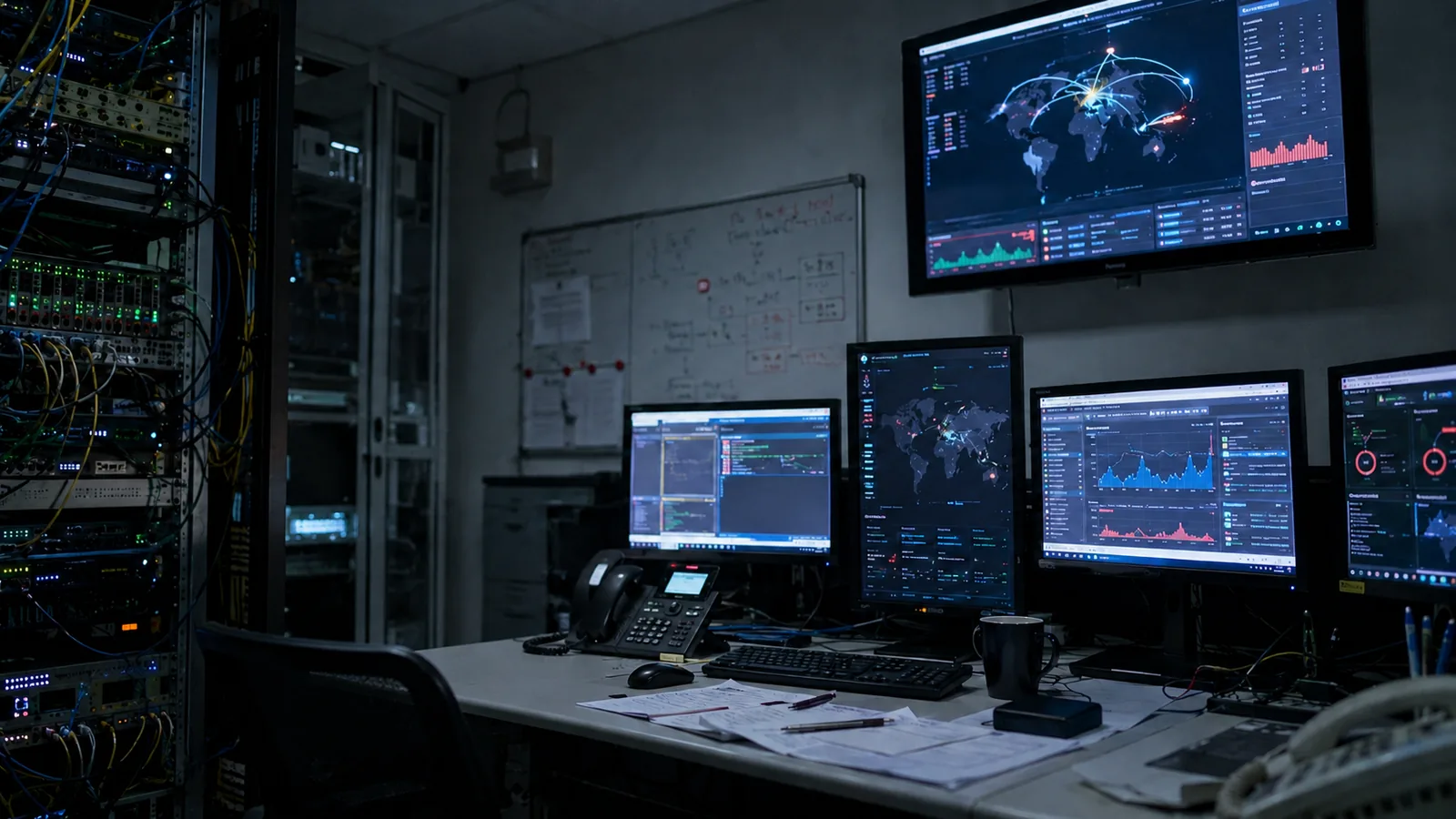
Taiwan absorbs more than 2.4 million foreign cyberattacks a day, and the actors behind them point, without exception, to APT groups backed by the Chinese state (officially described as "PRC-linked," or in Taiwan's own terminology "CCP cyber forces" — whether they belong to a specific People's Liberation Army unit remains unconfirmed). Government agencies, critical infrastructure, and supply chains are all on the target list. Three years after the Ministry of Digital Affairs was founded, a zero-trust architecture is being rolled out — but one unpatched computer in a county or city government office could cost an entire city its power.

Taiwan's Two Faces
The whole world depends on Taiwan's chips — and is quietly preparing for the day it might lose them. The same island is both the heart of the supply chain and a geopolitical powder keg. How can Taiwan's companies turn "irreplaceable" into an advantage that lasts?