
Kinmen and Matsu's Quasi-Integration: How Water Supply, Transport, and Cross-Strait Policy Are Amplifying the Outlying Islands' Resilience Test
Kinmen's water transfer from Fujian, the rebound in Mini Three Links traffic, and Fujian's integration policy are forcing outlying-island governance to face both livelihood convenience and single-source risk at once. The verifiable question is not whether the islands have 'already been taken over,' but how to make backup supply, transport, and commercial options more resilient.
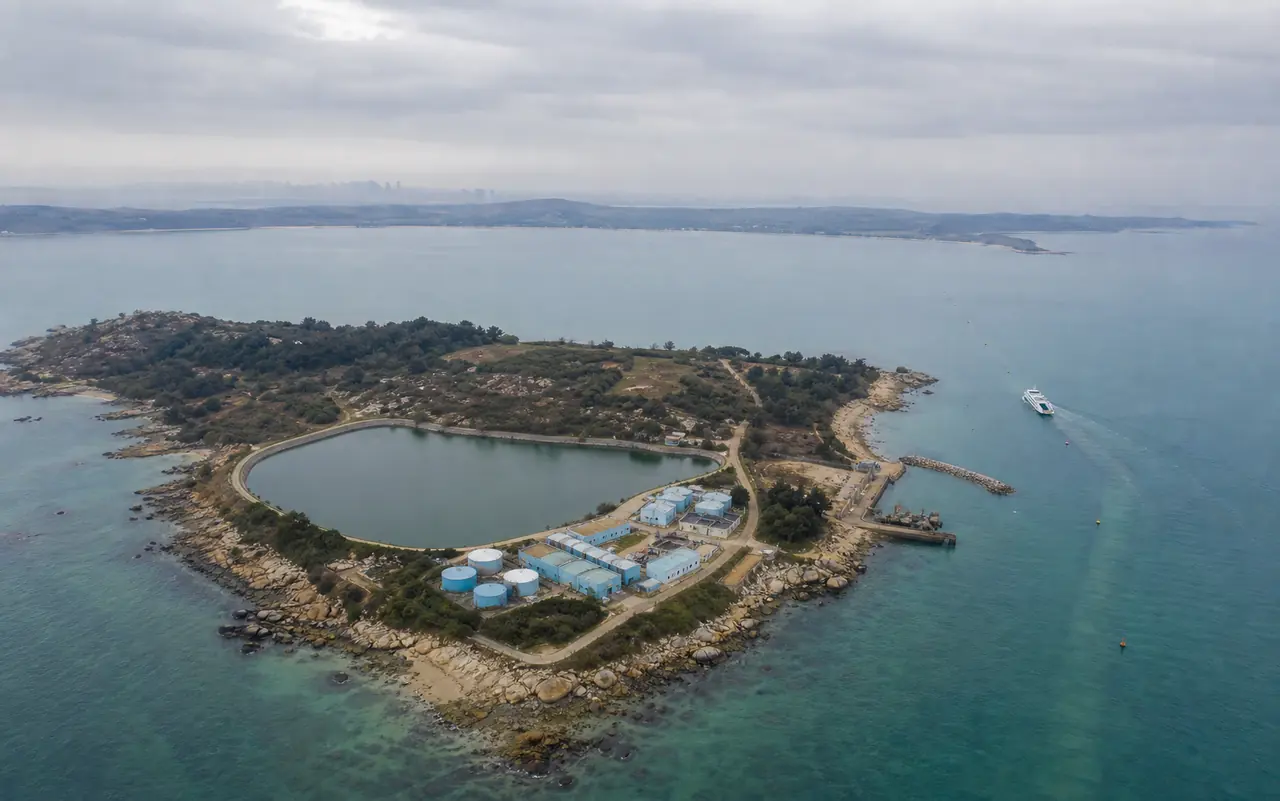
Article contents01 / 06
- Water Resources Agency data show Kinmen's public water demand runs at about 25,000 tonnes a day, with roughly 21,000 tonnes a day piped in from Fujian; desalination, reservoirs, and groundwater still form part of the backup supply, so the transfer volume should not be written as a fixed dependency ratio [1][2]
- Kinmen County Government statistics show Mini Three Links passenger traffic rising from 727,000 in 2023 and 1.303 million in 2024 to 1.843 million in 2025; this reflects a rebound in transport usage, but cannot alone prove anything about the local economy or political identity [3]
- Fujian has proposed an integration policy covering water, electricity, gas, and a bridge; the Xiamen-Kinmen Bridge is currently a Xiamen-side construction project with no matching construction plan from the Taiwan government, so it cannot be described as a cross-strait bridge already formed [4][5]
“Kinmen and Matsu's Quasi-Integration: How Water Supply, Transport, and Cross-Strait Policy Are Amplifying the Outlying Islands' Resilience Test” reports that Kinmen's Mini Three Links passenger traffic was 727,000, 1.303 million, and 1.843 million passenger-trips in 2023, 2024, and 2025 respectively.。 The county government's annual statistics measure inbound/outbound passenger volume; they cannot be used to directly infer spending levels or political attitudes [3]。
“Kinmen and Matsu's Quasi-Integration: How Water Supply, Transport, and Cross-Strait Policy Are Amplifying the Outlying Islands' Resilience Test” reports that Kinmen's public water demand runs at about 25,000 tonnes a day, while the volume piped in from Fujian is about 21,000 tonnes a day.(21,000 / 25,000 tonnes per day)。 Water-supply resilience also includes desalination, reservoirs, groundwater, and backup capacity; these two figures should not be read as a fixed, permanent share of supply [1][2]。
A Glass of Tap Water, and the Color Beneath a Frontline
Pour a glass of water in a restaurant in Kinmen, and there is a good chance what you are drinking came from Longhu in Jinjiang, Fujian.
This is not a metaphor — it is an engineering fact. In August 2018, the Fujian-to-Kinmen water supply project was formally switched on: a roughly 28-kilometer conveyance route, combining a land pipeline and a submarine pipeline, that carries raw water from Longhu in Jinjiang into Kinmen's tap-water system [1]. According to the Mainland Affairs Council (MAC), drawing water from the mainland is a phased measure to "solve Kinmen's long-standing water shortage and over-extraction of groundwater," and the competent authority has stressed that it will keep helping Kinmen develop water resources that are "self-sufficient, safe, and diversified" [2].
Data from the Water Resources Agency, Ministry of Economic Affairs (WRA) show that Kinmen's public water demand runs at roughly 25,000 tonnes a day, while the amount piped in from Fujian is about 21,000 tonnes a day; desalination, reservoirs, and groundwater still form part of the supply and backup [1][2]. Cross-strait water transfer is therefore an important source, but the intake figure at any given point in time cannot be generalized into "seventy percent permanent dependence," still less used to infer that either side can unilaterally "control the tap."
Audit and competent-authority materials also caution that the water-transfer contract, the actual volume used, and the guaranteed volume are not the same concept; when usage patterns change, they should be assessed together with the public contract, actual volumes, and backup facilities — rather than treating a design ceiling or a single contract as an inevitable trend [1][2].
This is precisely the awkward position Kinmen and Matsu occupy relative to Taiwan. On the map, they sit more than a hundred kilometers from Taiwan's main island, yet only a few to a dozen-odd kilometers from Xiamen and Fuzhou on the other side — a single speedboat ride away. In the Cold War era, this was the front line of "retaking the mainland," the battlefield that took the heaviest shelling; today it is the stretch of Taiwan's entire defense line that is geographically the most exposed, militarily the hardest to hold, and economically already the most deeply interlocked with the other side.
From the "Mini Three Links" to a "Same-City Living Circle"
To understand Kinmen and Matsu today, start with how people move.
The "Mini Three Links," opened in 2001, is small-scale direct traffic between Kinmen and Matsu and the coastal areas on the other side. According to Kinmen County Government statistics, passenger volume rose from 727,000 in 2023 and 1.303 million in 2024 to 1.843 million in 2025 [3]. This can illustrate a rebound in transport usage, but it cannot by itself quantify local consumption, employment, or political identity.
“Kinmen and Matsu's Quasi-Integration: How Water Supply, Transport, and Cross-Strait Policy Are Amplifying the Outlying Islands' Resilience Test” reports that Kinmen's Mini Three Links passenger traffic was 727,000, 1.303 million, and 1.843 million passenger-trips in 2023, 2024, and 2025 respectively.。 The county government's annual statistics measure inbound/outbound passenger volume; they cannot be used to directly infer spending levels or political attitudes [3]。
This route carries more than tourists. It carries Kinmen's young people commuting to Xiamen to study, work, see a doctor, or do business; it carries the supply chain of Kinmen shopkeepers restocking goods and hiring labor from the other side; and it is also the passage through which mainland tourists "transit" via Kinmen into and out of Taiwan's main island. What Kinmen County Government has repeatedly asked the central government for in recent years is not "please restrict the flow of people" but "please add more sea and air sailings" — what the local government wants is more openness and more traffic, not less [1].
Matsu's situation cuts closer to daily life. The Matsu Islands have such a sparse population that basic service and entertainment businesses simply cannot stay open, so the "Mawei–Matsu Mini Three Links" route fills that gap: with subsidized Mini Three Links ferry tickets, Matsu residents frequently travel back and forth to Fuzhou to buy daily necessities, see a dentist, get a haircut, or have a decent meal [4]. For many people in Matsu, Fuzhou is not "enemy territory" but the logistics base where "everything is available and everything is cheaper."
Convenient transport and civilian exchange are observable facts of daily life; their effect on identity or security should be tested with reproducible surveys and clear causal methods, not inferred directly from ferry-ticket numbers.
It is worth being honest that mainland tourism's "payback" to Kinmen and Matsu is actually limited and asymmetric. One Matsu innkeeper has said plainly that in more than twenty years of operating, mainland tourists have rarely come through the door, that Fuzhou does almost no promotion of Matsu tourism, and that many people on the other side have no idea where Matsu even is [4]. In other words, this dependency has a clear directionality — the momentum of Kinmen and Matsu residents "flowing out" to spend on the other side is far greater than the momentum of mainland tourists "flowing in" to spend here. Dependency is not the same as reciprocity of equal value.
After the Water Came On, Power and a Bridge Are Next in Line
If it were only water and the flow of people, this could still be called a natural outcome dictated by geography. What actually gives the term "quasi-integration" its weight is that Beijing has folded all of this into an explicit policy framework.
In September 2023, China's State Council issued its "Opinions on Supporting Fujian in Exploring a New Path for Cross-Strait Integrated Development and Building a Cross-Strait Integrated Development Demonstration Zone," designating the whole of Fujian as a "demonstration zone for integrated development" toward Taiwan, and explicitly calling for advancing "same-city integration between Xiamen and Kinmen" and "same-district integration between Fuzhou and Matsu," with content covering joint transport-infrastructure construction and the facilitation of trade and economic exchange, stating outright that the goal is to "promote reunification of the motherland" [7]. Right after that, Xiamen rolled out its "Several Measures for Integrating with Taiwan," putting "power, gas, and bridge links" with Kinmen one by one onto the agenda [5].
Fujian's policy documents list water, electricity, gas, and bridge links as directions for integration; this is a policy position asserted by China alone — it does not mean Taiwan has agreed to jointly implement it, nor does it mean any engineering project has actually crossed the strait.
The most symbolic of these is the Xiamen-Kinmen Bridge. What can be publicly confirmed is that construction on the Xiamen side and related transport infrastructure tied to Xiang'an Airport are moving forward; it is not a cross-strait bridge already connected to Kinmen, nor does it constitute any construction commitment from the Taiwan side [4][5]. Any security implications should be analyzed against a concrete plan, statutory procedure, and verifiable progress — not by treating an imagined project as an accomplished fact.
“Kinmen and Matsu's Quasi-Integration: How Water Supply, Transport, and Cross-Strait Policy Are Amplifying the Outlying Islands' Resilience Test” reports that Kinmen's public water demand runs at about 25,000 tonnes a day, while the volume piped in from Fujian is about 21,000 tonnes a day.(21,000 / 25,000 tonnes per day)。 Water-supply resilience also includes desalination, reservoirs, groundwater, and backup capacity; these two figures should not be read as a fixed, permanent share of supply [1][2]。
What must be flagged with a confidence level is this: the power and bridge links currently remain mostly at the stage of planning, declaration, and unilateral technical preparation on the other side — they are not yet an accomplished, settled fact. On Taiwan's side, regulation and political reality form real resistance: the current legal framework sets clear thresholds for jointly connecting power grids or jointly building a cross-strait bridge with the other side, and the central government's position has also been consistently cautious, even opposed (observation/inference; medium confidence) [5]. For the Xiamen-Kinmen Bridge to actually be "joined up" and opened to traffic, what is missing is not piers on the other side, but a political decision on Taiwan's end — and that vote will not be cast anytime soon.
Two Readings, Living on the Same Island
At this point, the key divide emerges: the same set of facts can be read into two almost opposite stories.
The first reading: livelihood pragmatism. Kinmen was short of water to begin with, and Jinjiang's water solved an urgent problem; Matsu never had much of a service sector, and Fuzhou filled that gap in daily life; the Mini Three Links gave outlying-island youth somewhere to study, work, and do business. For generations of Kinmen and Matsu people who have lived within artillery range, "doing business and living well with the other side" is not betrayal — it is a peace dividend paid for with decades of blood and tears. They ask back: can Taiwan's main island give Kinmen enough water? Can it give Matsu enough jobs? If it cannot, what right does it have to demand we refuse a convenience right in front of us? That question carries real, weighty legitimacy.
The second reading: erosion of sovereignty. The Mainland Affairs Council has publicly charged in recent years that Beijing is advancing an "integration" agenda in Kinmen and Matsu, intending to use deep economic and social binding to weaken Taiwan's sovereign ties and national identity [8]. International think tanks have also noted that as China's military power has grown, the military-defense value of Kinmen and Matsu has been greatly diluted, turning them instead into leverage points where Beijing can "apply low-cost pressure and test various reactions" — without firing a shot, simply by normalizing coast guard patrols and by holding the switches for water, power, and bridges, it can continuously change the status quo in the gray zone [9]. Following this line of reasoning to its end, Kinmen and Matsu could be built into a showcase of "successful integration," which would in turn erode the foundations of identity on Taiwan's main island.
The livelihood camp asks: "If you won't give me water, what right do you have to stop me drinking the other side's water?" The sovereignty camp answers: "Precisely because that water tastes so good, you forget whose hand is on the pipe."
Neither reading is a straw man — each corresponds to a real situation and a real fear. Branding Kinmen and Matsu residents wholesale as "a group that has been won over by united-front work" is the main island's arrogance; dismissing all this dependency as "pure livelihood" is dangerous naivety. Taiwan's real difficulty is that it has yet to give Kinmen and Matsu a credible alternative for living well without having to depend so heavily on the other side. When the main island can only shout "don't get absorbed by integration" while failing to provide enough water, power, jobs, and investment, that warning lands on Kinmen and Matsu ears as nothing but a hollow moral lecture.
The Line Called Identity Is Harder to Audit Than a Water Pipe
What actually keeps national-security officials up at night is not the water pipe or the bridge piers, but identity. Infrastructure can be audited — how large a share of the water supply comes from where, how far the bridge piers have been built, how many extra sailings have been added — all of it can be quantified. But "who Kinmen and Matsu people count themselves as, in their own hearts" has no dashboard that can be read.
There is a historical layer here that the main island often overlooks. Kinmen and Matsu were never a case of "growing close to the other side later on" — in blood ties, dialect, clan lineage, and ancestral homes, they share the same roots as southern Fujian (Minnan) and eastern Fujian (Mindong) to begin with. Kinmen people speak Minnan (Hokkien), almost mutually intelligible with Xiamen's dialect; Matsu people speak the Fuzhou dialect (Mindong); many families' ancestral graves, ancestral temples, and clan halls are on the other side. For them, traveling to and from Xiamen and Fuzhou is not "going abroad into enemy territory," but closer to "going home, visiting relatives." Beijing's "integrated development" is so hard to counter precisely because it is not a fabricated united-front slogan conjured out of nothing — it is grafted onto this genuine layer of geography and human ties. It does not need to convince you to "love China"; it only needs to make you feel that "exchange with the other side is simply natural and self-evident."
The most effective version of a united-front campaign was never about making you change your position — it is making you stop noticing that a position is even at stake.
For this reason, if Taiwan's main island tries to understand Kinmen and Matsu through the condescending frame of "you've been won over by united-front work," it is almost certain to fail. People in Kinmen and Matsu will feel insulted: I drink the other side's water, I see a doctor over there, I go back to sweep ancestral graves there — these are my life, so since when did that become the "surrender" you're talking about? This sense of being misunderstood only pushes Kinmen and Matsu further away from the main island's narrative. The loss of identity is, more often than not, not something pulled away by the other side, but something pushed away by the main island's arrogance and absence.
Looking at the cost structure from a different angle makes this clearer: Kinmen and Matsu bear the geographic risk of being the frontmost, hardest-to-hold stretch of the entire defense line, yet on the most basic livelihood matters — water, electricity, employment, medical care — they have long received investment from the main island that is nowhere near proportionate. When a place "carries the greatest risk and receives the fewest resources," its search for the nearest, most convenient alternative (namely, the other side) is less a betrayal than a rational choice forced out by the structure. To talk about national defense, one cannot talk only about military deployment — one first has to settle this long-imbalanced governance ledger.
Taiwan's Three Perspectives: How to Reinforce This Softest Stretch of the Line
The state's perspective. At its core, the Kinmen-Matsu problem is an asymmetry between "defense burden" and "governance commitment." Reinforcing this stretch of the line cannot be done through bans and condemnation alone; the key is to reduce the structural, hard necessity of "having no choice but to depend on the other side" — accelerate self-sufficient water sources such as Kinmen's desalination plant to reduce single-point dependence on the Jinjiang water transfer; hold the legal thresholds on power and bridge links cautiously but clearly, so that unilateral construction is not allowed to become an accomplished fact; and at the same time increase the density of resources invested in outlying-island governance, so that "the Republic of China effectively governs Kinmen and Matsu" is not just a declaration of sovereignty but something Kinmen and Matsu residents feel in their daily lives. The state must recognize: you cannot ask a people to be loyal to a government that has long been absent on their livelihood.
The industry-intermediary perspective. For trade associations and local chambers of commerce in tourism, shipping, and trade, the most realistic task is "diversifying risk," not "cutting the connection." Mini Three Links passenger traffic is the economic lifeline of Kinmen and Matsu; cutting it hard would strangle their own people first. But putting all the eggs in a single route and a single customer source (Xiamen, Fuzhou) is itself fragile. What intermediary organizations can do is help Kinmen and Matsu businesses expand into Taiwan's main-island and international customer bases, build a revenue structure that "can survive without mainland tourists," and turn the outlying islands' distinctive duty-free, logistics, and energy conditions into a bargaining chip for attracting investment from the main island and abroad — turning dependency into one option among several, not the only one.
The SME and outlying-island shopkeeper perspective. For Kinmen and Matsu small and medium businesses running guesthouses, selling sorghum liquor, or operating shipping and trade, this article is not telling you to "stop doing business with the other side" — that would be neither realistic nor fair. What genuinely belongs on your risk checklist are three things. First, single-market dependence: what share of your customer base and supply source is tied to the other side? Take Kinmen tourism as an example — Mini Three Links traffic is the biggest source of business, but the payback from mainland tourists is itself heavily swayed by policy switches; if a route is cut back or suspended for political reasons, how many months can a business that relies on transiting mainland tourists or stocking from the other side hold out? Work out your own "share of revenue from non-mainland customers," and treat it as a fitness indicator to pull upward year by year. Second, backup options for basic inputs such as water and power: about seventy percent of Kinmen's tap water comes from the Jinjiang water transfer [1] — if the water or power supply changes, does your operation have storage, backup, and alternative suppliers? Third, do not bet on a policy vision as though it were an accomplished fact — the Xiamen-Kinmen Bridge has only broken ground on the Xiamen side, and power and gas links remain mostly at the stage of unilateral preparation on the other side [5]; staking your livelihood on the assumption that "the bridge will definitely open, storefronts will definitely appreciate" turns geopolitical uncertainty directly into your own financial exposure. Concrete steps include phasing capital expenditure, keeping a cash buffer, and, when signing contracts, negotiating flexible clauses that allow extensions "in the event of disruption caused by cross-strait tensions." Pragmatism and vigilance have never been mutually exclusive — eat well, but also keep an escape route open.
That glass of water in Kinmen will keep flowing. The Mini Three Links ferries will keep sailing. The softness of this stretch of the defense line will not harden after a single article or a single ban. What Taiwan can do is not pretend the dependency does not exist, but face it honestly, reduce it item by item, and genuinely invest in Kinmen and Matsu people as "one of our own" — because in Beijing's script, Kinmen and Matsu were never outlying islands; they are the first fulcrum for prying loose the identity of Taiwan as a whole.
Sources
- Water Resources Agency, Ministry of Economic Affairs — Kinmen's water sources are sufficient; no need for a second water-supply channel
- Mainland Affairs Council — Continuing to help the Kinmen area develop self-sufficient, safe, and diversified sustainable water resources
- Kinmen County Government — 2025 Kinmen-Xiamen-Quanzhou Mini Three Links round trips surpass 1.84 million passenger-trips
- CNA (Central News Agency) — Filling the gap in basic services, Matsu residents frequently travel to and from Fuzhou
- UDN (United Daily News) — Fujian advances "Mini Four Links" with Kinmen and Matsu; mainland discloses new progress on Xiamen-Kinmen Bridge construction
- Commercial Times — 2024 Mini Three Links passengers surpass 1.3 million; a tourism boom expected for Kinmen
- UDN (United Daily News) — Mainland proposes cross-strait demonstration zone; Taiwan Affairs Office: Xiamen-Kinmen integration; Kinmen: win-win cooperation
- Taipei Times — MAC accuses China of pushing integration agenda in Matsu, Kinmen
- MP-IDSA (Manohar Parrikar Institute for Defence Studies and Analyses, India) — How Vulnerable are Kinmen and Matsu Islands?
The Philippines' Double Signal: If the Taiwan Strait Erupts, Is EDCA Strategic Depth or a Political No-Go Zone?
Marcos says, on one hand, that the Philippines will not become a springboard for a US attack on China — and, on the other, admits it cannot stay out of a Taiwan Strait crisis. EDCA's real significance is that capability has already been built, while specific activities remain subject to Philippine approval and bilateral mechanisms.
The Drone Army That Got Cut: Taiwan's Special Defense Budget Loses Nearly Two-Fifths — Can the Quills Still Grow?
The Legislative Yuan cut the special defense budget act's spending cap from NT$1.25 trillion to NT$780 billion. The version passed in May left out several originally planned domestic uncrewed platforms, joint Taiwan-US R&D, and part of the integrated air-defense capability. Is this democratic oversight, or a delay in building combat power?