
The Drone Army That Got Cut: Taiwan's Special Defense Budget Loses Nearly Two-Fifths — Can the Quills Still Grow?
The Legislative Yuan cut the special defense budget act's spending cap from NT$1.25 trillion to NT$780 billion. The version passed in May left out several originally planned domestic uncrewed platforms, joint Taiwan-US R&D, and part of the integrated air-defense capability. Is this democratic oversight, or a delay in building combat power?
Article contents01 / 06
- The Legislative Yuan cut the special act's spending cap from NT$1.25 trillion to NT$780 billion, a reduction of NT$470 billion — a 37.6% cut; this is an authorization ceiling, not money already spent.
- The version passed in May left out several originally planned domestic uncrewed platforms, NT$64 billion in joint Taiwan-US R&D, and part of the integrated air-defense capability; that does not mean all procurement for the year has been zeroed out.
- The Executive Yuan has separately proposed a NT$210 billion special act for uncrewed vehicles, planning 1,446 surveillance drones, four types of attack drones totaling 208,200 units, and 1,320 uncrewed vessels, still pending legislation and annual budget procedures.
“The Drone Army That Got Cut: Taiwan's Special Defense Budget Loses Nearly Two-Fifths — Can the Quills Still Grow?” reports that Special Act's Spending Cap Cut by Nearly 40%(-37.6%)。 Executive Yuan's original proposal vs. the version passed by the Legislative Yuan (in NT$100-million units) [12][13][14]。
“The Drone Army That Got Cut: Taiwan's Special Defense Budget Loses Nearly Two-Fifths — Can the Quills Still Grow?” reports that Gap Between the Original and Passed Ceilings(NT$470bn)。 The gap spans commercial purchases, contracted production and Taiwan-US cooperation — it cannot all be labeled domestic defense spending [13][14]。
“The Drone Army That Got Cut: Taiwan's Special Defense Budget Loses Nearly Two-Fifths — Can the Quills Still Grow?” reports that The Act Authorizes Annual Budgeting With Year-by-Year Review(2026 → 2033)。 NT$300bn ceiling for existing arms sales + NT$480bn ceiling for future items [14][15]。
On May 8, 2026, the Legislative Yuan cut the special defense budget act's spending cap from NT$1.25 trillion to NT$780 billion — a reduction of NT$470 billion, a 37.6% cut [12][13][14]. The passed version kept part of the arms purchases from the United States, but left out several originally planned domestic uncrewed platforms, joint Taiwan-US R&D, and part of the integrated air-defense capability [13][15][16].
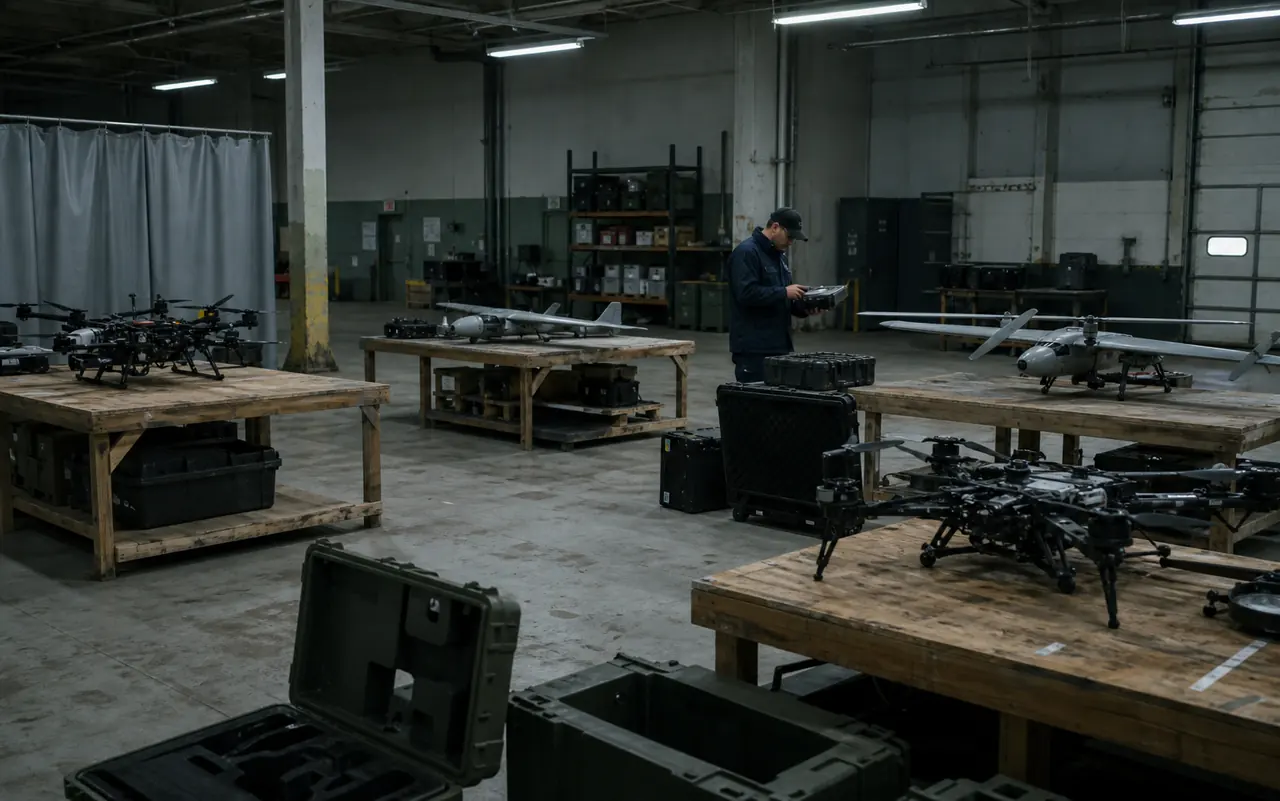
That does not mean "all domestic military drone procurement for 2026 has been zeroed out." The special act, the annual budget, existing procurement, and follow-on bills are separate channels; what can be confirmed is that the version passed in May did not carry forward that batch of domestic capability from the original proposal [13][19].
A Vote That Looked Unanimous but Masked a Deep Rift
On May 8, 2026, the Legislative Yuan passed the special act on its third reading. The final vote on the whole bill was 59 in favor, 0 against, and 48 abstentions; this is different from the vote counts on individual articles, and the two should not be conflated [14][21].
The version originally put forward by the Lai Ching-te government was a massive eight-year package worth NT$1.25 trillion (roughly US$40 billion), aimed at completing arms purchases from the US in one go, building up Taiwan's domestic defense industry, and constructing the integrated air-defense network he personally named "T-Dome (Taiwan's Shield)" [11]. But the opposition majority formed by the Kuomintang (KMT) and the Taiwan People's Party (TPP) cut it to NT$780 billion (roughly US$24.8 billion), a reduction of nearly 38% [1][2].
This budget's difficult birth had, in fact, dragged on for an entire winter. From early 2026, the Executive Yuan's version had been stuck for months in a standoff between the ruling and opposition camps, at one point described by foreign media as "gridlocked" even as military pressure from Beijing rose [11]. By May, the opposition finally forced a breakthrough with its own scaled-down version — a seemingly decisive vote that ended months of tug-of-war. But this "breakthrough" did not resolve the underlying disagreement; it simply pushed that disagreement from procedure into substance: the question is no longer "whether to pass it," but "what Taiwan actually bought after passage, and what it gave up."
“The Drone Army That Got Cut: Taiwan's Special Defense Budget Loses Nearly Two-Fifths — Can the Quills Still Grow?” reports that Special Act's Spending Cap Cut by Nearly 40%(-37.6%)。 Executive Yuan's original proposal vs. the version passed by the Legislative Yuan (in NT$100-million units) [12][13][14]。
A vote of 59 to 0 papered over one of Taiwan's deepest national-security rifts in recent years: not whether to defend itself, but whose way of defending itself.
The passed version was split into two blocks: one with a NT$300 billion ceiling for arms sales the US already approved in December 2025; the other with a NT$480 billion ceiling reserved for a new batch of weapons packages Washington is expected to announce later. The whole sum is spread over eight years, budgeted out to 2033, and every year's disbursement must wait for Taiwan to receive the US Letter of Offer and Acceptance (LOA) before being sent to the Legislative Yuan for annual review and release [3]. The opposition did not just cut the total — it also kept a firm grip on the gate of "year-by-year review."
What Was Precisely Cut Out Is Exactly the Quill Taiwan Most Wants to Grow
If this were simply a matter of trimming the total, the story would be simple enough. The real point of contention is which items got cut.
The list of items left out, published by the Ministry of National Defense on May 8, includes the "Qianggong" (enhanced Sky Bow) missile, the Ruiyuan II drone, vertical-takeoff-and-landing and coastal surveillance/strike drones, suicide uncrewed boats, and the TAK/TTN and AI-assisted modules [13]. The original and passed versions differ by NT$470 billion, but that gap also covers commercial purchases and contracted production alongside joint Taiwan-US R&D — it cannot all be labeled "the domestic-defense share."
“The Drone Army That Got Cut: Taiwan's Special Defense Budget Loses Nearly Two-Fifths — Can the Quills Still Grow?” reports that Gap Between the Original and Passed Ceilings(NT$470bn)。 The gap spans commercial purchases, contracted production and Taiwan-US cooperation — it cannot all be labeled domestic defense spending [13][14]。
Two other highly symbolic items were also cut: NT$64 billion in joint Taiwan-US R&D funding, and the tactical network, surveillance drones, and AI-assisted decision-making modules that T-Dome's integrated air defense needs [2][3]. DPP legislators warned that the act as passed effectively pulls out T-Dome's nervous system, leaving only scattered hardware [3].
T-Dome's policy concept is to string early-warning radar, air-defense missiles, surveillance drones, tactical data links, and AI-assisted decision-making into a single integrated air-defense network. If you compare it to a human body, the data links and decision-making modules could be seen as the nervous system — but that is only an analogy for ease of understanding, not an official definition, and it cannot be used to assert that leaving out some modules renders the entire system completely inoperable [13]. The version passed in May left out part of the tactical network and AI decision-making modules, which may lower the degree of integration planned in the original proposal; the actual effect still depends on how existing systems and other budgets fill the gap. The NT$64 billion in Taiwan-US joint R&D and procurement cooperation was likewise left out, but most of the details are classified and cannot be filled in independently [16].
Why drones? Battlefields such as Ukraine's have shown that large numbers of expendable uncrewed vehicles can change reconnaissance and strike methods; but their effectiveness still depends on jam resistance, command and control, munitions, air superiority, and mass-production capacity. Domestic drones are one tool in Taiwan's asymmetric defense — not a silver bullet that works on numbers alone.
What the Ukrainian battlefield offers Taiwan is the lesson that large numbers of expendable drones can supplement expensive conventional platforms. The width of the Taiwan Strait varies by location; whether uncrewed vehicles can build a cost advantage still depends on whether range, jam resistance, sensing, and command and control are matched to the task. The Executive Yuan's separate proposal for more than 200,000 drones and over a thousand uncrewed vessels aims, among other things, to establish a multi-year demand signal and a domestic supply chain [17][18]. If that demand signal stays unclear, capacity investment may be delayed — this is an inference about industry risk, not a procurement outcome that has already occurred [6][7][19].
There is a sharp paradox hiding here: Taiwan is a global semiconductor hub, and some companies are also seeking to qualify for the US trusted-drone-supply-chain program; but until an official product list has been checked item by item, a company's or the media's claims cannot be written up as proof that an entire firm has already obtained Blue UAS certification. On the other hand, Taiwan's domestic military market is limited, making it hard to spread the R&D cost of dedicated systems. If multi-year orders remain uncertain, manufacturers may delay investment — this is the effect of the cuts on industry most worth tracking [6][7].
Two Defensible Narratives, Head-On
Understanding this controversy requires honestly presenting two positions, neither of which is unreasonable.
The opposition's rationale: a democratic legislature does not sign blank checks. The KMT and TPP stress that they do not oppose national defense — they oppose "an opaque, massive special budget." They criticize the Executive Yuan's version as vague in many places and inflated in amount; accepting it wholesale, they argue, would amount to writing a blank check that could breed corruption [4][5]. Using a special budget — rather than the regular general budget — to bypass year-by-year review itself weakens the legislature's power of fiscal oversight; the opposition argues that tying the money to "case-by-case review after receiving the US Letter of Offer and Acceptance" is the proper procedure for watching taxpayers' money closely. An analysis from the Brookings Institution also notes that this conflict is, to some extent, a normal product of political competition within a democratic system — an opposition party using its budget power to check the executive is part of democracy, and cannot simply be equated with being "pro-Beijing" [10].
The ruling party's and Washington's rationale: this is a show of weakness toward Beijing. But the warnings from the other side are just as weighty. A US State Department spokesperson told Reuters that further delaying funding for the remaining planned capabilities is a concession to the Chinese Communist Party [20]. That remark came on the eve of a US-China summit, at a particularly sensitive moment; the DPP government, for its part, argues that the cuts will weaken Taiwan's self-defense capability [4]. These are all named positions — they cannot be directly treated as already-proven outcomes for combat power.
The opposition sees "an executive branch whose power has escaped oversight"; Washington sees "a legislature blind to the threat." Both anxieties are real — they simply point in different directions.
The root of the divide is not entirely values — it is how risk gets ranked. The opposition puts "fiscal discipline and preventing corruption" first; the ruling party and the US side put "the time window and the credibility of deterrence" first. When a threat is imminent, every day procedure is delayed can be read by an adversary as a loosening of resolve — this is precisely what makes this debate hardest to reconcile.
What deserves watching closely is that this rift is easily amplified by outside forces. For Beijing, any image inside Taiwan of "even defense gets cut" is ready-made material for cognitive warfare: it can be packaged into a narrative that "the Taiwanese themselves are unwilling to pay for their own defense," used to drive a wedge between Taipei and Washington and to wear down the island's will to resist. For Washington, a legislature that hesitates at a critical moment directly erodes the political foundation for the argument that "Taiwan is worth coming to the aid of" — at a time when there are already voices within the US questioning the cost of helping Taiwan, the image of Taipei cutting its own defense hands those voices ammunition [5]. The same vote is being read three completely different ways by three capitals — this is precisely the hardest position for a small state caught in the gap between great-power games: your domestic politics is never only domestic.
The Remedial Drone Program Is Stuck at the Same Gate
After the cuts, the Executive Yuan put forward a supplementary plan. On June 18, 2026, the Executive Yuan approved a draft special act on NT$210 billion for domestic uncrewed defense vehicles, with a planned timeframe from August 2026 to December 2031, covering 1,446 surveillance drones, four types of attack drones totaling 208,200 units, and 1,320 uncrewed vessels [17][18]. This is still a draft and a planned quantity, not an approved budget or a placed order.
On June 26, the opposition caucuses voted down a DPP caucus motion to send the Executive Yuan's draft to committee for review; on June 30, the KMT and the TPP each put forward their own versions [22][23]. This means both the legislative timeline and the final procurement content remain uncertain — the procedural delay alone cannot be used to conclude that all domestic military drone procurement for the whole of 2026 is zero [19][22][23].
“The Drone Army That Got Cut: Taiwan's Special Defense Budget Loses Nearly Two-Fifths — Can the Quills Still Grow?” reports that The Act Authorizes Annual Budgeting With Year-by-Year Review(2026 → 2033)。 NT$300bn ceiling for existing arms sales + NT$480bn ceiling for future items [14][15]。
Zooming out, this budget fight is actually embedded in a larger framework. Taiwan's 2026 defense spending is roughly 3.32% of GDP, and Lai Ching-te has proposed a target of raising it to 5% by 2030 [11]. Against that external pressure, it is not surprising that a high-profile cut of nearly 40% is being amplified and interpreted by both Washington and Beijing.
Three Layers of Numbers That Cannot Be Conflated: The Act's Ceiling, the Annual Budget, and Actual Delivery
The easiest mistake to make in this debate is writing three different stages up as if they were the same thing. The first layer is the special act: it sets out the purpose, period, and total spending ceiling that may be used — it is the legal framework for whether the government can go on to budget for items below it. The Legislative Yuan changed the ceiling from NT$1.25 trillion to NT$780 billion; what can be confirmed is that the authorized space shrank by NT$470 billion. But the gap between the two ceilings is not cash already saved on the spot, nor can it all be converted into orders lost by domestic industry [12][14][15].
The second layer is the annual budget. Even once the act has been promulgated, the administrative agencies still have to submit a budget by year and by item, and the legislature can still review the amount, the use, and the conditions of execution. This means "the act has passed" does not equal "every item has already received full funding"; conversely, "an item was not included in this act" does not mean it can never be handled through the regular annual defense budget, another program, or a later law. When assessing capability gaps, this act, the regular defense budget, and the separate uncrewed-vehicle draft act must be booked separately.
Only the third layer is procurement and delivery. After a budget passes, it still has to go through requirements confirmation, a tender or foreign military sales process, contract signing, production, testing, acceptance, and unit formation. Purchases from the US are especially affected by the Letter of Offer and Acceptance, production lines, and delivery schedules; domestic procurement also depends on manufacturer qualification, mass-production capacity, and acceptance standards. So any claim of "already bought," "reduced entirely to zero," or "will be combat-ready by such-and-such year" should be required to correspond to contract, award, delivery, or acceptance evidence — it cannot be inferred from the act's total alone.
Readers who want to keep tracking this can watch four fixed checkpoints: whether the act has been promulgated, whether the annual budget has passed, whether a procurement case has been awarded or a foreign military sale formally concluded, and whether equipment has completed delivery and acceptance. Missing any one of the four means you can, at most, say you are at the "authorization," "budgeting," "ordering," or "delivery" stage — one verb cannot cover them all. This distinction also constrains both camps at once: the administration cannot treat the ceiling as an accomplishment, and the opposition cannot equate a cut to the ceiling with spending that has already been saved.
Converging: This Wound, Seen From Taiwan's Three Perspectives
The state perspective. This is a test question about how a democracy makes defense decisions under the shadow of war. The opposition holds legitimate budgetary oversight power, and that is an asset of Taiwan's democracy, not a liability; but when the pace of that oversight is read by an adversary as a loosening of resolve, a real tension appears between procedural justice and the credibility of deterrence. For the state, the way out is not about which side prevails, but whether the ruling and opposition camps can build together a defense-review mechanism that is both transparent and does not send a signal of weakness abroad — achieving both "preventing blank checks" and "preserving the time window" at once. What this needs is institutional design, not more shouting. Workable directions might include turning the special budget into a phased authorization that "sets the framework first, then discloses costs item by item," so that opposition oversight happens in the open rather than through a blanket boycott; and building a cross-party mechanism for negotiating the national-security budget, so that arguments over "how much to spend and where" are absorbed inside the chamber rather than spilling out as a signal an adversary can use. After all, a democracy that treats defense as a routine chip in partisan warfare will sooner or later teach its adversary how to work its rhythm.
The industry-intermediary perspective. For Taiwan's domestic defense industry and its upstream supply chain, the lesson from this episode is clear: betting everything on a single large government order and tying one's fate to a single legislative vote carries too much risk. What drone makers need is a predictable, multi-year demand signal, and that is hard to guarantee in the short term amid the tug-of-war between the ruling and opposition camps. The pragmatic strategy is to simultaneously build export markets, qualify for trusted supply chains, pursue joint R&D with allies, and develop dual-use applications, so as to reduce dependence on a single buyer [6][7].
The SME perspective. The small and midsize manufacturers and component makers who have poured heavily into drones — many of them around Taichung — do not have the cash buffer of large firms; a single lost order can damage expansion plans and staff retention [6]. For these companies, the near-term priority is protecting cash flow and diversifying orders — not betting all capacity expansion on a government budget that has not yet been finalized, and making full use of the flexibility to shift orders between military and civilian uses; the medium-term priority is to keep a close eye on the legislative progress of that NT$210 billion drone special act, because once it passes, it will be the real lifeblood for this group of SMEs [8][9]. Until the standoff between the ruling and opposition camps is resolved, "don't put all your eggs in the Legislative Yuan's one basket" is the most realistic rule for survival.
The drone army that got cut has not truly disappeared — it is simply stuck in a piece of democratic haggling. Whether Taiwan's quills can still grow is a question whose answer lies not in Beijing, but in Taipei's own legislative chamber.
Sources
- Focus Taiwan — Taiwan passes arms-purchase bill with spending cap of US$24.8 billion (Updated)
- Jamestown Foundation — Taiwan's Special Defense Budget Bill Passes with Drastic Cuts
- Taipei Times — Legislature passes defense budget bill
- Nikkei Asia — Taiwan opposition votes to cut Lai's defense budget despite US urging
- Taipei Times — Cuts to budget 'concession' to China: US
- Nikkei Asia — Uncertainty plagues Taiwan's drone industry after budget cuts
- The Diplomat — Taiwan's Special Defense Budget Cut Will Cost Its Drone Capabilities
- Focus Taiwan — Cabinet proposes US$6.6 billion special budget for domestic drones
- Focus Taiwan — Opposition delays review of Cabinet's NT$210 billion drone procurement bill
- Brookings Institution — Defense in a democracy: Political competition and Taiwan's special defense budget
- GlobalSecurity / CNA — Taiwan defense spending to reach 3.32% of GDP in 2026: Premier
- Ministry of National Defense, Republic of China (Taiwan) — Original NT$1.25 trillion special budget plan
- Ministry of National Defense, Republic of China (Taiwan) — Explanation after the Legislative Yuan passed the NT$780 billion version
- Legislative Yuan, Republic of China (Taiwan) — Bill progress and third-reading record for the special act
- Office of the President Gazette, Republic of China (Taiwan) — Special Act for Procurement to Safeguard National Security and Strengthen Asymmetric Warfare Capabilities
- Military News Agency, Ministry of National Defense, Republic of China (Taiwan) — NT$64 billion in joint Taiwan-US R&D and procurement cooperation
- Executive Yuan, Republic of China (Taiwan) — Draft special act on procurement of domestic uncrewed defense vehicles
- Military News Agency, Ministry of National Defense, Republic of China (Taiwan) — Explanation of planned uncrewed-vehicle quantities
- National Council for Sustainable Development, Executive Yuan, Republic of China (Taiwan) — Drone industry investment and existing procurement
- Reuters — US concerned by Taiwan defence delay
- Reuters — Taiwan parliament approves extra defence spending
- Central News Agency (Taiwan) — Opposition delays review of uncrewed-vehicle draft act
- Central News Agency (Taiwan) — Opposition parties propose alternative version of uncrewed-vehicle act
The Philippines' Double Signal: If the Taiwan Strait Erupts, Is EDCA Strategic Depth or a Political No-Go Zone?
Marcos says, on one hand, that the Philippines will not become a springboard for a US attack on China — and, on the other, admits it cannot stay out of a Taiwan Strait crisis. EDCA's real significance is that capability has already been built, while specific activities remain subject to Philippine approval and bilateral mechanisms.
Kinmen and Matsu's Quasi-Integration: How Water Supply, Transport, and Cross-Strait Policy Are Amplifying the Outlying Islands' Resilience Test
Kinmen's water transfer from Fujian, the rebound in Mini Three Links traffic, and Fujian's integration policy are forcing outlying-island governance to face both livelihood convenience and single-source risk at once. The verifiable question is not whether the islands have 'already been taken over,' but how to make backup supply, transport, and commercial options more resilient.