
The Three-Layer Dividend of De-Risking from China: How Much Can Taiwan Actually Capture, and Who Might Route Around It?
De-risking offers Taiwan three kinds of opportunity: advanced manufacturing, emerging trusted supply chains, and China+1 orders. But moving assembly does not replace every upstream source, and overseas expansion changes who benefits. Suppliers need to identify the specific customer requirement that makes their contribution valuable.
Article contents01 / 09
- This article groups Taiwan’s opportunities into advanced manufacturing, emerging trusted supply chains, and China+1 orders. This is an analytical framework, not a statistically established ranking of returns.
- Using full-year U.S. goods data, McKinsey reports a roughly $130 billion nominal decline in imports from China in 2025 versus 2024. Some consumer-electronics assembly moved while upstream sources remained in Taiwan, South Korea, and China.
- IDA reports complete-drone exports of $115 million in Q1 2026 and $212 million in the first half. Growth does not mean every supplier is certified or has won an order.
“The Three-Layer Dividend of De-Risking from China: How Much Can Taiwan Actually Capture, and Who Might Route Around It?” reports that U.S. Imports From China Keep Sliding as the Pie Gets Redivided(-$130B)。 Full-year U.S. goods data; nominal dollar change, 2025 versus 2024 [1]。
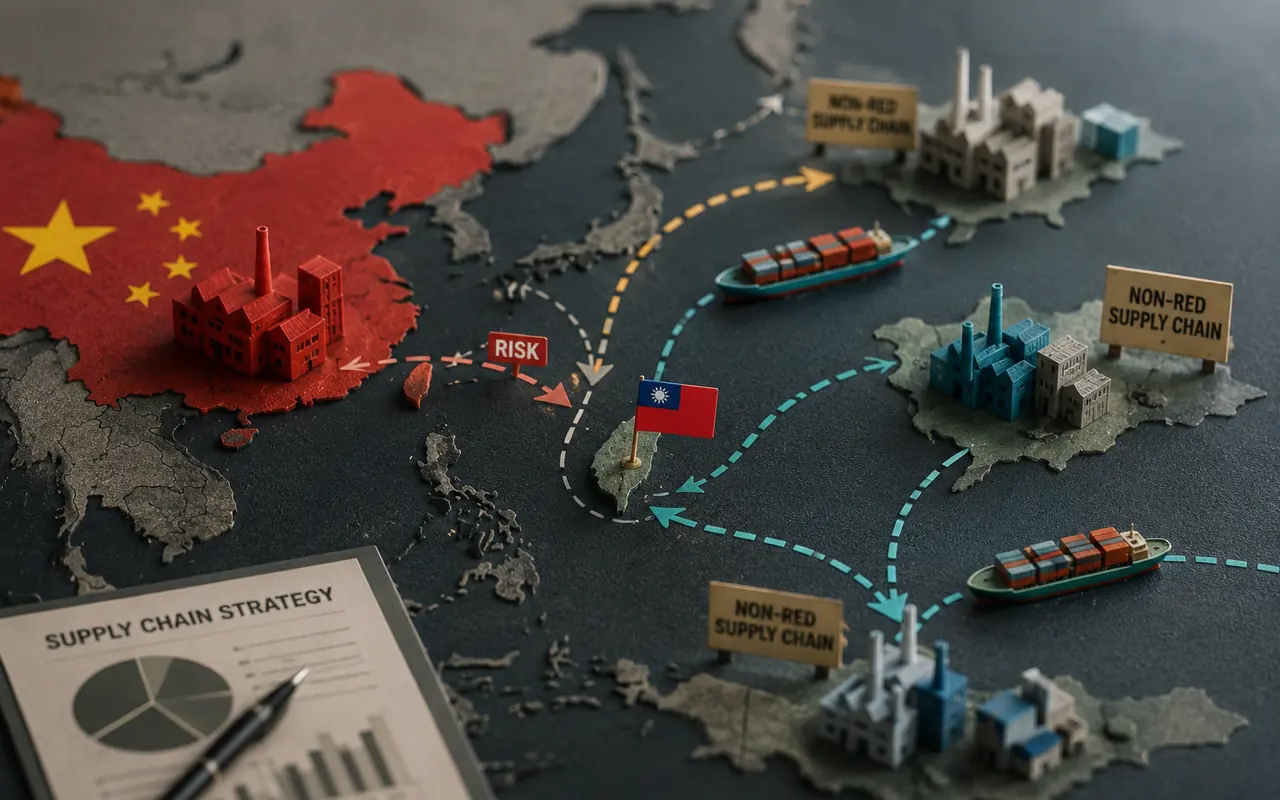
“The Three-Layer Dividend of De-Risking from China: How Much Can Taiwan Actually Capture, and Who Might Route Around It?” reports that Taiwan’s Opportunities: Advanced Manufacturing Capabilities, New Supply Chains, China+1 Orders(Three Layers)。 Editorial framework, not a classification established by these sources [1][9][11]。
“The Three-Layer Dividend of De-Risking from China: How Much Can Taiwan Actually Capture, and Who Might Route Around It?” reports that Taiwan’s Complete-Drone Exports, H1 2026($212M)。 Export value for complete drones, not component exports or industry output [10]。
“The Three-Layer Dividend of De-Risking from China: How Much Can Taiwan Actually Capture, and Who Might Route Around It?” reports that Assembly Can Move While Upstream Dependencies Remain(China+0.5)。 Editorial metaphor, not a statistical category or a finding of unlawful transshipment [1]。
“The Three-Layer Dividend of De-Risking from China: How Much Can Taiwan Actually Capture, and Who Might Route Around It?” reports that Historical Examples of Taiwanese Firms Expanding Abroad(Dual-Sourcing)。 2023 reporting, not 2026 capacity; this review obtained no suitable industry-wide share [8]。
“The Three-Layer Dividend of De-Risking from China: How Much Can Taiwan Actually Capture, and Who Might Route Around It?” reports that The Paradox: U.S. Semiconductor Onshoring Could Keep the Dividend at Home(Routed Around?)。 The dividend does not land automatically [3]。
For a Taiwanese supplier, a customer moving production out of China raises a practical question: will the next order come our way? Semiconductor, drone, and traditional component makers all face a supply-chain reshuffle, but they are competing for different kinds of opportunity.
But “winner” is far too vague a word. This article groups Taiwan’s opportunities into three layers, none of which delivers a dividend automatically. More jarring still, in some scenarios this reshuffle could even route around Taiwan entirely.
Assembly Can Move While Upstream Dependencies Stay
To work out how much of this pie Taiwan can actually eat, you first need to see how the pie is being cut, and how deep that cut really goes.
McKinsey’s 2026 trade report finds that U.S. goods imports from China fell by about $130 billion in 2025 compared with 2024. It uses full-year U.S. data in nominal dollars. That measures a change in direct trade, not the value of orders won by Taiwan [1].
“The Three-Layer Dividend of De-Risking from China: How Much Can Taiwan Actually Capture, and Who Might Route Around It?” reports that U.S. Imports From China Keep Sliding as the Pie Gets Redivided(-$130B)。 Full-year U.S. goods data; nominal dollar change, 2025 versus 2024 [1]。
Moving assembly does not mean replacing the whole supply chain. McKinsey’s consumer-electronics examples show final assembly shifting to India, Vietnam, and Thailand while key components still come from Taiwan, South Korea, and China [1]. This article uses “China+0.5” as a metaphor for that continuing upstream dependence. It is not a statistical category, nor does it mean most overseas production is merely transshipment. Manufacturing location and component origin need separate examination.
“The Three-Layer Dividend of De-Risking from China: How Much Can Taiwan Actually Capture, and Who Might Route Around It?” reports that Assembly Can Move While Upstream Dependencies Remain(China+0.5)。 Editorial metaphor, not a statistical category or a finding of unlawful transshipment [1]。
Our assessment is that capabilities which replace specific upstream dependencies and meet customer requirements may be more valuable. Taiwanese firms with relevant advanced-manufacturing capabilities can pursue these opportunities.
Three Layers of Dividend, Each With Its Own Stability and Competitive Intensity
Layer one: advanced manufacturing capabilities — holding a position through technology. Investment in advanced processes and packaging continues in Taiwan. ASE and WUS, for example, announced a new Kaohsiung facility on May 8, 2026, focused on advanced packaging. This is a planned facility, not capacity already in operation [11]. The opportunity rests on technology and production capability. Our assessment is that advanced processes and packaging offer a stronger basis for bargaining power, but today’s lead is no permanent guarantee.
Layer two: positioning in new de-risked supply chains — an opportunity Taiwan can actively pursue. Drones offer a concrete example. Taiwan’s Industrial Development Administration (IDA) reports $115 million in complete-drone exports in the first quarter of 2026, exceeding the $93 million reported for all of 2025 [9]. The Ministry of Economic Affairs’ July 17 update puts first-half 2026 exports at $212 million [10]. These are export values for complete drones, not unit counts, component exports, or industry output. Growth alone does not show that all the demand came from European de-risking.
The opportunity is still taking shape: Taiwan can compete for specifications and a place in the supply chain, while checking customer requirements and validation costs before investing.
“The Three-Layer Dividend of De-Risking from China: How Much Can Taiwan Actually Capture, and Who Might Route Around It?” reports that Taiwan’s Complete-Drone Exports, H1 2026($212M)。 Export value for complete drones, not component exports or industry output [10]。
Layer three: China+1 order diversion — opportunity with competition. Orders in traditional industries and assembly will not necessarily land in Taiwan; Vietnam, India, and Mexico are also production locations companies consider. Suppliers need to compare infrastructure, delivery schedules, and origin requirements alongside price. Those factors call for a case-by-case assessment, not a blanket “highest risk” ranking for any country. This is the layer where Taiwan has to fight head-on for every order.
“The Three-Layer Dividend of De-Risking from China: How Much Can Taiwan Actually Capture, and Who Might Route Around It?” reports that Taiwan’s Opportunities: Advanced Manufacturing Capabilities, New Supply Chains, China+1 Orders(Three Layers)。 Editorial framework, not a classification established by these sources [1][9][11]。
Taiwanese manufacturers started expanding abroad well before this reshuffle. An April 23, 2023 CNA report republished by The News Lens described Quanta, Compal, and Inventec in Vietnam and Foxconn, Pegatron, and Wistron in India. It also discussed Delta’s additional investment in India and Lite-On’s plans in Taiwan, Southeast Asia, and the United States [8]. These are historical examples, not a statement of 2026 capacity or verified dual sourcing. This review did not obtain statistics suitable for estimating an industry-wide share.
Taiwan is therefore more than a recipient of diverted orders; its firms also organize production across borders. An April 2026 analysis by Lee Chen-lin in Excellence argues that the changing Asian supply chain could strengthen Taiwan’s strategic position, subject to conditions including energy, infrastructure, and supply capability [7]. Whether that improvement materializes depends on those conditions.
“The Three-Layer Dividend of De-Risking from China: How Much Can Taiwan Actually Capture, and Who Might Route Around It?” reports that Historical Examples of Taiwanese Firms Expanding Abroad(Dual-Sourcing)。 2023 reporting, not 2026 capacity; this review obtained no suitable industry-wide share [8]。
Drones: A Model for "Writing Yourself Into the Spec Sheet"
Of the three layers, drones are the one most worth dwelling on, because they show what "actively securing a position" actually looks like.
The drone challenge cannot be reduced to “a Chinese component must contain a back door.” Concerns about origin, cybersecurity, and continuity need individual verification. IDA’s May 2026 announcement describes suppliers entering U.S. drone supply chains [9]. AUVSI’s own statement specifies the authorization: ITRI joins Green UAS as a Recognized Assessor focused on cybersecurity testing, while AUVSI retains U.S.-based supply-chain vetting and related compliance determinations [12].
That suggests a practical route: turn component-origin and testing records into evidence a customer can inspect. Access to technical assessment in Taiwan does not mean every Taiwanese supplier or product is certified, or that overall certification authority has moved to Taiwan.
The lesson of this story is: Taiwan's opportunity does not lie in "being cheaper than Vietnam," but in "being more trustworthy than China." When an industry needs a "de-China, trustworthy" supply chain for geopolitical reasons, Taiwan's value is upgraded from "manufacturing cost" to a "trust premium." And that trust premium is precisely the chip Taiwan should be cultivating hardest in this reshuffle. But this is our strategic assessment: trust must be earned through traceability, testing, and delivery, rather than asserted on the strength of origin or political ties.
What Should Worry Us Most: Taiwan Could Be Routed Around
The most uncomfortable line in this piece — and the one most worth saying — is this: the de-risking dividend does not land automatically, and Taiwan could even be routed around.
The Stimson Center flags a paradox: under the CHIPS Act and U.S. semiconductor onshoring — especially TSMC's massive investment in Arizona — anxiety has emerged inside Taiwan that its "silicon shield could be hollowed out": part of the dividend from de-risking supply-chain diversification could end up benefiting the United States itself, rather than Taiwan [3]. The world cannot do without Taiwan's existing high-end manufacturing, and yet it is also letting its most advanced capacity get replicated, piece by piece, outside Taiwan — what it wants is "Taiwan's technology," but it would also prefer that technology "not live in Taiwan alone."
“The Three-Layer Dividend of De-Risking from China: How Much Can Taiwan Actually Capture, and Who Might Route Around It?” reports that The Paradox: U.S. Semiconductor Onshoring Could Keep the Dividend at Home(Routed Around?)。 The dividend does not land automatically [3]。
Two different risks meet here: other production locations may win traditional manufacturing orders, while overseas expansion in advanced manufacturing may change Taiwan’s domestic share of the benefits. Both deserve attention; neither proves Taiwan has already been bypassed.
The Most Paradoxical Piece: Taiwan Is Diversifying Away From Itself
The most concrete version of the "routed around" risk is, in fact, already playing out inside Taiwan's own strongest industry: semiconductors.
TSMC’s 2025 Annual Report states that the first Arizona and Kumamoto fabs have entered volume production, while Dresden remains a construction project. The same report describes continuing investment in advanced processes and packaging in Taiwan [13]. Overseas expansion therefore does not mean domestic investment has stopped, nor that every overseas location has the same advanced capabilities.
Whether expansion dilutes Taiwan’s leverage remains an inference to test. Optimists see a thicker “silicon shield” as more countries depend on Taiwanese technology networks; pessimists worry that overseas capacity may reduce the scarcity of production located in Taiwan [3]. Both views need to be assessed against technology gaps, investment progress, and customer demand, rather than the mere existence of an overseas site.
This is the deepest paradox the de-risking supply chain poses for Taiwan: the very same act of "dispersal" can be resilience that Taiwan actively cultivates, or leverage that Taiwan passively loses — the difference lies in who holds the steering wheel, and in whether Taiwan simultaneously keeps "the next generation of irreplaceability" (more advanced processes, packaging, materials) firmly anchored on the island. Continued investment in next-generation technology is one way to retain leverage. Whether it creates an advantage depends on research results, production costs, and customer adoption.
The Solution: Write Taiwan Into Everyone Else's Spec Sheet
If the dividend does not land automatically, then what Taiwan needs to do is clear: actively "design" itself into the specifications and certifications of Europe and America's de-risked supply chains.
Component traceability, testing, supplier qualification, and export-control requirements are different matters. A Taiwanese supplier that participates in specification discussions, passes customer validation, and consistently meets quality, delivery, and cost requirements may improve its chances of adoption. That is our strategic assessment, not a guarantee that certification produces an order. Alternative technologies, diversified purchasing, and changing specifications can still weaken an established position.
Participating in standards can help a supplier understand requirements earlier. Retaining orders still depends on consistent delivery.
Taiwan's Real Position: Not a Factory, but an "Intermediary"
Pulling together the three layers of dividend, the risk of being routed around, and the warning behind China+0.5, Taiwan's best position in this reshuffle is not "another world factory" but the "indispensable intermediary."
What does that mean? In an awkward world that wants to de-risk from China yet cannot cut itself off from China's upstream, the most valuable role is the bridge that can "connect both ends and be trusted": using Taiwan's technology, management, and credibility to integrate capacity scattered across many locations into a high-quality product that meets Western specifications. Taiwan's machine tools, components, equipment, and IC design already play exactly this role — hidden in the middle of the supply chain, yet indispensable — which is precisely the core value of Taiwan as a "global industry intermediary" described in "Taiwan's Two Faces."
For SMEs, this points to a clear path: don't just think about "landing a U.S. order" or "moving to Vietnam" — think instead about "can I become the one irreplaceable link in this new supply chain." A small firm making a niche connector or a specialty-process component, if its product is written into Europe and America's "trusted supply chain" specification and is hard to replace, has an additional basis for retaining orders, although its position still depends on quality, delivery, and the customer’s alternatives. That is the real way for Taiwan's SMEs to survive in the age of de-risking.
Before Chasing an Order, Make the Requirement Specific
For a supplier, “the customer wants to de-risk from China” is not enough to justify an investment. Start with one actual product. Is the requirement about assembly location, the origin of a specific component, data handling, or supplier qualification? These can overlap, but they should not be collapsed into a single “non-China” label. Check whether engineering and quality teams use the same criteria as the purchasing contact. When answers differ, recording the disagreement is more useful than rushing into a relocation proposal.
Then separate documentation from capability. A bill of materials identifies inputs; a supplier declaration offers evidence about origin; a test report addresses particular performance questions. They cannot substitute for one another. This is an editorial planning approach, not a new certification scheme. Mark missing evidence as awaiting a supplier response or customer validation. A quotation or a sample does not establish readiness for production and delivery.
Only then compare what the order warrants spending. Put alternative-component costs, sampling and testing time, minimum order quantities, treatment of old inventory, and delivery arrangements on one page. Distinguish confirmed figures from estimates. A request to replace one component does not automatically require moving a factory; if the core process cannot pass validation, a cheaper source is not yet a ready alternative. The purpose is to identify the next piece of evidence that could change the decision, rather than assume expansion or relocation is the answer.
When the question shifts from entering a supply chain to delivering through a disruption, use the order worksheet in “Real Resilience Is How Fast You Recover.” For the gap between public budgets and support reaching businesses, “The Tariff-Relief Implementation Gap” offers dated administrative snapshots, not a live eligibility guide. The Geopolitical Economy topic brings these related questions together.
Three Taiwanese Perspectives
For the state: actively design Taiwan into Europe and America's de-risking specifications and standards (component traceability, supplier qualification, applicable export controls) — don't passively wait for orders to be diverted. At the same time, run a two-track approach on the risk that "semiconductor onshoring dilutes Taiwan's irreplaceability": on one hand, keep consolidating the high-end scarcity that makes Taiwan indispensable; on the other, build Taiwan's own footholds abroad among friendly-shore partners, so that "dispersal" is something Taiwan drives itself, rather than something used to disperse Taiwan away.
For industry: attack in layers — defend the moat at the high end (advanced packaging, specialty materials), grab position in new supply chains (drones, non-China components), and have traditional industries pragmatically build "China+1" overseas capacity and dual sourcing. See through the warning behind "China+0.5": what is really valuable is not "moving assembly out of China," but the ability to "swap out the upstream too, with non-China sources that can be certified."
For SMEs: ask the customer which origin, testing, and supplier-qualification requirements apply; there is no universal “de-China certificate” that guarantees an order. Assemble the evidence those requirements call for, avoid the compliance minefield of pure transshipment, and move toward niches and specialty processes — make yourself the named supplier on someone else's spec sheet. For resource-constrained SMEs, rather than chasing the same red-ocean diverted orders everyone else is fighting for, it is safer to go deep into a niche that is hard for others to copy and that the whitelist actually needs — in this era, depth beats size.
The world is redrawing its supply-chain map. Taiwan’s place depends on the capabilities and evidence its suppliers can offer. De-risking opportunities become orders through meeting requirements and delivering consistently; describing Taiwan as a trusted partner does not make that happen automatically.
Competitors can improve quality, gain qualifications, and expand capacity too. Customers may deliberately retain several suppliers to reduce concentration risk. Being written into a specification is therefore the start of an ongoing relationship: someone must maintain origin records, respond to revisions, track production performance, and check whether changing costs still support delivery. These tasks attract less attention than a factory announcement, but they provide a practical way to test whether a “trust premium” stays with the supplier.
There is no guaranteed timetable for this opportunity. A company can start with one product, one customer, and one outstanding requirement, identify the evidence it needs, and decide how much to invest once the conditions are clearer. Whether Taiwan’s technology, overseas operations, and intermediary capabilities reinforce each other will depend on those decisions, not a claim of permanent indispensability.
Sources
- McKinsey Global Institute (2026) — Geopolitics and the geometry of global trade: 2026 update
- The Diplomat (2026-04) — China's Sanctions Hit Europe's Emerging Drone Doctrine
- Stimson Center (2025) — Why Taiwan Fears 'America First' Risks Eroding Its 'Silicon Shield'
- Global Taiwan Institute (2026-05) — The Reorientation of Middle Powers and Taiwan's Strategic Window
- Rhodium Group — China and the Future of Global Supply Chains
- CommonWealth English (2025-09) — Taiwan–Europe Non-China Drone Partnership Surges
- UDN (United Daily News) — Asia's New Supply-Chain Landscape Takes Shape, Taiwan's Strategic Position Rises
- The News Lens — Taiwanese Firms' "De-Sinicization" Shifts Toward Southeast Asia and India to Build New Supply Chains
- Industrial Development Administration — May 4, 2026: first-quarter complete-drone exports and certification authorization
- Ministry of Economic Affairs — July 17, 2026 newsletter: first-half complete-drone exports
- ASE Technology Holding — May 8, 2026: planned advanced-packaging facility in Kaohsiung
- AUVSI — January 28, 2026: ITRI’s cybersecurity assessment role and U.S. supply-chain vetting
- TSMC — 2025 Annual Report: overseas project stages and continued investment in Taiwan
Taiwan's Two Faces
The whole world depends on Taiwan's chips — and is quietly preparing for the day it might lose them. The same island is both the heart of the supply chain and a geopolitical powder keg. How can Taiwan's companies turn "irreplaceable" into an advantage that lasts?
Japan Takes Economic Security Overseas: Can OESA Bring Taiwan's Supply Chains Into State-Level Financing?
Japan has created OESA, extending policy finance to overseas projects that matter for economic security but are hard for existing tools to carry. Taiwan has an opening, but the law taking effect is not the same as Taiwan already being on the list — the real threshold lies in Japan's own interests, project design, and implementing rules that have yet to be published.