
Japan Takes Economic Security Overseas: Can OESA Bring Taiwan's Supply Chains Into State-Level Financing?
Japan has created OESA, extending policy finance to overseas projects that matter for economic security but are hard for existing tools to carry. Taiwan has an opening, but the law taking effect is not the same as Taiwan already being on the list — the real threshold lies in Japan's own interests, project design, and implementing rules that have yet to be published.

Article contents01 / 09
- OESA has been enacted into law, but as of 2026-08-24 the implementing rules are still pending; a scheme 'existing' and Taiwan 'already being eligible to apply' are two different things.
- Official materials focus on international transport, important services, and the overseas deployment of important technologies, citing vessel fuel, satellite equipment and Open RAN as examples.
- Whether a Taiwan project can get in hinges not on whether Taiwan's industry matters, but on whether it forms an overseas project with demonstrable value to Japan's economic security.
- Japanese company participation, certification by the competent minister, JBIC support and the mobilization of private capital form a more concrete institutional chain than any political slogan.
“Japan Takes Economic Security Overseas: Can OESA Bring Taiwan's Supply Chains Into State-Level Financing?” reports that OESA support is not automatic once a filing is made(4 Links in the Chain)。 Overseas project → Competent minister's certification → JBIC assessment and support → Mobilizing private capital。
“Japan Takes Economic Security Overseas: Can OESA Bring Taiwan's Supply Chains Into State-Level Financing?” reports that Taiwan projects have varying degrees of fit with OESA(3 Types of Scenario)。 Submarine cables, satellites and Open RAN sit closer to important-service/technology deployment; port and shipping fuel has an official example; ordinary procurement or capacity expansion cannot be justified by industry importance alone。
In 2026 Japan added a new acronym to its economic security toolkit: OESA, the Overseas Economic Security Arrangement. It is not the OSA established in 2023 — Official Security Assistance; OSA is grant-based security assistance for the armed forces and related organizations of like-minded countries, while OESA deals with policy-based finance. [1][2][9] When an overseas project matters to Japan's economic security but is hard for ordinary finance to carry — because of a long payback period, thin early-stage demand or political risk — the Japanese government wants the Japan Bank for International Cooperation (JBIC) to have more room to take on risk.
In Taiwan, this scheme is easily compressed into an enticing headline: "Japan is going to use state funds to invest in Taiwan's supply chains." But as of 24 August 2026, that headline is running ahead of the evidence. The legal amendment has indeed been promulgated, and the scheme's skeleton, project categories and financing tools are fairly clear; yet OESA is still to take effect within a year of promulgation, and the basic policy, detailed orders, review standards and first batch of cases have not yet been fully disclosed. More importantly, no Japanese government document currently available names Taiwan or approves any OESA project located in Taiwan. [1][3][4]
The right question is therefore not "has Japan already brought Taiwan in," but "what kind of Taiwan-linked project might fit this scheme's policy grammar." The distinction sounds cautious, but it actually decides whether a company should prepare a genuine project plan or only a political slogan.
Start With the Gap OESA Is Meant to Fill
Japan's existing policy finance is not short of tools. JBIC has long supported overseas infrastructure, resources and the international operations of Japanese companies; export credit, official development assistance and commercial banks each play their own role. What OESA is meant to fill is a more awkward gap: projects that have strategic value for Japan's supply chains, technology or basic services, but that cannot prove they are worth investing in through short-term commercial returns — and if the market is left to mature on its own, the critical node may end up controlled first by another country, company or technology bloc.
The Cabinet Office's description of the scheme states the conditions quite directly: an overseas plan that is important to Japan's economic security, has uncertain profit prospects, and is not adequately covered by existing support measures can be proposed by a private business, and once the competent minister has certified it, JBIC then provides support. [2] This is not automatically nationalizing losses — it first uses a policy judgment to confirm the national interest, and then has a dedicated account take on risk that ordinary policy finance is not well suited to bear.
What is genuinely worth noting in the design is that JBIC's new account does not have to be fully bound by the general account's two governing principles: certainty of repayment for individual cases, and a balance of revenue and expenditure across the account as a whole. Diet deliberations repeatedly touched on this shift in risk-bearing. [6][8] In other words, Japan is not saying commercial discipline no longer matters — it is acknowledging that part of the return on economic security may show up as "avoiding disruption," "preserving options" or "staying within a technology bloc," and may not be fully reflected in a project's cash flow.
This arrangement can lower the up-front risk to private capital through capital contributions and "subordinated contributions and the like." What the official explanation calls a subordinated contribution ranks behind other contributors in the distribution of profits and ahead of other contributors in absorbing losses when they occur; it should not simply be rewritten as a loan with a lower repayment priority. [2] OESA must also be kept separate from OSA: Japan's Ministry of Foreign Affairs defines OSA as grant-based security assistance — equipment, infrastructure and the like — provided to the armed forces and related organizations of like-minded countries, while OESA is overseas policy finance in which a private business forms the plan, the competent minister certifies it, and JBIC carries it out. [1][2][9]
Three Project Types That Draw the Boundary of a Scheme, Not of a Country
The publicly available documents currently list three broad directions. The first is facilities or operations needed for resilient international transport networks; the second is facilities that provide important services; the third is facilities needed to deploy important technologies overseas. [2][4] Official examples include ocean-going vessel fuel-supply bases, satellite ground equipment, and open mobile-communication networks such as Open RAN.
These examples reveal that OESA's first-layer boundary is the "project," not an abstract industry. Semiconductors matter, but that does not mean any chip investment can qualify; communications matter, but that does not mean any software procurement will get support. A candidate case has to be able to spell out concrete facilities, operating arrangements, technology deployment, participating companies, the funding gap, and how it lowers the risk of a supply or service disruption facing Japan.
The second-layer boundary is "Japan's economic security interest." Diet responses place allies, like-minded countries and the Global South within a cooperative framing, and emphasize strengthening global supply chains that include Japanese companies. [5] But this is not a regional whitelist. The law does not say a project automatically qualifies simply because it is located in a friendly region, nor does it state publicly that a Taiwanese legal entity can propose a plan on its own. A reasonable reading is that the participation of Japanese companies, technological control, procurement relationships or service dependence will be important evidence for establishing the policy nexus; the actual threshold still has to wait for the basic policy and administrative practice.
The third-layer boundary is "existing tools are insufficient." If a deal can be completed through ordinary export finance, commercial banks or conventional investment, OESA may have no reason to step in. What an applicant needs to explain is not just that the project is good, but why the market has failed to deliver it at the time and scale Japan needs, and how much private capital can be mobilized once public funds take on the higher risk.
Taiwan's Semiconductors Matter, But Mattering Is Not the Same as Qualifying
The most intuitive association for Taiwan is semiconductors. The Japanese government already treats the supply of advanced chips as an economic security issue, and has provided large-scale support to JASM, the venture TSMC set up with Japanese partners in Kumamoto. Japan's Ministry of Economy, Trade and Industry explained in 2025 that support for JASM's second fab could reach a ceiling of ¥732 billion. [10] That proves Japan is willing to commit national resources to supply-chain resilience — it does not prove that a Taiwan project has entered OESA.
The reason is simple: the Kumamoto fab is located inside Japan and uses Japan's domestic semiconductor industry policy. OESA's defining feature is precisely that it is "overseas." Writing JASM up as an OESA precedent gets the geography, the legal basis and the policy tool wrong all at once.
So is there any possibility for a semiconductor case located in Taiwan? Reasonable inference — low-to-medium confidence: if a Japanese company invests in a facility in Taiwan for critical-material recovery, equipment maintenance, process backup or cross-border R&D, and can demonstrate that the facility is irreplaceable for the continuity of Japan's critical supply, it may sit closer to OESA's "overseas deployment of important technology" than simply buying more wafers would. But this still faces two unknowns: whether administrative rules will interpret semiconductor manufacturing as falling within that category of project, and how the competent authority will weigh the added geopolitical risk of placing more assets in Taiwan.
In other words, supply-chain resilience does not always mean "add more capacity in Taiwan." Sometimes resilience comes from diversification, sometimes from strengthening an existing core node, and sometimes from linking Taiwan's technical capability to Japan's alternative production, inventory or maintenance networks. If OESA's review matures, it should assess the whole network, rather than looking only at the political symbolism of a single plant.
Communications Resilience May Sit Closer to the Official Examples Than a Fab Does
For Taiwan, submarine cables, satellite communications, ground stations and mobile-network backup may be a more direct test case. The authorities have already listed satellite ground equipment and Open RAN, showing that "important services" and "overseas deployment of important technology" are not limited to traditional manufacturing. [2] Taiwan is an island economy dependent on submarine cables and digital infrastructure; a Japanese company could simultaneously be an equipment vendor, systems integrator, operating partner or service user.
Reasonable inference — medium confidence: if a Japanese company takes part in a Taiwan submarine-cable landing station, a satellite backup network or an Open RAN deployment, and can quantify the value of keeping Japanese companies' and the region's communication services running under incidents, disasters or gray-zone pressure, this kind of project fits reasonably well with the current official examples. That still does not mean approval is guaranteed, because whether a Taiwanese legal entity can propose it directly, and how data governance and security review would be handled, remain unclear.
Companies also cannot treat "security" as a pass that exempts them from technical and financial due diligence. Vendor credibility for communications equipment, rights over software updates, data flows, maintenance staffing, spectrum and licensing, and liability for cybersecurity incidents will all affect whether a resilience project truly delivers public value. Swapping in a new batch of equipment without operating and governance arrangements makes it hard to show that this is a systemic project worth having policy finance take on the risk for.
Ports, Shipping and Energy Offer the Clearest Point of Comparison
Japanese officials' listing of ocean-going vessel fuel-supply bases makes the ports, shipping and energy scenario more concrete than many high-tech imaginings. [2][7] Japan is a maritime trading nation, and its shipping routes, fuel transition, port maintenance and logistics nodes bear directly on its economic security. Taiwan sits on an important Western Pacific shipping route and also has large ports, shipping activity and manufacturing demand.
Reasonable inference — medium confidence: a low-carbon vessel fuel-supply, maintenance or backup facility built jointly by a Japanese shipping company, trading house or energy company and a Taiwanese partner could fit the policy direction of resilient international transport networks. If a new fuel lacks stable demand in its early stages while requiring huge equipment investment, ordinary financing may indeed fall short — and that is closer to the market gap OESA is meant to address.
But a project still has to answer: does it serve Japan's shipping network, or is it general local development? Is there a long-term procurement or usage commitment? Who is responsible for environmental and safety compliance? If a regional conflict disrupts the port, how does the investment spread its risk? If policy importance cannot be translated into a verifiable operating design, it is just pasting "economic security" onto conventional infrastructure.
"State-Level Financing" Is Not the Government Doing Everything
OESA is easily understood as the state directly picking industry winners. The actual process involves at least three separate decisions. First, a private business forms and proposes an overseas plan; second, the competent minister judges, under the basic policy, whether it serves an economic security purpose; finally, JBIC still has to choose the appropriate financing tool and deal structure. [2] Policy certification and financial execution are linked, but they are not the same stamp of approval.
This also means a Taiwanese company's role could take many forms: project company, technology partner, local operator, supplier, co-investor, or long-term off-taker. The most dangerous claim right now is to assert flatly that "a Taiwanese company can apply to the Japanese government." Still to be verified: whether the final rules will allow a non-Japanese legal entity to make a proposal independently, whether a Japanese company must be the principal, and how the certifying ministers will divide responsibility — public information is still insufficient on all of this.
Japan's Ministry of Foreign Affairs official material on Taiwan maintains the framing, in place since 1972, of a non-governmental working relationship. [11] That does not necessarily rule out commercial policy finance, but it is a reminder that regional arrangements, contract structures and the wording of government documents may be more complicated here than in an ordinary country case. Any definitive judgment on eligibility has to wait for the implementing rules and the first batch of practice — it cannot be inferred directly from friendly political signals.
What Taiwanese Companies Can Prepare Now
Waiting for the detailed rules does not mean there is nothing to do but wait. First, a company can turn "Japan's interest" from a slogan into a verifiable dependency map: which Japanese factories, shipping routes, communication services or end markets use this node; how much damage a disruption of a given length would cause; how long a current alternative would take to bring online. What OESA is meant to support is Japan's economic security, not vague bilateral friendship.
Second, write the investment up as a project, not an industry wish list. It should list the facility's location, ownership, technology licensing, operating responsibility, procurement commitments, capital structure, cash flow and exit mechanism. For a submarine-cable or communications case, add cybersecurity and data governance; for a port, shipping or energy case, add environmental permits, long-term contracts and accident liability; for a semiconductor case, explain technology control and backup design.
Third, prove why existing tools are insufficient. Is demand not yet mature, is the construction cycle too long, is the geopolitical risk premium too high, or can private lenders simply not absorb the early-stage losses? If the goal is only to obtain cheaper money, the policy rationale is not enough. Only by showing how a subordinated contribution would draw banks, insurers and industry partners into co-investing does a proposal get close to what OESA is designed for.
Fourth, design the risk-sharing arrangement in advance. State-level financing will not make Taiwan Strait risk disappear — if anything, it is likely to demand a clearer stress test: whether the project can still provide partial service if sea or air transport is disrupted, export controls are imposed, energy runs short, key personnel cannot move, or insurers refuse coverage. Hiding the worst-case scenario only makes policy certification and financial review harder.
How to Tell Whether OESA Is Actually Raising Resilience
Once the scheme starts accepting cases, outside observers should not judge success or failure by the approved amount alone. A project that receives a huge amount of policy funding may simply be swapping in cheaper capital for an investment that would have happened anyway; a much smaller case might fill the one node that was missing from a Japanese company's port, communications or maintenance network. The additional value of economic security should be separated from effects that ordinary commercial investment would have produced regardless.
The first indicator is "additionality": without a capital or subordinated contribution from OESA's new account, would the project fail to be completed because of risk, tenor, or insufficient early-stage demand? The second indicator is "reduced dependence": once completed, does Japan's exposure to a single shipping route, equipment vendor, communications node or maintenance base actually fall, rather than the asset merely changing hands under a new name? The third indicator is "crisis usability": do the contracts reserve service, inventory, maintenance and priority dispatch for an emergency, rather than losing all policy control once the investment is completed in peacetime?
The fourth indicator is "private mobilization." If OESA's risk-taking can draw banks, insurers, industry customers and local partners into co-investing, that shows public money is generating leverage; if a project can only survive long-term on repeated government top-ups, that should raise a check on whether it lacks sustainable operations. The fifth indicator is "concentration risk": tying several of Japan's critical supply chains to the same geographic node in Taiwan at once may raise efficiency, but it does not necessarily raise overall resilience.
For Taiwan, this framework carries an important reminder. Pursuing OESA should not only prove that Taiwan is a trustworthy partner — it should also put forward a cross-border backup design: how Taiwan's core technology connects to Japanese production capacity, data copies, alternative ports, joint maintenance and personnel training. That way, Taiwan is not a passive high-risk location but a node that keeps the regional network running under pressure. This remains a policy recommendation, not a current review standard; the final yardstick has to follow Japan's basic policy.
Conclusion: A Policy Door Has Opened, But Taiwan Does Not Yet Have a Ticket
What is confirmed is that Japan has created OESA by law, and is preparing to let JBIC use its new account, capital contributions, subordinated contributions and similar tools to support overseas projects with economic security value. The statutory categories and official examples do indeed cover communications, shipping and energy, and critical-technology fields where Taiwan has the capacity to take part. [1][2][4]
Reasonable inference — medium confidence is that if a Taiwan project has a Japanese company's participation, can demonstrate concrete value to Japan's supply chains or important services, and meets conditions such as being an overseas facility and existing tools being insufficient, it could become a candidate. This is a conditional analysis based on the scheme's structure, not a confirmation of eligibility.
What remains unknown is whether Taiwan will appear in the basic policy or the first batch of cases, whether a Taiwanese legal entity can propose a plan directly, which industries will be prioritized, and how JBIC will price and bear Taiwan Strait risk. Passing the legal amendment does not mean the funds are already available to use, and an industry's importance does not mean a project is already eligible.
So the real significance of OESA is not that Japan has already written a national check for Taiwan's supply chains, but that Japan is beginning to build an institutional interface capable of converting the public value of overseas supply chains into policy finance. For Taiwanese companies, the most useful preparation is not to rush out and announce that they have "made the list," but to turn Japan's interest, the project structure, the funding gap and risk governance into an evidence package that can withstand review. Only when the door genuinely opens will this material be able to turn geopolitical importance into a project that can actually be financed.
Sources
- Japan Cabinet Office — OESA page
- Japan Cabinet Office — Overview of the OESA scheme
- Japan Cabinet Office — Act on the Promotion of Ensuring National Security through Integrated Implementation of Economic Measures, and the 2026 amendment
- Japan Cabinet Office — Overview of the 2026 amendment
- Japan House of Representatives — Minutes of the Cabinet Committee, 15 May 2026
- Japan House of Representatives — Minutes of the Cabinet Committee, 13 May 2026
- Japan House of Representatives — Minutes of the Plenary Session, 28 April 2026
- Japan House of Councillors — Research material on the amendment to the Act on the Promotion of Ensuring National Security through Integrated Implementation of Economic Measures
- Japan Ministry of Foreign Affairs — Official Security Assistance (OSA)
- Japan Ministry of Economy, Trade and Industry — Briefing on support for JASM's second fab
- Japan Ministry of Foreign Affairs — Taiwan: basic data and Japan-Taiwan relations
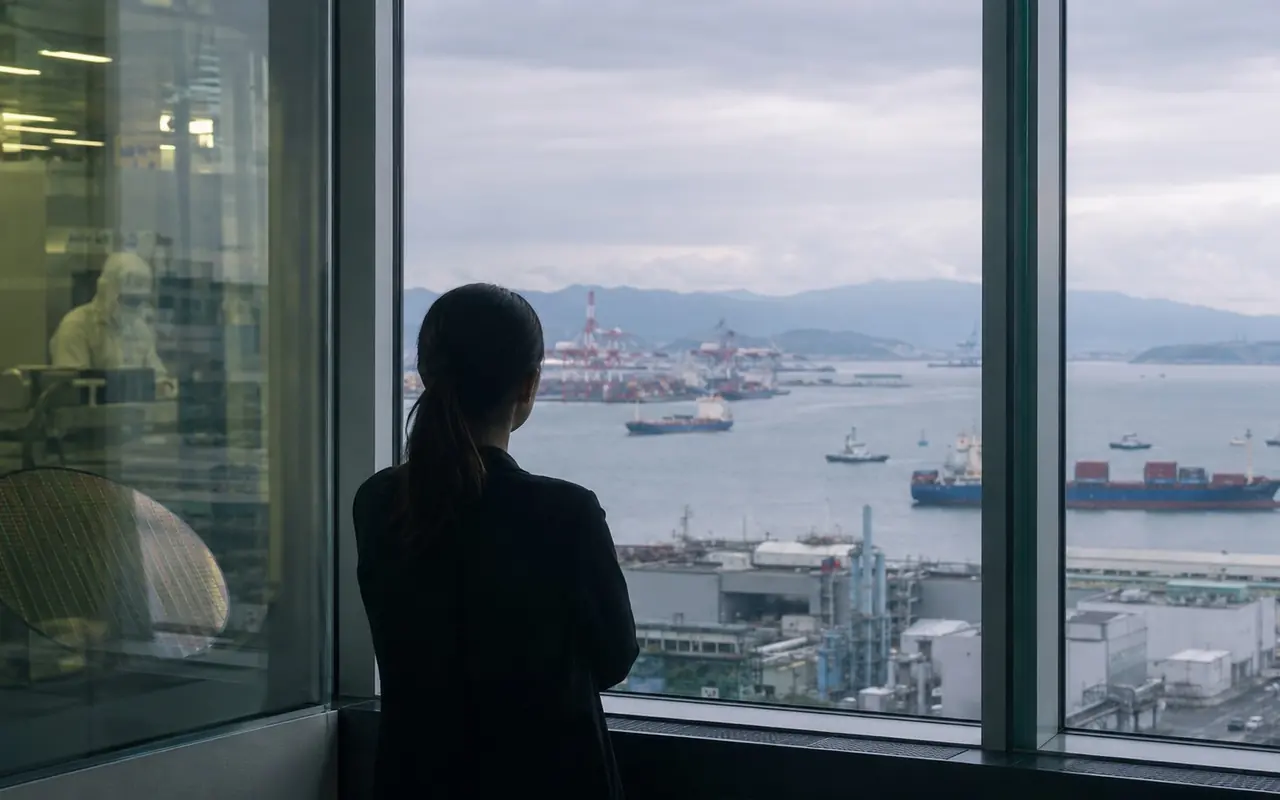
Taiwan's Two Faces
The whole world depends on Taiwan's chips — and is quietly preparing for the day it might lose them. The same island is both the heart of the supply chain and a geopolitical powder keg. How can Taiwan's companies turn "irreplaceable" into an advantage that lasts?

Not a September Vote: How the WTO's "Fish Week" Puts Taiwan's Distant-Water Fishing Fleet on the Transparency Exam Table
The WTO's first Fish Week is scheduled for September 21–25, but the chair has already made clear this is not a decision-making moment. What has actually already taken effect is the first-tranche prohibitions and transparency obligations; what has not yet been agreed is the rules on overcapacity and overfishing subsidies. What Taiwan needs to prepare is not a hastily assembled list of subsidies to cut, but an evidence chain that can trace every piece of support back to vessels, catch, and stock status.