
The India Card: Taiwan's South Asia Push, the India+1 Opportunity, and the China-India-Taiwan Triangle
Tata is building a large fab in Gujarat with a PSMC technology partnership, Foxconn assembles iPhones in Bengaluru, and Taiwan-India trade has grown nearly 80% in five years — Taiwan-India relations are entering a new density. But is this a genuine strategic pivot, or opportunism born of the China factor?
Article contents01 / 06
- In 2025, Taiwan-India bilateral trade reached $12.5 billion (up 17% year-on-year); the number of Taiwanese businesses in India continues to rise, but sources use inconsistent counting conventions and there is no reliably traceable precise count at this time.
- Tata Electronics is building an approximately $11 billion fab in the Dholera Special Investment Region, with PSMC providing technology cooperation; the project is planned to cover processes from 28nm to 110nm with a monthly capacity of 50,000 wafers.
- Since the 2020 Galwan clash on the China-India border, India's wariness toward China has risen; India adheres to strategic autonomy and does not openly support Taiwan, but legislator exchanges and semiconductor industry cooperation between Taiwan and India have increased.
“The India Card: Taiwan's South Asia Push, the India+1 Opportunity, and the China-India-Taiwan Triangle” reports that Taiwan-India Bilateral Trade ($ billion)($12.5 billion)。 Up 17% year-on-year from an estimated 2024 figure; year-by-year data for 2021-2023 lack a traceable official source and are not shown in this chart [1]。
“The India Card: Taiwan's South Asia Push, the India+1 Opportunity, and the China-India-Taiwan Triangle” reports that Cap on Indian Central Government Capex Support for the Project(50%)。 Tata Electronics leads the fab investment, with PSMC providing technology cooperation; this is not equivalent to Taiwanese direct investment in India [3]。
“The India Card: Taiwan's South Asia Push, the India+1 Opportunity, and the China-India-Taiwan Triangle” reports that Milestones of the Tata Fab(Groundbreaking March 2024)。 Groundbreaking 2024-03 -> about 50% complete by 2026-04 -> first chips expected 2026-12 [3][4]。
Gujarat, a Construction Site Still Smoking
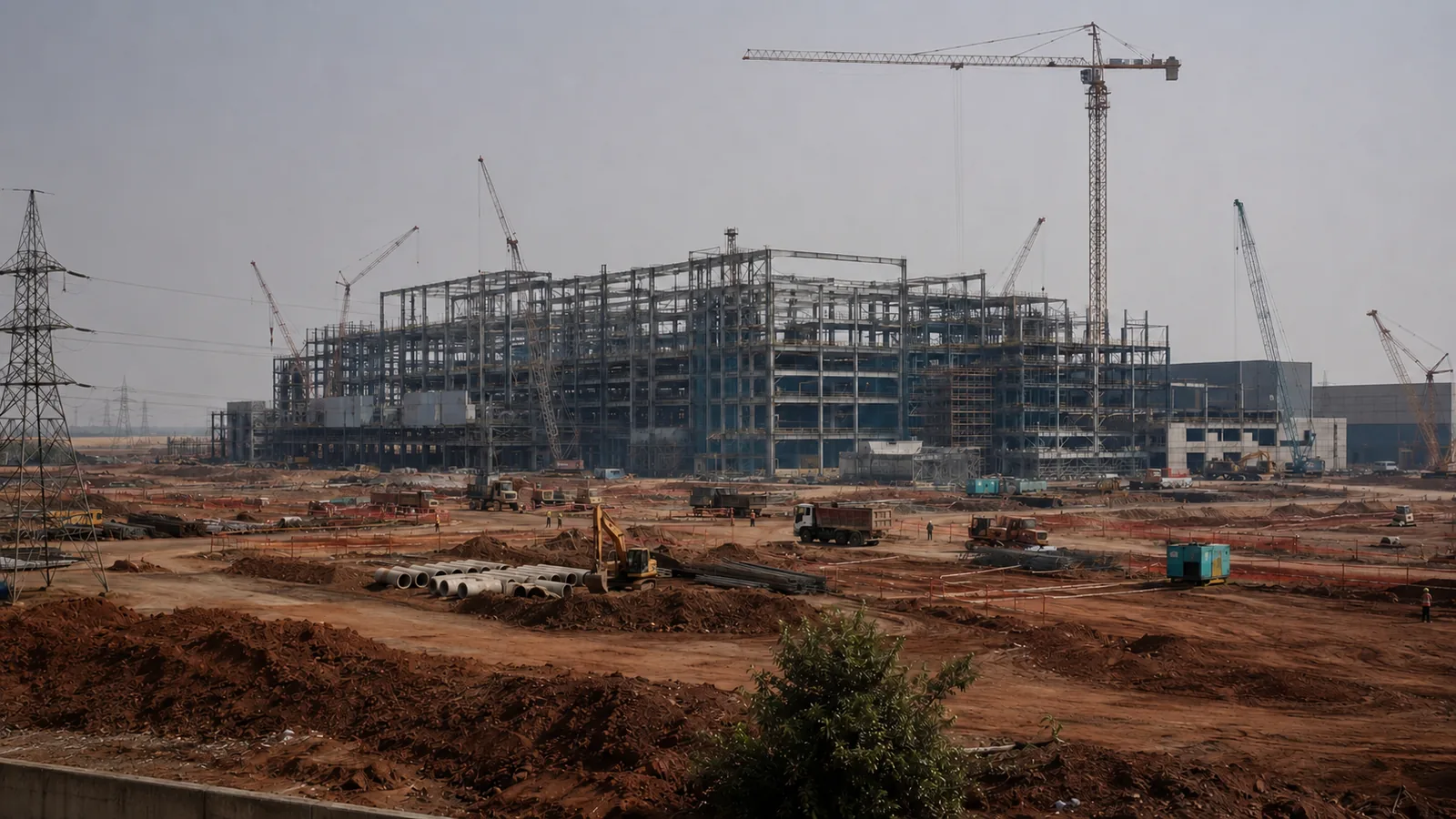
In April 2026, if you stood on a rise in India's Dholera Special Investment Region (Dholera SIR) in Gujarat and looked south, you would see a sprawling construction site: steel frameworks already rising into multi-story plant skeletons, hundreds of excavators working the red earth at once, with power infrastructure and ultra-pure water systems being rushed to completion around them.
This is one of the most representative large-scale fab projects in India's semiconductor policy.
The fab project led by Tata Electronics carries a total investment of about $11 billion (INR 91,000 crore), with PSMC providing technology cooperation, and the Indian central government approving support of up to 50% of the capital expenditure [3]. Its technology nodes span 28nm, 40nm, 55nm, 90nm, and 110nm, with a monthly capacity of 50,000 wafers at full production — an unprecedented manufacturing scale for India.
“The India Card: Taiwan's South Asia Push, the India+1 Opportunity, and the China-India-Taiwan Triangle” reports that Taiwan-India Bilateral Trade ($ billion)($12.5 billion)。 Up 17% year-on-year from an estimated 2024 figure; year-by-year data for 2021-2023 lack a traceable official source and are not shown in this chart [1]。
India building semiconductors is not news. But the choice of a Taiwanese technology partner, the scale of the Dholera plant, and the news that ASML signed an MOU in May 2026 to supply lithography equipment give this investment an entirely different weight [4]. It tells Taiwan's business community one thing: India+1 is turning from a slogan into bricks and steel.
1. The Numbers: A Trade Relationship That Has Doubled in Five Years
“The India Card: Taiwan's South Asia Push, the India+1 Opportunity, and the China-India-Taiwan Triangle” reports that Cap on Indian Central Government Capex Support for the Project(50%)。 Tata Electronics leads the fab investment, with PSMC providing technology cooperation; this is not equivalent to Taiwanese direct investment in India [3]。
Start reading the temperature of Taiwan-India relations from the trade figures.
According to the Taiwan External Trade Development Council (TAITRA) and official Indian data, Taiwan-India bilateral trade reached a total of $12.5 billion in 2025, up 17% from an estimated $10.7 billion in 2024, and up nearly 80% from $7 billion five years earlier [1]. In terms of structure, Taiwan's exports to India were about $9.2 billion (electronic ICs, plastics, electrical machinery), while India's exports to Taiwan were about $3.3 billion (mineral fuels, aluminum, steel) — a clearly asymmetric relationship: Taiwan's highly technology-intensive exports are matched against India's raw materials.
Taiwan's cumulative foreign direct investment (FDI) in India has already reached 198 cases totaling $1.68 billion [6]. Among Taiwanese business deployments, besides Tata-PSMC, the most notable include:
Foxconn: building a large manufacturing park in Bengaluru, where it began mass production of the iPhone 17 in August 2025 — an important node in Apple's India+1 strategy, and a sign that Taiwan's contract manufacturers see India as a manufacturing base outside China [9]. Actual products, output volumes, and investment progress should be verified against the latest announcements from the company and local government.
Delta Electronics: continuing to deepen its presence in the Indian market, with a footprint in both power supplies and automation solutions.
Quanta and Delta: have manufacturing or procurement footprints in India, following the logic of Apple's supply-chain relocation.
Public data shows the number of Taiwanese businesses setting up in India continuing to rise; different sources use inconsistent criteria for "already established" versus "under evaluation," so the two should not be combined into a precise headcount [7].
2. Official Mechanisms Warming Up: TAITRA, TECC, MoU
Taiwan's official footprint in India is also quietly being upgraded.
TAITRA's Service Presence in India
Its service outposts in India, together with Taiwan trade expos, are an important channel through which Taiwanese businesses obtain market information and matchmaking resources [7]. As for a Taiwan-India FTA, it remains a policy proposal and negotiating option, not something that should be treated as already in formal negotiations.
TECC Mumbai
In October 2024, Taiwan established the Taipei Economic and Cultural Center (TECC) in Mumbai. This is an expansion, at the city level, of Taiwan's formal diplomatic representative office in India, representing formal recognition of India's strategic importance to Taiwan as a market [8].
Labor MoU
In February 2024, Taiwan and India signed a labor cooperation memorandum of understanding, allowing Indian workers to come to Taiwan for employment while also opening a formal framework for bilateral labor mobility [10]. The MoU itself is not large in scale, but its symbolic significance is clear: Taiwan needs labor, India has a young demographic dividend, and the two sides have found a politically non-sensitive point of cooperation.
3. Tata-PSMC: The Depth of Technology Transfer Is the Biggest Question Mark
“The India Card: Taiwan's South Asia Push, the India+1 Opportunity, and the China-India-Taiwan Triangle” reports that Milestones of the Tata Fab(Groundbreaking March 2024)。 Groundbreaking 2024-03 -> about 50% complete by 2026-04 -> first chips expected 2026-12 [3][4]。
Back to the Dholera construction site. The scale of the Tata-PSMC investment is beyond question, but a question that has not been fully discussed in public is: can the depth of this technology cooperation let India truly build an autonomous semiconductor capability?
PSMC's role is positioned at mature processes (28nm to 110nm), not TSMC's advanced processes (below 3nm). That choice has its own real-world logic: mature processes have lower barriers than advanced processes in terms of equipment, materials, and engineering talent, making them a better fit for India's current infrastructure level. But it also means that even if Tata-PSMC succeeds in mass production, it will only be entering the mature segment of the global chip market, not the high end.
The deeper question is whether the technology is really being transferred. The core know-how of Taiwan's semiconductor industry — process integration, yield engineering, customer service — is accumulated in engineers' heads and in corporate culture; it is not something that can be handed over on a design drawing. PSMC's engineers will be stationed at the plant for an extended period to assist, but how quickly India's local engineers can master the core technology remains, for now, the biggest unknown.
Beyond that, the challenges of India's infrastructure should not be underestimated:
- Power and water stability: Fabs require ultra-stable electricity and ultra-pure water supply. Gujarat's power supply is relatively stable, but infrastructure gaps remain at the all-India scale.
- Logistics and customs: The customs procedures and warehousing logistics for importing Taiwanese equipment and materials into India are far more complex than in Japan or the United States.
- Bureaucratic procedures: The multi-layered approval processes of India's federal and state governments are the entry barrier Taiwanese businesses complain about most often.
Yield is the ultimate test. Even if the project produces its first chips on schedule, the path from pilot production to stable commercialization still requires equipment, materials, talent, and suppliers to be worked in together; there is no fixed timeframe that can be confirmed from this article's sources, and actual yield and customer qualification should continue to be watched.
4. The Geopolitical Triangle: Unofficial Warming After the China-India Border Clash
There is a severely underrated geopolitical factor behind the recent warming of Taiwan-India relations: the China-India border clash.
The Galwan Valley clash of June 2020 was the most serious military confrontation between China and India since the 1962 border war, resulting in deaths on both sides. That clash fundamentally changed India's strategic wariness toward China. India subsequently banned TikTok and other Chinese apps, restricted Chinese capital investment in sensitive sectors, and adopted a more explicit counterbalancing stance in multilateral settings.
Unofficial Taiwan-India contacts have warmed noticeably in the post-Galwan era. Exchanges of visits between Taiwanese and Indian legislators have increased; Indian media coverage of Taiwan's semiconductor technology has grown more in-depth than before; and when Indian officials mention Taiwan in public settings, the phrasing has shifted from "the Taiwan question" toward "Taiwan (as a supply-chain partner)." India's official narrative on the Tata-PSMC deal centers on reducing overall import dependence and building self-reliant semiconductor capacity (this publication's observation: a motive to also reduce dependence on Chinese supply chains is plausible, confidence: medium, though this is not explicitly stated in any official document) [5].
But there is a line India has not crossed, and does not intend to cross: its official One-China policy. At the United Nations and in formal diplomatic settings, India still maintains the official position that "Taiwan is part of China." This is, in fact, because India has its own China calculus to manage — conceding on this front can buy political room on border issues, while getting too close to Taiwan could increase pressure from Beijing at the border.
This is the core logic of the China-India-Taiwan triangle: India will not speak up for Taiwan, but India needs Taiwan's chips, factories, and technology. This relationship of "interest without commitment" is the real bottom line of Taiwan's leverage in India.
5. Three Converged Views From Taiwan
The state's view: Treat India+1 as an industrial-policy tool, not an equivalent replacement
India+1 is not a full replacement for China+1, but a useful supplement for spreading risk. Taiwan should actively push, at the policy level, for a Taiwan-India FTA to enter formal negotiations, and use Tata-PSMC as a test bed for technology cooperation — planning the pace of any further expansion of investment only after understanding the boundaries and patterns of that cooperation. Taiwan's diplomatic leverage point is to gradually lock the "unofficial warming" between Taiwan and India into an institutionalized framework, rather than pursue an unrealistic official breakthrough. (Observation; high confidence)
Industry's view: Follow the Apple supply chain, but don't put all your chips on India
For Taiwan's manufacturing sector, the answer to "where in India should we operate?" varies by industry. Following the Apple supply chain (assembly, electronic components) into India carries relatively clear odds of success, because the customers and orders already exist. But Taiwanese traditional-industry SMEs striking out on their own to develop the Indian market should not underestimate the infrastructure, regulatory, and cultural barriers they will face. India is a market that requires a local partner — going in alone costs more than it would in China or Southeast Asia. (Observation; medium confidence)
SMEs' view: Start by plugging into existing Taiwanese business clusters to lower the cost of exploration
For Taiwan's SMEs, the most practical path into India is to follow established Taiwanese leaders such as Foxconn and Delta that are already rooted there, becoming their suppliers or outsourcing partners in India. This can substantially reduce the uncertainty and upfront investment of localization. The market consulting and exhibition-matching services provided by TAITRA's service presence in India are free and concrete resources that should be put to good use. (Observation; high confidence)
Sources
- Newswire — Taiwan-India Trade Totaled $12.5 Billion in 2025, Up 17%
- India Semiconductor Mission — Official Website
- Tata Electronics — Tata Electronics and PSMC Complete Landmark Agreement for Technology Transfer to Build India's First Semiconductor Fab
- ASML — ASML and Tata Electronics Announce Strategic Partnership (2026-05-16)
- Carbon Credits — Analysis of Tata's $11 Billion Investment and PSMC Partnership (supplementary web media)
- Taiwan External Trade Development Council (TAITRA) — Market Research and Business Intelligence Portal (the original "India Market Report" citation could not be found in a public version; replaced with the official market-research portal)
- Taiwan Expo India 2025 — Official Website
- Ministry of Foreign Affairs, Republic of China (Taiwan) — Press Release on the Inauguration of the Taipei Economic and Cultural Center, Mumbai
- Business Today — Foxconn's Bengaluru Plant Begins Mass-Producing the iPhone 17 (2025-08-18; the original 2023 pre-production report had gone stale and was replaced with this mass-production confirmation)
- Ministry of Labor — Press Release on the Taiwan-India Labor Cooperation Memorandum of Understanding (2024-02-16)

Taiwan's Two Faces
The whole world depends on Taiwan's chips — and is quietly preparing for the day it might lose them. The same island is both the heart of the supply chain and a geopolitical powder keg. How can Taiwan's companies turn "irreplaceable" into an advantage that lasts?
Japan Takes Economic Security Overseas: Can OESA Bring Taiwan's Supply Chains Into State-Level Financing?
Japan has created OESA, extending policy finance to overseas projects that matter for economic security but are hard for existing tools to carry. Taiwan has an opening, but the law taking effect is not the same as Taiwan already being on the list — the real threshold lies in Japan's own interests, project design, and implementing rules that have yet to be published.