
The Frontier Is Not the Finish
China's frontier AI trails the U.S. by only about seven months — and in coding, the gap is almost closed. But the real battlefield isn't the model, it's chips and money: over 90% of the world's most advanced logic-process capacity is concentrated in Taiwan, channeling trillion-dollar AI capital toward this island. How should Taiwan catch it?
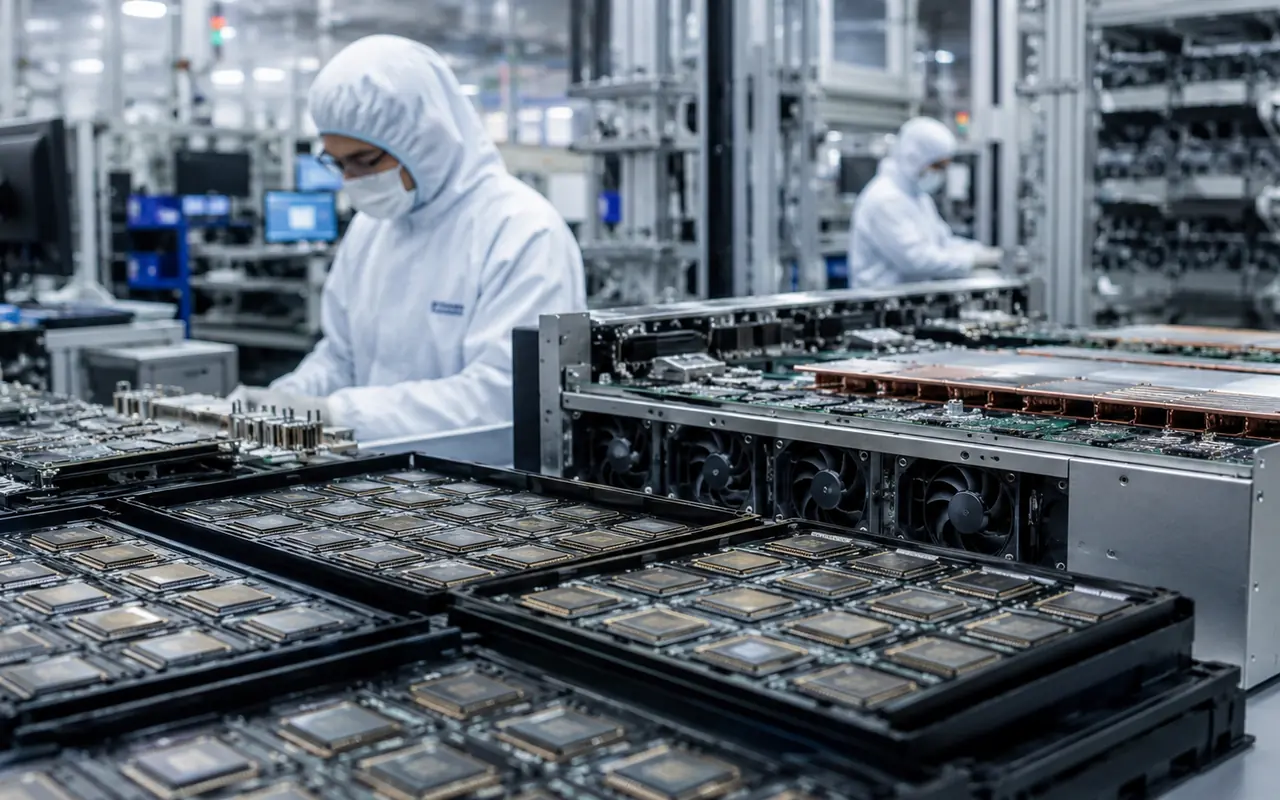
Article contents01 / 08
- As of mid-2026, China's frontier models trail the U.S. by roughly 7 months on average, with the coding gap effectively closed. But this is not a generational gap — it is a strategic fork: the West pursues closed frontier + high capital; China pursues open-weight + extreme cost efficiency.
- The real battleground is not the model but chips and capital flows. Over 90% of the world's most advanced logic-process capacity (nodes at or below 3nm) is concentrated in Taiwan, alongside the most critical advanced packaging — channeling global AI capital measured in hundreds of billions of dollars to this island.
- MIT research shows 95% of enterprise AI pilots see no measurable P&L impact; the divide hinges on implementation method, not model quality. For Taiwan's SMEs, the pragmatic path is not building engines — it's building what only you can assemble.
“The Frontier Is Not the Finish” reports that China's Frontier Models Trail U.S. by ~7 Months(7 months)。 Epoch AI Capability Index [1]。
“The Frontier Is Not the Finish” reports that Enterprise AI Pilots With No Measurable P&L Impact(95%)。 MIT NANDA 'GenAI Divide' [15]。
“The Frontier Is Not the Finish” reports that Global AI Infrastructure Spending Surging Toward $1T($1 trillion)。 IDC estimates 2029 >$1 trillion [13]。
“The Frontier Is Not the Finish” reports that AI-Referred Visitor Conversion Far Exceeds Search(15.9%)。 ChatGPT vs. organic search [21]。
In spring 2026, two seemingly contradictory numbers surfaced in the AI race back to back: China's frontier models trailed the United States by roughly seven months on average, and on coding tasks the gap had essentially closed [1]; meanwhile, China's open-weight models accounted for more than 45% of traffic on OpenRouter, a leading developer platform for accessing large language models [4]. The gap once framed as a "generational divide" is narrowing.
But at the very same time, another number lands ice-cold: according to research from MIT, enterprises have poured tens of billions of dollars into deploying generative AI, yet as many as 95% of pilot projects show no measurable impact on profit and loss [15]. On one side, capability is surging and getting cheaper for everyone; on the other, mountains of cash go in and nothing echoes back.
Put the two numbers side by side, and the real tension of the 2025–2026 AI race snaps into focus: model capability is converging fast, but enterprise investment does not necessarily convert into results. For Taiwan, what matters is not the model leaderboard, but where the chips and the capital are flowing — and the manufacturing endpoint of that flow sits right here, on this island.
Gap Closing, Paths Diverging
Let's be precise about "the gap," because this number is the easiest to misread. By Epoch AI's Capability Index, every model that has stood at the capability frontier since 2023 has come from the United States; China trails by roughly seven months on average [1]. But "seven months behind" is deceptive — on the heaviest reasoning benchmarks, the West still leads by roughly 3 to 8 percentage points, while on tasks like code generation, the gap has effectively vanished [2].
“The Frontier Is Not the Finish” reports that China's Frontier Models Trail U.S. by ~7 Months(7 months)。 Epoch AI Capability Index [1]。
The real watershed is the strategic path, not the scoreboard. The West is pursuing closed frontier plus heavy capital: OpenAI, Anthropic, and Google lock their strongest models behind an API, building a moat out of massive compute and enterprise revenue. China is pursuing open weights plus extreme cost efficiency: publishing model weights openly, driving costs to the floor, and capturing market share through ecosystem diffusion. In April 2026, five Chinese labs released frontier-class models within a span of four weeks [3]. The Brookings Institution frames it precisely: the West holds the closed frontier and the revenue; China holds the open ecosystem and the adoption curve [5].
Convergence is only the surface; divergence is the substance. America capitalizes the frontier; China commoditizes it. Same capability curve, two different logics for cashing it in.
For Taiwan, this fork carries an immediate implication: as frontier models themselves become ever more like commodities — ever cheaper — the truly scarce, price-setting layer moves downstream, toward the chips needed to manufacture these models, and toward the application layer that turns a model into a business. Those two layers are exactly where Taiwan should be watching.
This "commoditization" trend means opposite things to different players. For companies hoping to make money by selling models, it is bad news — your product gets freely copied by a rival every few months. But for the vast majority of enterprises that use AI rather than build it, it is an enormous windfall: the engine upgrades for free, and costs keep falling. Taiwan's industrial structure happens to sit on the winning side of that divide. Understanding this is what keeps you from being hijacked by the anxiety of "should we build our own foundation model too?" — for most Taiwanese companies, the practical answer is no.
The Truth About "Cheap": The $6 Million Myth, Trimmed
In 2025, the Chinese startup DeepSeek dropped a bombshell: it claimed its flagship model had been trained for only a few hundred thousand dollars. Almost overnight, a narrative that "China beat Silicon Valley for $6 million" spread around the world. But that story had been trimmed.
Look closely at the numbers: DeepSeek's self-reported $294,000 covers only the cost of "the final training run" — a figure that later even made it into the journal Nature [6]. But the RAND think tank points out that this self-reported number excludes the extensive earlier experimentation, labor, and hardware amortization; pricing a comparable model's "final run" at today's market rates would run to roughly $3 million, and the underlying foundation model's R&D cost is considerably higher still. Once the full capital and operating costs are folded in, SemiAnalysis estimates server capital expenditure at roughly $1.6 billion and annualized operating costs at nearly $944 million — magnitudes that likewise run into the thousands relative to the self-reported figure [7][8].
Cheap is real, but the magnitude was wildly overstated. The lesson for Taiwan is not "China won" or "China was bluffing" — it is a lesson in method: in the world of AI, fact and narrative can differ by three orders of magnitude. Any judgment built on a single sensational number, mistaken for a trend, exacts a price at decision time.
This matters especially for Taiwan's decision-makers, sitting at the core of manufacturing. Every few months the AI industry produces a new "this changes everything" narrative — cheaper training, stronger open source, faster agents — and most of them shrink once you check the magnitude and the timeline. Treating every wave as a truth you must bet on immediately, and treating every wave as a bubble, are equally dangerous forms of laziness. The real discipline is to separate fact from narrative, label inference with a confidence level, and only then decide whether — and when — to act.
The Real Battleground: The Wall Called Chips
If a model can be distilled, open-sourced, and made cheaper every cycle, the contest will not be decided by models alone. What actually blocks the race is hardware that no amount of software can route around: chips.
U.S. export controls have set up checkpoints precisely along this supply chain. In late 2024, Washington imposed nationwide export restrictions on China covering high-bandwidth memory (HBM), choking the AI chip supply at its throat [9]. China's flagship contender, Huawei, remains stuck at a 7-nanometer-class process for its Ascend chips; Georgetown University's research judges that it will not produce a chip that surpasses NVIDIA's H200 within two years, with the next generation not expected until the end of 2027 [10][11]. Huawei's response has been to stockpile foreign HBM and compensate with sheer volume, planning to double Ascend output in 2026 [12] — but the very premise of "being able to stockpile foreign memory" can itself be tightened further.
Models can be distilled, open-sourced. Chips cannot. That gap, measured in years, is the real clock running on this entire race — and the hand on that clock is in Taiwan's grip.
This is precisely Taiwan's strategic core. Once the fulcrum of competition lands on chips, and more than 90% of the world's most advanced logic-process node capacity is concentrated in Taiwan, Taiwan is transformed from "a link in the supply chain" into "the fulcrum of the contest." The next section shows how that fulcrum channels global AI capital, step by step, onto this island.
This wall is not a single component; it is a row of narrow chokepoints. Extreme ultraviolet (EUV) lithography machines are controlled by a single supplier; the most advanced electronic design automation (EDA) software sits with a handful of American firms; HBM high-bandwidth memory is dominated by Korean and American manufacturers. Tighten any one of these chokepoints, and the entire advanced-chip production line seizes up. That is also why "stockpiling" can only delay, never bypass — the inventory you can buy today, your rival can cut off tomorrow. For Taiwan, what this row of chokepoints ultimately protects is its irreplaceable position in the global division of labor.
The Money Is Flooding In — Straight to Taiwan
To understand why Taiwan is the winner here, first look at how much money this race is burning. Market researcher IDC estimates global AI infrastructure spending hit $90 billion in the fourth quarter of 2025 alone, will rush toward $487 billion in 2026 — growth of more than 50% — and will break $1 trillion by 2029 [13]. The four hyperscalers alone — Amazon, Microsoft, Google, and Meta — have committed a combined $635–665 billion in 2026 capital expenditure (an early-2026 estimate, since revised upward as fresh earnings come in), the vast majority of it aimed at AI [14].
“The Frontier Is Not the Finish” reports that Global AI Infrastructure Spending Surging Toward $1T($1 trillion)。 IDC estimates 2029 >$1 trillion [13]。
Where does that money ultimately land? NVIDIA's GPUs are the first stop, and the advanced logic-process node capacity NVIDIA's chips depend on is more than 90% concentrated at Taiwan's TSMC [11]. TSMC's fourth-quarter 2025 revenue grew more than 20% year-on-year, with high-performance computing accounting for nearly 60% of full-year revenue [19]; and at the AI chip's other chokepoint — advanced packaging (CoWoS) — more than half of TSMC's planned end-2026 monthly capacity is already claimed by NVIDIA alone [22].
This global AI arms race, measured in the hundreds of billions of dollars, has issued one giant invoice — and it is addressed to Taiwan. That is Taiwan's most solid source of confidence, and its hardest-to-replace leverage. The chip wall described above exists precisely to protect that invoice.
How fierce and concentrated is this demand? One number tells the story: the entire data-center semiconductor market grew 44% year-on-year in the second quarter of 2025 alone. And its endpoint is highly concentrated — TSMC alone captures more than 60% of global foundry revenue in advanced-process chips, and at the most cutting-edge nodes it comes even closer to a monopoly. The lifeline of global AI computing power runs through one island — arguably one company. That is an unprecedented strategic lever for Taiwan, and also a concentration that must be carefully managed. This duality will resurface repeatedly in the sections ahead.
This concentration has another concrete chokepoint worth remembering: advanced packaging. AI chips require stacking a compute die together with HBM memory — a process epitomized by TSMC's CoWoS — and it is currently one of the tightest capacity segments in the world, likewise concentrated overwhelmingly in Taiwan. Even if other countries build fabs of their own, without Taiwan's packaging capacity, advanced AI chips still cannot ship. Taiwan's leverage has never been just "the ability to make the most advanced chips" — it is holding the entire set of capacity that nobody else can replace on short notice.
The Section to Pin on Your Wall: The 95% Divide
But the frenzy over chips and capital obscures a colder fact: most of the money going in produces no echo at all.
MIT's NANDA initiative, in its report "The GenAI Divide," analyzed $30–40 billion in enterprise spending, 52 executive interviews, a survey of 153 leaders, and more than 300 real-world deployments. Its conclusion is sobering: 95% of integrated AI pilots produced no measurable profit-and-loss impact whatsoever; only 5% actually created value in the millions of dollars [15]. More critically, this divide is not driven by model quality or regulation — it is determined by implementation method.
“The Frontier Is Not the Finish” reports that Enterprise AI Pilots With No Measurable P&L Impact(95%)。 MIT NANDA 'GenAI Divide' [15]。
Other figures fill out the picture: consultancy Gartner projects that more than 40% of agentic AI projects will be cancelled before 2027 [16]; separately, a Microsoft-sponsored IDC study found that enterprises which get the method right recover an average of $3.70 for every $1 invested in generative AI [23]. The same dollar — and it is method that decides whether it lands in the 95% or the 5%.
AI does not lack capability. What it lacks is a method for turning capability into profit and loss. For Taiwan's industry, that sentence is worth more than any model ranking.
This is a clear signal for Taiwan's SMEs and the institutions that support them: rather than worrying over whether to chase the newest model, it is smarter to put resources into "implementation method" — how AI is embedded into a process, how data is fed into it, how ROI thresholds are set. Whoever learns first to turn AI into profit and loss stands on the 5% side of the divide.
What does "getting the method right" actually look like? MIT's research and other surveys point in the same direction: the successful 5% did not win by buying the most expensive model — they won by embedding AI deep into existing workflows, feeding it proprietary enterprise data, and setting a measurable profit-and-loss threshold for every application. The failing 95%, by contrast, often bought the tool without changing the process — they built a demo that was never connected to revenue. IBM's 2025 executive survey echoes the same pattern: only about a quarter of AI projects met their expected returns. Anyone can afford the tool; method is the real scarcity — and that happens to be exactly the gap Taiwan's dense network of SMEs and support institutions is best positioned to fill.
The Search Shift: From "Being Searched" to "Being Cited by AI"
AI is rewriting more than factories — it is rewriting marketing too. A shift with direct stakes for Taiwan's brands and consultancies is underway: the entry point for search is moving from Google's blue links to AI's generative answers.
The numbers are stark: in the first five months of 2025, AI-referred website traffic grew 527% year-on-year (industry data; medium confidence) [20]; Gartner predicted in 2024 that traditional search volume would decline 25% by 2026, though as of this review the actual decline has run far below that forecast [17]. What matters most is quality — visitors referred by large language models convert far better than organic search: visitors from ChatGPT convert at roughly 15.9% (industry data; medium confidence), versus only about 1.76% for organic search [21].
“The Frontier Is Not the Finish” reports that AI-Referred Visitor Conversion Far Exceeds Search(15.9%)。 ChatGPT vs. organic search [21]。
This has spawned a new battlefield: Generative Engine Optimization (GEO) — getting your brand, your data, and your definitions actively cited when AI answers a question. Today, most large enterprises have already begun building out GEO, but most SMEs have not yet moved (industry observation; medium confidence) [18]. For Taiwan's many small and mid-sized brands and marketing consultancies, that is a rare first-mover window.
The power of this shift hides inside a ratio. Web analytics firm Ahrefs found that AI search drives only about 0.5% of visit traffic, yet contributes as much as 12.1% of signup conversions — working out to roughly 24 times the efficiency of organic search (industry data; medium confidence). For Taiwan's brands and consultancies, this means the rules of the game are being rewritten: rather than fighting for keyword rankings, it pays more to make your own data, definitions, and viewpoints into a source AI is willing to cite when answering a question. Citable structured content, authoritative data, and clearly worded definitions are displacing the old SEO playbook.
Where Taiwan Stands: Pivot Point, and Single Pillar
Put the previous six sections together and Taiwan's position comes into focus. It sits at the physical endpoint of the global AI transmission chain: the most advanced chips, the most critical packaging — both are on this island. As the fulcrum of competition shifts down from "the model" to "the chip," Taiwan's strategic value does not shrink — it grows. That is both its moat and its leverage.
But the very same structure is also Taiwan's greatest risk. When an island's growth, its exports, even its currency, are all bound to a single AI demand curve, "glory" and "risk" become two faces of one coin. Should AI capital expenditure undergo a bubble-style correction, or should U.S. chip policy toward China suddenly loosen and erode the value of that wall, Taiwan would take the first hit. Advanced process technology is the moat — but outside the moat lies fertile ground irrigated by only a single water source.
This, from Taiwan's vantage point, is the real double swing-factor of this AI race: how long the chip wall can hold, and whether this wave of AI capital expenditure is structural demand or a bubble. The former determines how much Taiwan's leverage is still worth; the latter determines how long that invoice can keep being issued.
The "silicon shield" debate sits squarely on this structure. Optimists believe that, precisely because the whole world cannot do without Taiwan's chips, any move that destabilizes the Taiwan Strait would come at the cost of paralyzing global AI — and that deterrence protects Taiwan. Pessimists worry that as capacity and R&D gradually disperse to the United States and Japan, that protection will be diluted. Both arguments hold; the only difference is timing — which is exactly why one of the most important signals to watch in the coming years is which generation of process technology TSMC's new U.S. fabs actually take away, and which one stays, at the cutting edge, in Taiwan.
As for the bubble question, no one can currently give a definitive answer. IDC draws its 2029 spending line above $1 trillion, but that remains a forecast, not a realized fact; every past technology wave has taught us that a demand curve can shift overnight. For an economy that has staked its growth, exports, and currency on AI compute, that uncertainty is not abstract — it means the thickness of Taiwan's largest pillar rests, in part, on capital-expenditure decisions made in Silicon Valley. Diversifying that risk, and cultivating a second pillar, is therefore not excessive worry — it is national-level homework.
Three Stances: How Taiwan Should Play This Hand
Facing this position of being both the fulcrum and a single pillar, Taiwan's three types of actors need three different stances. This is our team's converged directional guidance (decision-oriented; not investment advice).
For the state, the mandate is to guard the physical load-bearing wall: advanced process technology, CoWoS packaging, talent, and energy. At the same time, treat shifts in chip-control policy toward China and the global AI capital-expenditure curve as national-security-level indicators to watch — because both directly determine the safety of Taiwan's largest pillar.
For industry intermediaries (trade associations, startup federations), the task is to push members from the 95% side to the 5% side. Don't just debate which model is strongest — help members build "method-right" implementation capability: workflow integration, proprietary data, ROI thresholds. At the same time, help brand-facing SMEs seize the first-mover window on GEO.
For SMEs, the single most practical sentence, worth pinning on the wall:
Don't compete with the engine makers to build engines — go build the car only you can assemble.
Foundation models are a capital-intensive, winner-take-all battlefield; jumping into that fight only gets you run over. The real moat is in the application layer and vertical integration — proprietary data, workflow integration, domain know-how, customer relationships, distribution channels. A model gets stronger and cheaper every few months, and for anyone not building models, that is pure upside: your engine upgrades for free, and all you have to guard is the part nobody else can take from you.
What does this look like on the ground? A Taiwanese machine-tool manufacturer does not need to train its own foundation model — it needs to plug off-the-shelf AI into its existing quoting, scheduling, and fault-diagnosis workflows, feeding it decades of accumulated machining parameters that no general-purpose model has ever seen — proprietary data that belongs to no one else. A local marketing consultancy does not need to out-compete Google on search algorithms — it needs to organize its clients' authoritative data into a format that AI is happy to cite, and claim territory in the generative engines. The moat was never in the model. It lives in these details that nobody else can carry away.
The frontier is not the finish line. For the United States and China, the frontier is about face; for Taiwan, the point was never to stand at the frontier — it was always to see clearly where the money flows, and to place yourself where that capital flow cannot route around you. Taiwan has already done that. What remains is to hold on to it, and to learn to spread that dividend — from the fabs outward, to every company on this island that wants to turn AI into profit.
This also echoes our team's unchanging position: stand on Taiwan's side, and think for Taiwan. We do not need to pick a side between Washington and Beijing, nor endorse either side's narrative. What we need is to look clearly at the structure of this board, then ask the simplest question of all: what is best for Taiwan? The answer is not on any frontier-model leaderboard. It is in the position of that capital flow, in that wall of chips, and in whether every company on this island can learn to turn AI into profit and loss.
Sources
- Epoch AI — US vs China Capabilities Index (7-month lag)
- Digital Applied — Open-weight vs closed-source AI models, Q2 2026
- 1023 Jack — China Sphere Capability Gap Q2 2026 Update
- LLM-Stats — AI Trends (OpenRouter traffic)
- Brookings — Competing AI strategies for US and China
- CNN — DeepSeek training cost $294K (Nature)
- RAND — What DeepSeek Really Changes About AI Competition
- SemiAnalysis — DeepSeek Debates (full-cost estimate)
- CSIS — Updated Export Controls (HBM restrictions)
- CSET (Georgetown) — Huawei's AI Chip Tests Export Controls
- CFR — China's AI Chip Deficit (Ascend can't catch NVIDIA / Taiwan's manufacturing share)
- IEEE ComSoc — Huawei to double Ascend output in 2026 / HBM orders
- IDC — AI infrastructure spending ($90B Q4 2025, $1T+ by 2029)
- tech-insider — Big-4 cloud AI capex 2026 ($635–665B)
- MIT NANDA "GenAI Divide" — 95% of pilots fail to deliver ROI (via legal.io)
- tech-insider — Agentic AI enterprise market analysis (citing Gartner)
- Gartner — press release: Search Engine Volume Will Drop 25% by 2026
- Frase — What is GEO? 2026 Guide
- TSMC official press release — Q4 2025 earnings (revenue +20.5% YoY)
- theStacc — AI Search Referral Traffic Statistics 2026 (527% growth data)
- Seer Interactive — Case Study: How Traffic from ChatGPT Converts
- Digitimes — TSMC expands CoWoS capacity with Nvidia booking over half for 2026-27
- Microsoft News — Microsoft-sponsored IDC report: GenAI ROI reaches 3.7x
The AI Act Starts Enforcing: For Taiwanese Models, SaaS and Content Platforms Entering the EU, Who Is Provider, Who Is Deployer?
The EU AI Act has entered a new phase of enforcement and transparency obligations. The real first question for Taiwanese companies is not where the underlying model comes from, but which legal role they occupy in each product, brand and use case.
The AI Boom Reaches Mature Nodes: TSMC Revenue Hits a Record — Will Chip Price Hikes Reach Your Products?
June revenue of NT$442.68 billion and roughly NT$1.27 trillion for the second quarter — TSMC has again hit a record, driven by AI demand. At the same time, word is spreading through the industry that mature-node prices are about to be adjusted too. The real story is not that every chip is getting more expensive at once — it's that AI servers have started consuming huge volumes of power-management, control and optical-communication peripheral chips, handing pricing power back to production lines once written off as old.