
The AI Boom Reaches Mature Nodes: TSMC Revenue Hits a Record — Will Chip Price Hikes Reach Your Products?
June revenue of NT$442.68 billion and roughly NT$1.27 trillion for the second quarter — TSMC has again hit a record, driven by AI demand. At the same time, word is spreading through the industry that mature-node prices are about to be adjusted too. The real story is not that every chip is getting more expensive at once — it's that AI servers have started consuming huge volumes of power-management, control and optical-communication peripheral chips, handing pricing power back to production lines once written off as old.
Article contents01 / 10
- TSMC's record June and second-quarter revenue are confirmed facts; the scope, magnitude and effective date of any mature-node price adjustment are still industry reports and should not be conflated with the confirmed revenue figures.
- AI servers are spreading demand from advanced GPUs to PMICs, BCD process chips, control chips and optical-communication peripherals; combined with shrinking 8-inch capacity, this is handing some mature-node lines their pricing power back.
- The price increases are not across the board: 12-inch mature nodes still face oversupply and competition from China. Taiwanese companies should segment by process node and product rather than accept a blanket narrative that "AI has made every chip scarce."
“The AI Boom Reaches Mature Nodes: TSMC Revenue Hits a Record — Will Chip Price Hikes Reach Your Products?” reports that TSMC's June revenue sets a new monthly record(NT$442.68B)。 Monthly revenue, January–June 2026; June up 67.9% year on year [3][14]。
“The AI Boom Reaches Mature Nodes: TSMC Revenue Hits a Record — Will Chip Price Hikes Reach Your Products?” reports that Q1 wafer revenue from 7nm and more advanced nodes(74%)。 3nm 25%, 5nm 36%, 7nm 13% [1]。
“The AI Boom Reaches Mature Nodes: TSMC Revenue Hits a Record — Will Chip Price Hikes Reach Your Products?” reports that Top-ten foundries' 8-inch utilization rebounds(nearly 90%)。 TrendForce estimate: from about 80% in 2025 to nearly 90% in 2026 [6]。
“The AI Boom Reaches Mature Nodes: TSMC Revenue Hits a Record — Will Chip Price Hikes Reach Your Products?” reports that The next confirmation point is TSMC's Q2 earnings call(16 July 2026)。 Watch whether the company addresses demand, capacity, margin and pricing — don't answer for the company in advance [13]。
Start by separating two pieces of news that landed on the same day but should not be blended together.
The first is a number TSMC published itself, one that can be checked: consolidated revenue for June 2026 came to NT$442.68 billion, up 6.2% month on month and 67.9% year on year, a new monthly record; second-quarter revenue came to roughly NT$1.27 trillion, up about 36% year on year, also an all-time high. [3][14] This is a result that has already happened.
The second is supply-chain reporting. The Economic Daily News, citing multiple IC design companies, reported that TSMC is in discussions with customers about a 2027 price adjustment for mature nodes, with the size of the increase varying by customer and product line, possibly in the single-digit percentage range; TSMC did not comment, citing its quiet period ahead of its earnings call. [8] Research firms have also tracked upward pricing trends for both advanced and some mature-node processes, though conditions vary by wafer size, node and customer terms. [5][7]
So it cannot yet be written that "TSMC has announced an across-the-board mature-node price increase." The more precise statement is: the record revenue is confirmed; the direction of a price adjustment is backed by multiple industry signals, but the actual scope, magnitude and effective conditions still await confirmation from the company and its customers.
What is genuinely worth following is not just a new price sheet, but the industry shift behind it. Discussion of AI chips used to focus only on 3nm GPUs and CoWoS packaging. Now, demand is starting to spread to power-management, control, networking and optical-communication peripherals. This AI beast is not only consuming the most advanced chips — it is starting to tighten supply on production lines once dismissed as "old process."
“The AI Boom Reaches Mature Nodes: TSMC Revenue Hits a Record — Will Chip Price Hikes Reach Your Products?” reports that TSMC's June revenue sets a new monthly record(NT$442.68B)。 Monthly revenue, January–June 2026; June up 67.9% year on year [3][14]。
I. Separate Fact from Rumor First
There is little ambiguity in TSMC's revenue momentum. The company's first-quarter revenue was NT$1.1341 trillion, up 35.1% year on year; gross margin reached 66.2% and net margin 50.5%. June then pushed monthly revenue to NT$442.68 billion, bringing first-half cumulative revenue to roughly NT$2.40 trillion. [1][3]
Ministry of Finance trade data offer corroborating evidence. Taiwan's June exports came to US$74.83 billion, up 40.3% year on year, with a monthly trade surplus of US$12.2 billion; the government attributes the main driver to ICT and AI demand. [4] This does not mean every Taiwanese company is thriving in lockstep, but it does show that global AI capital expenditure is genuinely flowing through Taiwan's production lines — not merely a story confined to stock prices.
Pricing news, by contrast, has to be held with more conditions attached. When TSMC discussed pricing on its April earnings call, Chairman C.C. Wei stressed that customers are partners, and that the company will not change prices drastically — it wants customers to succeed and to grow together with TSMC; that is the company's own public statement. [2] The mature-node pricing information obtained by the media in July is a description from customers and the supply chain. [8] The two are not necessarily contradictory — a strategic adjustment that varies by customer and by node is not the same thing as a one-off across-the-board hike — but until a formal document appears, it should still be labeled "market reporting."
This distinction matters for companies. Slotting an unconfirmed single-digit increase directly into every procurement budget risks overstating cost; but ignoring it entirely just because the company has not made an announcement risks missing the six-months-to-a-year window needed to renegotiate contracts and qualify a second source.
II. What Hit a Record Isn't Just Revenue — It's Pricing Power
In TSMC's first-quarter wafer revenue, 3nm accounted for 25%, 5nm for 36%, and 7nm for 13%, totaling 74%. [1] This structure shows that the core of the record result is still advanced nodes — mature nodes have not suddenly taken over.
“The AI Boom Reaches Mature Nodes: TSMC Revenue Hits a Record — Will Chip Price Hikes Reach Your Products?” reports that Q1 wafer revenue from 7nm and more advanced nodes(74%)。 3nm 25%, 5nm 36%, 7nm 13% [1]。
But that 74% leaves another question hanging: the remaining 26% has not disappeared. Automotive, industrial control, power management, display drivers, sensors, network control and various specialty processes still make up a huge long tail. The key point is that for an advanced chip to actually work, it has to be surrounded by an entire ecosystem of mature-node chips.
A GPU can be manufactured at 3nm or 5nm and handle the computing. But a server also needs a PMIC to convert high voltage into voltage the chip can use, power switching components, a BMC to manage the motherboard and rack status, and control chips connecting the network and optical modules. As the number of AI servers rises and per-rack power draw climbs, demand for these unglamorous peripheral components rises right along with it. [5][6]
TSMC's pricing power is therefore coming from two layers at once. The first comes from technology leadership and tight capacity at the most advanced nodes. The second comes from AI demand spilling over and colliding with long-term capacity reductions on mature lines, producing localized tightness. The first kind of scarcity is "nobody else can do it as well"; the second is "plenty of people can do it, but not enough qualified capacity is available right now." The two kinds of scarcity are different, but both can support higher prices.
III. Why Is AI Relighting Old 8-Inch Production Lines?
The tightness in mature nodes shows up most clearly in 8-inch wafers. TrendForce estimates that the average 8-inch capacity utilization rate among the world's top ten foundries rose from about 80% in 2025 to nearly 90% in 2026, and may stay above 80% through the first half of 2027. [6]
“The AI Boom Reaches Mature Nodes: TSMC Revenue Hits a Record — Will Chip Price Hikes Reach Your Products?” reports that Top-ten foundries' 8-inch utilization rebounds(nearly 90%)。 TrendForce estimate: from about 80% in 2025 to nearly 90% in 2026 [6]。
On the supply side, the reason is that major players such as TSMC and Samsung have been gradually cutting 8-inch capacity since the second half of 2025, shifting capital and fab resources toward advanced or higher-value processes. [6] 8-inch fabs run on old equipment with limited returns on expansion, and building a new one is not necessarily worth it; when supply does not increase quickly, even a modest rebound in demand can push utilization up sharply.
On the demand side, the driver is AI's appetite for power. PMICs, BCD-process chips and discrete power components mostly do not need the smallest line widths — what matters instead is high-voltage tolerance, reliability, long-term supply and cost. TrendForce has observed foundries shifting some display-driver and image-sensor capacity toward power-related applications, because the latter carries a better average selling price and margin. [6] This is essentially a game of "musical chairs" within mature nodes: AI power components move to the front of the line, while low-margin standard products get pushed out.
This also explains why "AI demand" cannot be measured by GPU shipments alone. Every additional watt of compute a data center adds requires matching power supply, cooling, networking and control. Advanced nodes determine how fast the computation runs; mature nodes determine whether the whole machine can stay reliably switched on. AI's physical footprint is wider than any model parameter count suggests.
IV. Not Every Mature Node Is Actually Short
The easiest mistake to make at this point is generalizing the tightness in 8-inch power components into "every mature node is in shortage." The data does not support that claim.
TrendForce's March outlook stated clearly that 8-inch capacity is improving because of both supply cuts and AI power demand, but 12-inch processes at 28nm and above are still affected by weak consumer electronics demand, memory costs and continued capacity expansion pressure, so utilization is not fully saturated across the board — meaning that price increases are more likely to be selective. [5] June tracking also showed that UMC's adjustments for its existing large customers were relatively mild, while VIS and PSMC are moving at different paces depending on their capacity and product mix. [7]
Chinese capacity is another constraint. TrendForce estimates that nearly 70% of new global 12-inch mature-node capacity is being driven by China. [6] When Taiwanese fabs raise prices or scale back standardized nodes, some high-voltage, image-sensor and display-related customers will look for Chinese foundries in exchange for more stable pricing and capacity. [6]
So the market is splitting into three different price stories: advanced nodes hold strong pricing power on the back of technology and demand; 8-inch mature nodes are seeing localized price increases from supply cuts and power demand; and 12-inch mature standard products remain pinned down by Chinese expansion and weak consumer demand. Saying only "mature-node prices are rising" lumps three separate markets into one.
V. How Would the Cost Actually Flow Down Taiwan's Supply Chain?
The first stop is IC design companies. Once foundry prices rise, a design company can choose to absorb the cost, raise the chip's selling price, redesign for a different node, or move the order to another foundry. The problem is that even though a mature chip is technologically older, requalifying it is not simple. Automotive, industrial and power products involve reliability and customer certification; switching foundries can mean redoing photomasks, testing and lengthy requalification, and companies without sufficient volume may not get favorable minimum wafer-start terms.
The second stop is module, board, power and server suppliers. What they buy is not "a wafer" — it's a combination of multiple chips plus memory, passive components, PCBs, thermal solutions and packaging/testing services. If only one PMIC rises by a single-digit percentage, the overall system cost will not rise proportionally; the compounding effect only becomes noticeable if wafers, packaging/testing, memory and power components all rise at the same time. [7][8]
The third stop is the brand and the end customer. Large brands have volume, long-term contracts, and the leverage to ask suppliers to help absorb costs. Low-margin, small-batch-many-products SMEs usually do not have the same bargaining power. So the same wafer price increase might show up as barely a dent in a large customer's margin, while it can be enough to eat an entire order's profit on a small manufacturer's books.
This is why "will phones get more expensive" is not the best question to ask. The more precise question is: which category of product has a high chip-cost share, low inventory, few alternative sources, and a supplier with no room left to absorb costs? Industrial power supplies, dedicated networking equipment, small-batch server boards, and equipment requiring long-term guaranteed supply are more likely to feel the pressure earlier than mass consumer electronics.
VI. A 5% Wafer Increase Doesn't Automatically Mean a 5% Product Increase
Supply-chain quoting often compresses a complicated situation into one line: "prices went up upstream, so we have to raise ours too." Sometimes that's justified; sometimes it's just AI hype being used as a bargaining tactic.
The judgment method is simple. First ask which node, which wafer size, and which foundry is actually raising prices; then ask what share of the module's cost that chip represents, how long existing inventory will last, and when the long-term contract comes up for renegotiation. If a supplier only cites "TSMC might raise prices" without being able to name the affected part numbers and the batch it takes effect from, the buyer has no obligation to accept a vague, blanket price increase.
Conversely, companies also cannot use "end-market demand is weak" to dismiss every pressure point. The capacity utilization and order-switching cost for 8-inch power components are real constraints. [6] The most practical approach is not to guess at a single industry-wide average increase, but to break the bill of materials down item by item — tracking advanced compute, power and control, memory, packaging/testing, and passive components separately, so every price adjustment has corresponding evidence behind it.
VII. Taiwan's Geo-Economic Paradox: The More It Can Raise Prices, the More It May Push Orders Toward China
TSMC's ability to keep hitting records at high margins proves that Taiwan still holds the most important pricing power in the global AI supply chain. First-quarter gross margin of 66.2%, with advanced nodes making up nearly three-quarters of wafer revenue, shows that the market is willing to pay for reliable volume production and technology leadership. [1]
But mature nodes are not the same kind of moat. Many standardized products have alternative sources; when Taiwanese fabs cut capacity and raise prices, orders can shift to China. TrendForce has already observed high-voltage and image-sensor customers looking for Chinese suppliers, and 12-inch mature-node expansion is also heavily concentrated in China. [6]
This creates a policy paradox: from a company's perspective, it makes sense to shift limited capacity toward higher-value AI power components; from a national perspective, if large volumes of standard mature-node production move to China, Taiwan may lose industrial breadth, and supply-chain de-risking could go into reverse. The government cannot ask companies to keep low-margin production lines forever, but it can help specialty, automotive and industrial chips upgrade, so that the mature-node capacity that stays in Taiwan competes on reliability and certification rather than on matching China's lowest price.
VIII. Red-Team Test: Could This Just Be Pre-Earnings-Call Price Talk?
Skepticism is warranted here. TSMC will hold its second-quarter earnings call on 16 July, and the market is widely expecting the company to raise its outlook; a wave of pricing news appearing right before that call could reflect some mix of genuine customer conversations, investor expectations, and media amplification all at once. [13]
The three strongest pieces of counter-evidence are: first, TSMC has not formally confirmed a mature-node price adjustment; second, 12-inch mature nodes are not fully saturated; and third, weak consumer electronics demand and Chinese expansion still constrain prices. [5][8] So it would be wrong to infer, from June's record revenue alone, that every product line will smoothly raise prices in 2027.
The evidence on the other side is that advanced nodes have long been fully booked, 8-inch utilization has risen markedly, other Taiwanese foundries and packaging/testing companies already show signals of selective price adjustment, and AI servers' demand for power components is not a one-month blip. [5][6][7][12] The most reasonable middle judgment is: pricing pressure has a structural basis, but it will concentrate on nodes and customers where supply is tight, switching is hard, and value is high; "across-the-board increases" still lacks evidence.
IX. Taiwan's Three-Tier Decisions: Don't Wait for a Single Percentage Figure
At the national level, statistics and industrial policy should stop lumping "mature nodes" together. The supply and demand for 8-inch PMICs, 12-inch 28nm-and-above, image sensors, display drivers and power components are all completely different; publishing a single average capacity-utilization figure gives companies nothing to act on. The government should also track how much mature-node business is shifting to China, and use R&D, automotive-grade qualification and trusted-supply-chain certification to support high-reliability specialty processes, rather than subsidizing a race to the bottom on low-cost capacity.
Industry intermediaries and large companies should build cross-company timelines and shared specifications for second-source qualification. A single small or mid-sized IC design company can rarely afford to fund a foundry switch and requalification on its own; trade associations can coordinate pilot runs, reliability testing and supplier audits. Large ODMs should make the actual affected part numbers and batches transparent, rather than passing risk downstream through a blanket price increase.
SMEs should immediately put together three lists. The first lists key chips by wafer size and node. The second lists inventory levels, long-term contract expiry dates and alternative parts. The third lists how many months a requalification would take. Turn "I heard prices are going up" into "which part, when, by how much, and can it be substituted." If a supplier asks for a price increase, demand supporting evidence tied to foundry, packaging/testing or memory costs — not just an appeal to "AI shortage."
“The AI Boom Reaches Mature Nodes: TSMC Revenue Hits a Record — Will Chip Price Hikes Reach Your Products?” reports that The next confirmation point is TSMC's Q2 earnings call(16 July 2026)。 Watch whether the company addresses demand, capacity, margin and pricing — don't answer for the company in advance [13]。
Final Judgment: The AI Boom Is Widening, Not Lifting the Whole Ocean at Once
Record June revenue confirms that AI demand remains strong; the pricing signals in mature nodes show that this demand is spreading from the most advanced compute chips outward to their surroundings. This is a more important shift than "how much did TSMC make this time" — AI infrastructure is starting to revalue the entire semiconductor chain, not just rewarding its most cutting-edge sliver.
But the market is not one single sea rising all at once. 8-inch power components, 12-inch mature standard products and 3nm advanced processes are each driven by different supply and demand forces. TSMC having pricing power does not mean every Taiwanese foundry does; a wafer price increase does not mean every end product will get proportionally more expensive.
The 16 July earnings call is the next confirmation point — not the moment a prophecy comes true. What really matters is how the company describes demand and capacity, what formal terms customers receive in the fourth quarter, and whether 8-inch utilization can be sustained. For Taiwanese companies, the most dangerous thing is not the price increase itself — it's letting one dramatic average number stand in for a judgment that should be made chip by chip, supply chain by supply chain.
Sources
- TSMC — First Quarter 2026 Results
- TSMC — Q1 2026 Earnings Call Transcript
- Focus Taiwan — TSMC's June sales smash previous monthly record
- Ministry of Finance — Summary of Exports and Imports for June 2026
- TrendForce — Strong AI Momentum to Drive 24.8% Growth in Foundry Revenue in 2026
- TrendForce — AI Power ICs Set Stage for Mature-Node Foundry Price Increases
- TrendForce — Foundry Market Bulletin, June 8, 2026
- Economic Daily News — AI's Red-Hot Demand Spreads to Mature Nodes, TSMC Sets Off a New Wave of Price Increases
- TSMC — 2026 Shareholders' Meeting Resolutions
- Ministry of Economic Affairs — AI Wave Drives Transformation of Taiwan's Export Structure
- TrendForce — Foundry Market Bulletin, April 13, 2026
- TrendForce — UMC, VIS and PSMC Reportedly Eye Mature-Node Price Hikes
- TSMC — 2026 Second Quarter Results Schedule
- Reuters — TSMC Q2 revenue jumps 36%, beating market expectations
- TSMC — 2025 Annual Report on Form 20-F
The AI Act Starts Enforcing: For Taiwanese Models, SaaS and Content Platforms Entering the EU, Who Is Provider, Who Is Deployer?
The EU AI Act has entered a new phase of enforcement and transparency obligations. The real first question for Taiwanese companies is not where the underlying model comes from, but which legal role they occupy in each product, brand and use case.
From Regulator to Enforcer: The Cost of Criminalizing Taiwan's AI-Chip-to-China Export Controls
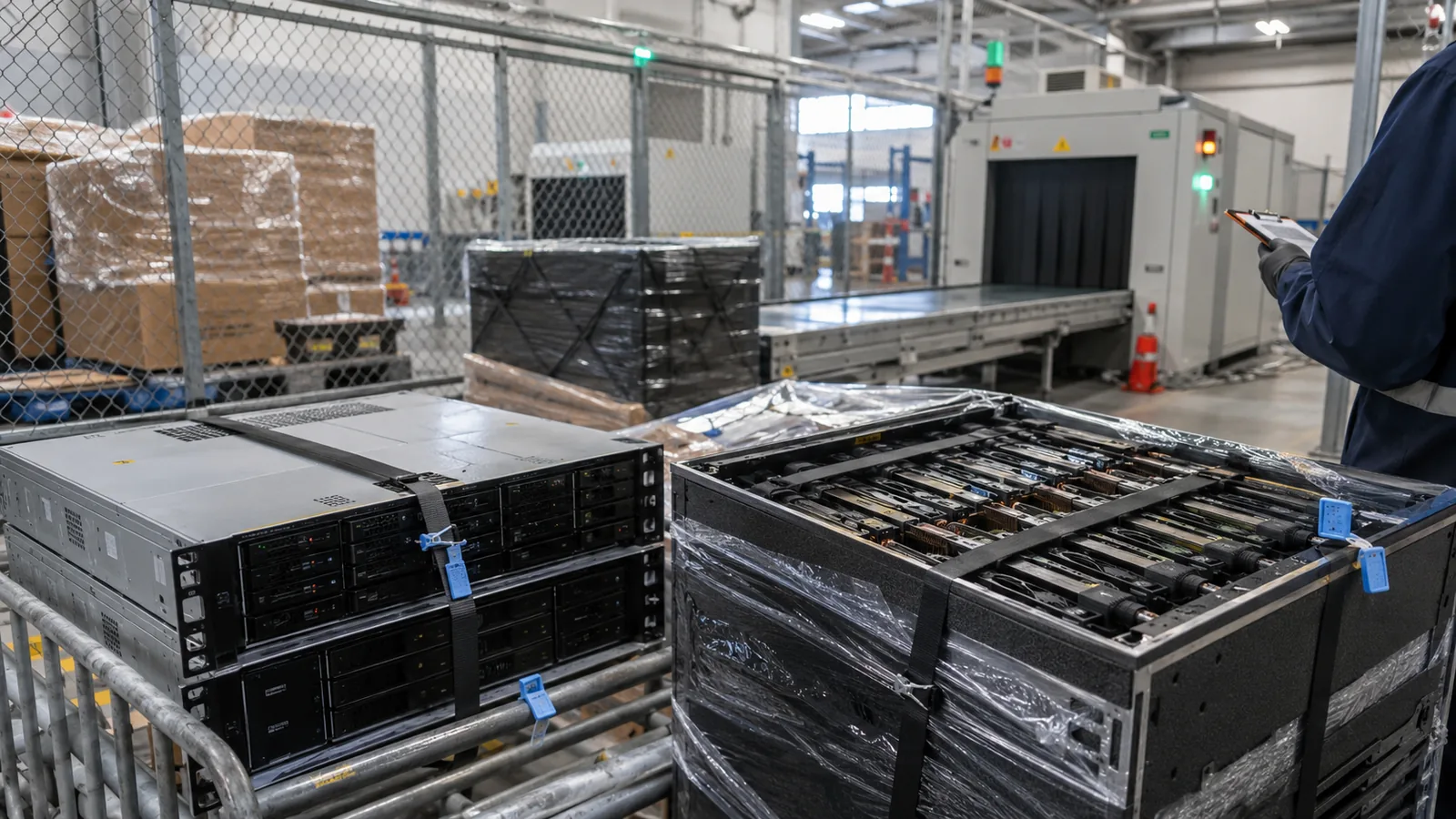
The Super Micro server transshipment case has put an awkward fact in the open: smuggling AI chips into China is not, as things stand, a crime in Taiwan. As Taipei considers amending the Foreign Trade Act to close this criminal-liability gap and align with Washington, Taiwan will also shift from a passive rule-taker to a rule-enforcer holding prosecutorial power — and the bill will land first on the kingdom that ships 44 percent of the world's AI racks.