
The Dead Sea and Doha: The Third Nerve Running Through Taiwan's Chips
Helium comes from Doha, bromine from the Dead Sea — two Middle Eastern gases you've never heard of, buried deep inside every chip's manufacturing process. The moment the Strait of Hormuz closed, Taiwan's fabs started rationing helium, with inventories down to several months. Beyond the electricity covered in 'Eleven Days' and the oil covered in 'Hormuz Shock, Taiwan's Other Bill,' this is the third nerve running through Taiwan's chips.
Article contents01 / 09
- In 2024, 69% of Taiwan's helium came from the Middle East's GCC states; liquid helium keeps for only 35–48 days, Asian fabs are down to several months of inventory, and by 2026 Taiwanese and South Korean fabs were already 'rationing' it — this is another short-fuse lifeline for Taiwan's chips, alongside the electricity covered in 'Eleven Days.'
- The acute risk of a bromine/HBr supply cutoff sits mainly with South Korean memory makers (Israel and Jordan together hold about two-thirds of the world's bromine); Taiwan, running mainly logic processes, is exposed 'directly but not to a full line stoppage' — the bigger exposure is the 'indirect bill': DRAM/HBM price spikes feeding back into Taiwan's AI packaging costs.
- The 2022 Ukraine neon crisis proved that 'a supply cutoff doesn't equal a production stoppage' (the industry resolved it through diversification, use-reduction, and recycling), but helium has no chemical substitute and a short shelf life, making it harder to solve the same way — a full line stoppage is a tail risk; what's actually happening right now is 'price hikes, longer lead times, and rationing.'
“The Dead Sea and Doha: The Third Nerve Running Through Taiwan's Chips” reports that Nearly 70% of Taiwan's Helium Comes From the Middle East's GCC States — an Extremely Concentrated Supply(69%)。 2024 data (a Barclays analyst estimate, cited by other media); liquid helium keeps for only 35–48 days and has no chemical substitute [4]。
“The Dead Sea and Doha: The Third Nerve Running Through Taiwan's Chips” reports that Taiwan Holds 11 Days of Strategic LNG Reserves, but Zero Strategic Helium Reserve(0 Days)。 TSIA is calling for a helium reserve modeled on the oil reserve [14][7]。
“The Dead Sea and Doha: The Third Nerve Running Through Taiwan's Chips” reports that Israel and Jordan Together Hold About Two-Thirds of the World's Bromine(66%)。 The Dead Sea is Earth's most bromine-rich body of water; bromine is the feedstock for HBr etching gas [5][6]。
“The Dead Sea and Doha: The Third Nerve Running Through Taiwan's Chips” reports that Memory Supply Disruption Feeds Back Downstream: DRAM/HBM Prices Jump in a Single Quarter(+90%)。 Roughly 80–90% higher in 2026 Q1 versus the prior quarter (Counterpoint Memory Price Tracker; medium confidence); the increase passes down the chain to Taiwan's AI packaging。
Taiwan's semiconductor supply chain relies on two critical gas sources that are easy to overlook: helium from the Gulf gas producer Qatar, and bromine from the Dead Sea region. Neither appears on a chip's design blueprint, yet both go directly into steps like cleaning, etching, and packaging; once shipment is disrupted, what's at stake isn't just the price of energy — it can be whether a factory can keep running at all.
The 2026 Middle East crisis briefly closed the Strait of Hormuz to Western merchant ships. This piece tracks a third supply chain, beyond energy: specialty gases. When tankers can't get through Hormuz, Taiwan first needs to know which materials have no alternative source, how long inventory can last, and which processes are exposed first.
Three Nerves, Three Different Levels of Risk
To talk about "specialty gases" properly, you first have to separate them into layers — these three nerves mean completely different things for Taiwan:
- Helium (Qatar): used for wafer cooling and process purging, with no substitute. This is Taiwan's most direct, most acute nerve.
- Bromine / hydrogen bromide, HBr (the Dead Sea): used to etch polysilicon, in both logic and memory. The acute supply-cutoff risk sits mainly with South Korean memory makers; Taiwan's exposure is mostly indirect.
- Neon (Ukraine, the control case): used in lithography lasers. The 2022 crisis already trained the industry to build resilience here, so it's listed as a control case rather than the main risk.
The easiest mistake to make is lumping all three together and adding a line like "if the Middle East blows up, TSMC stops." The reality is far more nuanced than that.
Why Does the Most Advanced Chip Depend on the Oldest Gases?
At first this sounds bizarre: humanity's most cutting-edge technological product — the AI chip — turns out to depend on helium from beneath the Qatari desert and bromine from Dead Sea brine. But this is exactly the truth about semiconductor manufacturing that's easiest to overlook: making a chip takes more than silicon wafers and lithography machines — it also needs dozens of high-purity "specialty gases" and chemicals, used at different steps of the process to cool, purge, etch, and dope. Without any single one of them, even the most expensive tool on the floor won't run.
Many of these gases come from a handful of very specific geological conditions found in only a few places on Earth: helium is a byproduct of natural gas extraction, and one of the world's largest helium sources happens to be in Qatar; bromine is concentrated in extreme-salinity bodies of water like the Dead Sea. A chip's supply chain has one end plugged into humanity's most advanced nanometer processes, and the other end buried deep in Middle Eastern rock strata and salt lakes — and between those two ends sits a strait called Hormuz. This is modern technology's most paradoxical fragility: the more precise something is, the more likely its lifeline can be strangled by an invisible gas or a distant strait.
Helium: Taiwan's Own "Other Eleven Days"
Of everything in this story, helium is the one that most resembles Taiwan's own Achilles' heel.
“The Dead Sea and Doha: The Third Nerve Running Through Taiwan's Chips” reports that Nearly 70% of Taiwan's Helium Comes From the Middle East's GCC States — an Extremely Concentrated Supply(69%)。 2024 data (a Barclays analyst estimate, cited by other media); liquid helium keeps for only 35–48 days and has no chemical substitute [4]。
Qatar accounts for roughly a third of global helium production [4]. In 2024, 69% of Taiwan's helium came from the Gulf's GCC states (a Barclays analyst estimate, cited by other media) — heavily concentrated in the Middle East.
On March 2, 2026, QatarGas halted production of LNG and associated products because of Iran's attacks; two days later, on March 4, it formally declared force majeure. Helium extraction was disrupted along with it, and for a time roughly 27–38% of global helium supply was taken off the market (medium confidence; institutional estimates differ — Fusion Worldwide/Digitimes put it at 30–38% [12], other analyses at 27–30%; Fortune separately reports that Qatar cut annual helium exports by 14% [4]).
The trouble is helium's physical nature: liquid helium keeps for only 35–48 days (it naturally boils off), so it can't be stockpiled long-term the way oil can. The helium inventories of Asian chip fabs such as Samsung and SK Hynix are reportedly down to several months [4]. Around 200 dedicated helium tank containers, each costing roughly $1 million, were at one point stranded in the Middle East [4][15]. Spot prices have already doubled (up roughly 100% from before the crisis) [4].
By 2026, fabs in Taiwan and South Korea were already rationing helium [18][6]. The semiconductor industry accounts for about 24% of global helium consumption, a share market research firms estimate will rise to 30% by 2030; and helium has no substitute for cooling and purging — cut off the helium, and the fab stops the line. This helium crisis has also handed the United States, which holds production capacity, a new bargaining chip within the semiconductor supply chain [8].
This is why the Taiwan Semiconductor Industry Association (TSIA) has urgently called on the government to build a strategic helium reserve modeled on oil: several weeks of Middle East conflict exposed how fragile this critical supply chain really is [14][7][16]. And Taiwan's current buffer is — roughly 11 days of strategic LNG reserves, and zero strategic helium reserve [14]. The same number, "eleven days," is electricity in "Eleven Days" and material inputs here. Taiwan's buffer against a Middle East supply cutoff always seems to rest on a very small number of days.
“The Dead Sea and Doha: The Third Nerve Running Through Taiwan's Chips” reports that Taiwan Holds 11 Days of Strategic LNG Reserves, but Zero Strategic Helium Reserve(0 Days)。 TSIA is calling for a helium reserve modeled on the oil reserve [14][7]。
Bromine and HBr: The Dead Sea's Nerve, and South Korea Feels It First
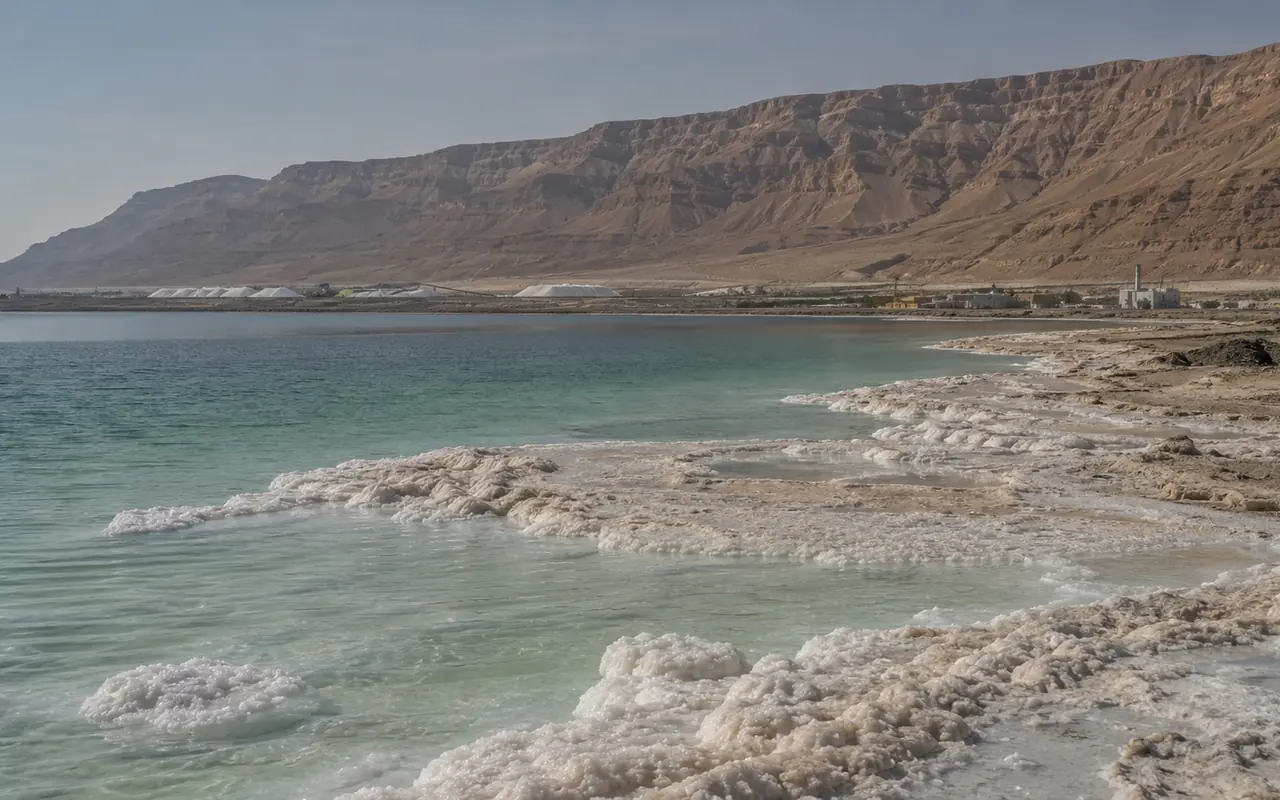
The Dead Sea is the most bromine-rich body of water on Earth. Israel's ICL Group extracts it at the world's lowest cost and is estimated to hold roughly 35–40% of global bromine supply (there is no settled figure for its precise market share; estimates vary between company-level and country-level accounting). Israel and Jordan together account for roughly two-thirds of global bromine production, and both countries sit right next to the conflict zone [5][6].
“The Dead Sea and Doha: The Third Nerve Running Through Taiwan's Chips” reports that Israel and Jordan Together Hold About Two-Thirds of the World's Bromine(66%)。 The Dead Sea is Earth's most bromine-rich body of water; bromine is the feedstock for HBr etching gas [5][6]。
Bromine is the feedstock for manufacturing semiconductor-grade hydrogen bromide (HBr) etching gas. When HBr etches polysilicon, it achieves an extremely high selectivity of silicon over oxide and photoresist (up to 100:1), making it a critical etching gas for both logic gate and memory processes [5][3].
Here it's essential to be honest and layer the risk properly, rather than overstating Taiwan's exposure:
- The acute risk of an HBr supply cutoff sits mainly with South Korean memory makers (DRAM/NAND). South Korea's bromine imports from Israel are put at roughly 90% by one account [19], and as high as 97.5% by another (the figures rest on different bases) [5][17].
- Taiwan runs mainly on logic processes; HBr is used in gate etching, an exposure that is direct but does not stop the entire line.
- What Taiwan actually needs to watch is the indirect bill: DRAM and HBM prices jumped sharply in the first quarter of 2026 (the Counterpoint Memory Price Tracker estimates roughly 80–90% higher than the prior quarter; medium confidence); and HBM is exactly the critical material behind Taiwan's AI packaging (CoWoS) — when South Korean memory supply is disrupted, it passes down the chain into the cost and lead time of Taiwan's AI chips.
“The Dead Sea and Doha: The Third Nerve Running Through Taiwan's Chips” reports that Memory Supply Disruption Feeds Back Downstream: DRAM/HBM Prices Jump in a Single Quarter(+90%)。 Roughly 80–90% higher in 2026 Q1 versus the prior quarter (Counterpoint Memory Price Tracker; medium confidence); the increase passes down the chain to Taiwan's AI packaging。
On this Dead Sea nerve, Taiwan isn't being gripped by the throat directly — it's having its bill quietly raised indirectly.
The Lesson of 2022: A Cutoff Doesn't Equal a Stoppage — Except Helium May Be the Exception
Could this be another case of crying wolf? The question deserves to be taken seriously.
When the Russia-Ukraine war broke out in 2022, Ukraine supplied roughly 50% of the world's neon (a legacy of the Soviet steel industry; estimates vary widely with the accounting used, ranging from 40% to 80% depending on whether only semiconductor-grade purity is counted) [2][10][9], and media at the time predicted a semiconductor "production catastrophe." It never happened — the industry resolved it with three moves: diversifying sources (firms such as ASML reportedly reduced their reliance on Russian and Ukrainian neon), cutting usage (excimer lasers reduced neon use by 25–70% [11]), and recycling and purification (semiconductor manufacturers recycled and reused neon). Taiwan's chip fabs, in fact, had already begun diversifying rare gas sources even earlier, starting from Russia's 2014 annexation of Crimea [9].
This is Red Team East's reminder: don't write this up as doomsday and repeat the overprediction mistake of 2022.
But Red Team West's counterpunch also holds up: helium and neon are fundamentally different. Neon can be recycled, used in smaller quantities, and partially substituted with other inert gases; helium cannot — it has no chemical substitute, a short shelf life, and limited recyclability. Qatar's share is even more concentrated in a single geography than Ukrainian neon was, and it's bottlenecked through the single chokepoint of Hormuz. The successful playbook from 2022 cannot save helium in 2026.
Where the two sides overlap is an honest conclusion: what's actually happening right now is "price hikes, longer lead times, and rationing"; a full line stoppage is a tail risk (low-to-medium confidence, depending on how long a Hormuz disruption lasts). Writing a tail risk up as a foregone conclusion is dishonest; but ignoring strategic reserves just because it's a tail risk is a dereliction of duty too.
Bromine Is More Manageable Than Helium — It Has a Backup Plan
The good news is that bromine has more geographic alternatives than helium. Beyond the Dead Sea, the world's main bromine-producing regions also include Arkansas in the United States (the Smackover Formation brine) and China [1]. Arkansas has supplied the entire United States with bromine since 2007 [21]; Tetra Technologies is advancing its Evergreen bromine plant project there — its board approved the final investment decision in May 2026, with roughly $220 million in remaining capital expenditure, and the plant is expected to be operational by the end of 2027, with first production in early 2028 [22]. China, meanwhile, is advancing what will be its largest seawater-bromine-extraction project at Caofeidian in Tangshan, targeting annual output of 30,000 tonnes and completion in 2026.
The problem is that this new capacity won't come fully online until 2026–2027, so the short term remains under Middle East influence. And helium — the one with the least substitution flexibility — is precisely Taiwan's most direct exposure. This is also why Taiwan's helium imports from Qatar dropped sharply in 2026 and shifted toward the United States, and why Air Liquide opened new capacity in Taiwan in April 2026 [13][15]: sourcing is already being restructured — whether it can keep pace with Hormuz's on-and-off disruptions is a separate question.
The Real Lesson: Don't Let "Cheap" Decide "Safe"
Laying out these nerves — helium, bromine — side by side reveals a shared structural flaw: over the past few decades, Taiwan's critical materials supply chain grew according to the logic of "lowest cost," not "lowest risk." Buy helium wherever it's cheapest, source bromine wherever it costs least — and so single geographic sources like Qatar and the Dead Sea quietly, unnoticed, became extremely concentrated chokepoints. In calm times, this logic kept Taiwan's chip costs among the lowest in the world and its competitiveness razor-sharp; but the moment a geopolitical chokepoint like Hormuz runs into trouble, every cent saved back then has to be paid back, with interest, in the form of rationing, price hikes, and line-stoppage risk.
This is really the chronic illness of globalized division of labor: when the market only rewards "cheaper," nobody pays for "safer" until a cutoff actually happens. A material like helium — normally cheap, yet irreplaceable once it's gone — is a textbook victim of exactly this kind of market failure: it's too unremarkable, too cheap, for anyone to want to spend money stockpiling it or building a backup, so fragility keeps quietly accumulating until the day it becomes irreversible. Helium's 35–48-day shelf life, several months of inventory, and zero strategic reserve are all, at their core, the fragility left behind by "cost first." Fixing it requires first admitting something: the supply security of certain materials cannot be left entirely to market pricing — it has to be governed by the state as a strategic matter. This is the very same wall that "Eleven Days" ran into discussing electricity, and that "Hormuz Shock, Taiwan's Other Bill" ran into discussing oil and gas.
The Third Nerve Is Really the Same Question
Put Qatar's helium, the Dead Sea's bromine, and Ukraine's neon side by side, and connect them to the natural gas behind electricity and the oil behind the Middle East — and you'll find they're really different facets of "the same question": Taiwan is an island that pulls in the world's most critical materials, energy, and gases, processes them, and ships them back out — and almost every one of these inputs rests on a very short number of days, a very distant geography, or a very narrow chokepoint. The height of the sacred mountain is built on top of these thin, elongated supply lines; the thinner the supply line, the more carefully the mountain needs to be guarded.
So what this third nerve is really telling Taiwan isn't as simple as "stockpile a bit more helium." It's asking a more fundamental question: as Taiwan forges itself into the world's indispensable chip hub, has it also inventoried, built backups for, and negotiated every supply line that supports that hub, treating each one as a matter of national security? Raising the security of "materials" to the same strategic altitude as "electricity" and "the military" — that is the real lesson the Dead Sea and Doha are trying to teach Taiwan.
Three Positions: Holding the Chip Industry's Third Nerve
For the state: govern helium as "another Eleven Days." But helium can't just be "stockpiled" (its shelf life is only 35–48 days) — it needs a combined approach of diversified sourcing, long-term contracts locking in volume, local production capacity, and recycling; TSIA's strategic-reserve proposal deserves a serious evaluation of its technical feasibility and cost. For bromine/HBr, push for diversified procurement backups in places like Arkansas and China, to reduce reliance on any single Middle East source.
For the semiconductor industry: helium recycling and purification (TSMC's neon experience can be replicated) and use-reduction are the most pragmatic short-term fixes. A memory supply cutoff will feed back into AI packaging costs, so the advanced-packaging supply chain needs to build HBM/DRAM price and lead-time volatility into its hedging and inventory strategy.
For SMEs: PCB, passive-component, and downstream assembly firms need to recalculate the cost pass-through of bromine-based flame retardants and memory price hikes; heavy gas users (specialty and industrial gas distributors) need to re-examine their share of Middle East sourcing, inventory their days of stock on hand, and rehearse scheduling and customer communication in advance for a "rationing" scenario.
A chip's fragility often lies not in its most advanced lithography step, but in the most unremarkable breath of gas behind it. The Dead Sea and Doha — two Middle Eastern place names that have nothing to do with chips on the surface — are a reminder to Taiwan: part of the sacred mountain's lifeline is stitched together with an invisible gas, and that gas passes through a strait that could close at any moment. Holding onto it is homework this island cannot skip, no less than holding onto its power supply or its coastal defenses.
Sources
- USGS — Mineral Commodity Summaries 2025: Bromine
- USITC — Ukraine, Neon, and Semiconductors
- U.S. Patent US5007982A — Reactive ion etching of silicon with hydrogen bromide
- Tetra Technologies / PRNewswire (2026) — Board of Directors Approves Final Investment Decision for Arkansas Bromine Production Facility
- Fortune (2026-03-21) — Iran war cuts off helium from Qatar, threatening chip supply chains
- War on the Rocks (2026) — The Bromine Chokepoint
- The Diplomat (2026-04) — The Gas Inside Your AI Chip
- Nikkei Asia (2026) — Taiwan chip industry calls for helium, LNG reserves amid Iran war risks
- The Oregon Group — Helium crisis puts US in control of semiconductor supply chain
- AmCham Taiwan Business Topics (2022-11) — Will the War in Ukraine Impact Noble Gas Supplies?
- CNBC (2022-03-25) — Russia-Ukraine war: Laser neon shortage threatens semiconductor industry
- SPIE Photonics Focus (2023) — Supplying noble gases for photonics in war-time
- Digitimes (2026-03-29) — 2026 Global Helium Supply Crisis
- Logistics Viewpoints (2026-04-13) — Taiwan's Helium Imports Shift to the U.S.
- Tom's Hardware — Taiwanese chip makers call on government to stockpile helium, LNG (TSIA)
- Tom's Hardware (2026-04) — Air Liquide opens Taiwan factory as helium shortage tightens
- TVBS News English — Taiwan's chip sector calls for strategic helium stockpiles
- TrendForce (2026-03-09) — Middle East Energy Turmoil Raises Chip Risks, Spotlight on Bromine for DRAM
- semiconductorsinsight (2026) — Iran War Semiconductor Impact 2026: Helium, Memory, and TSMC at Risk
- Beyond News Report — Geopolitical Crisis Ignites Bromine Shortage
- J2 Sourcing — The Global Helium Crisis: Semiconductor Manufacturing and Electronic Components
- Wikipedia — Bromine production in the United States (citing USGS)
Taiwan's Two Faces
The whole world depends on Taiwan's chips — and is quietly preparing for the day it might lose them. The same island is both the heart of the supply chain and a geopolitical powder keg. How can Taiwan's companies turn "irreplaceable" into an advantage that lasts?
Japan Takes Economic Security Overseas: Can OESA Bring Taiwan's Supply Chains Into State-Level Financing?
Japan has created OESA, extending policy finance to overseas projects that matter for economic security but are hard for existing tools to carry. Taiwan has an opening, but the law taking effect is not the same as Taiwan already being on the list — the real threshold lies in Japan's own interests, project design, and implementing rules that have yet to be published.