
Coast Guard Lawfare: How Beijing Is Rewriting the Rules of the Taiwan Strait With White Hulls
Since 2021, China's coast guard ships have carried a legal authorization to open fire. Their presence in waters around Taiwan keeps climbing — not to fight a war, but to use legal ambiguity to rewrite the Taiwan Strait's rules of navigation, one incident at a time, so that Taiwan's sovereignty claims look unsustainable long before any formal conflict begins.
Article contents01 / 06
- After China's Coast Guard Law took effect in 2021, it authorized coast guard ships to board, seize, and even use weapons against foreign vessels within waters Beijing calls its own 'jurisdictional waters,' giving this lawfare a domestic legal foundation.
- The frequency with which Taiwanese fishing boats have been driven off or seized by Chinese coast guard ships in the South China Sea, the East China Sea, and waters around Taiwan's main island has risen markedly since 2021, with some incidents occurring in waters traditionally under Taiwan's jurisdiction.
- The operating pattern of China's coast guard ships is a textbook case of gray zone tactics: the intensity of each action stays below the threshold that would trigger a military response, but the cumulative effect is creating a new de facto order.
“Coast Guard Lawfare: How Beijing Is Rewriting the Rules of the Taiwan Strait With White Hulls” reports that China Coast Guard "Routinized Law-Enforcement Patrol" Sorties in the Kinmen-Xiamen Waters (by Year)(117 sorties)。 The Fujian Coast Guard announced the launch of routinized law-enforcement patrols in the Kinmen-Xiamen waters on February 18, 2024; by May 28, 2026, sorties had reached a cumulative 117: 52 in 2024, 46 in 2025, and 19 from January through May 2026. Source: Coast Guard Administration data, as reported by Liberty Times [11]。
In July 2024, the Penghu-registered fishing boat Dajinman No. 88 was boarded and seized by two Chinese coast guard vessels while operating in waters off Kinmen and towed to Fujian; Taiwan's Coast Guard Administration moved to intervene but broke off pursuit to avoid escalating the confrontation. The boat's six crew members were not released, along with the vessel itself, until they paid the fine in full that November. Beijing's account was that it had "crossed the line to fish illegally"; Taipei's account was that it had been "operating normally in its own jurisdictional waters."
This divergence is not simply a matter of differing political positions — it reflects a deeper question: in the waters around Taiwan, whose rules actually count?
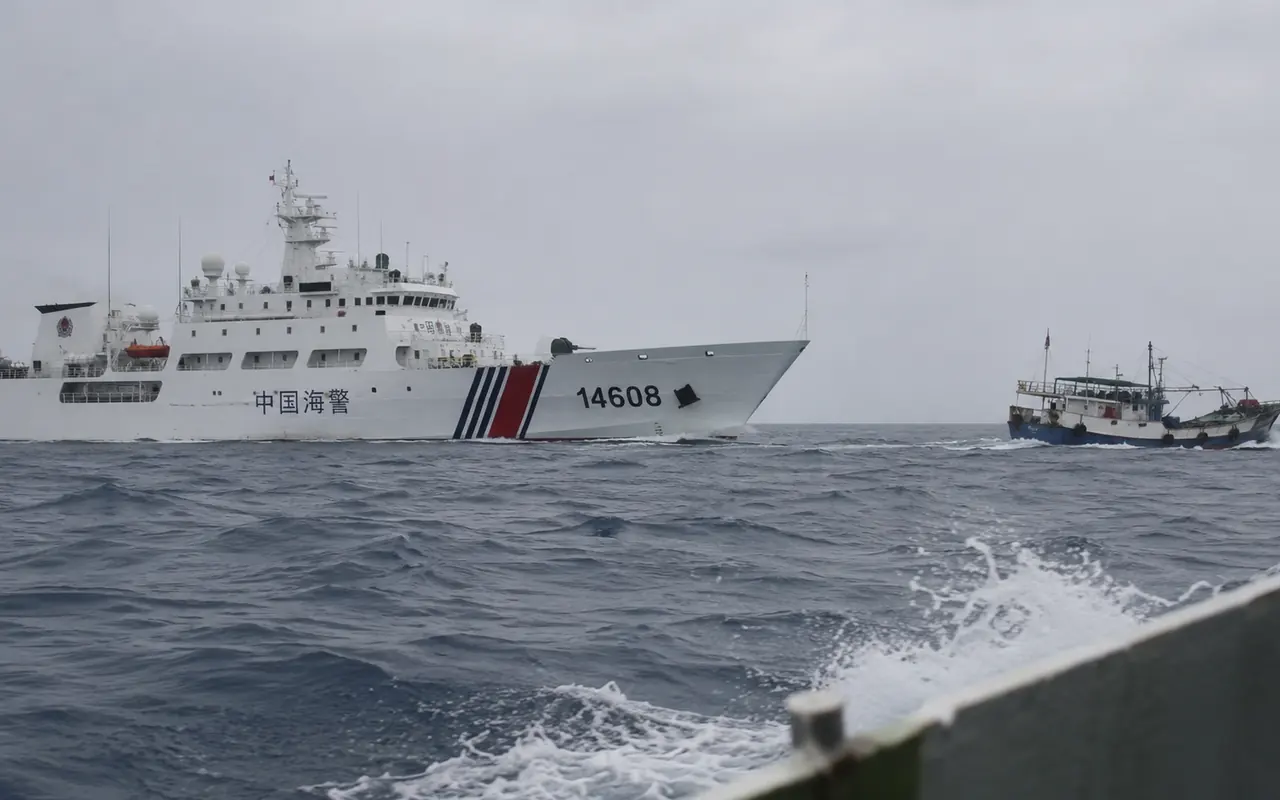
That is precisely the core logic of Beijing's lawfare: not missiles, but legal documents; not seizing territory outright, but first rewriting the definition of jurisdiction. Coast guard ships with white hulls and black lettering are the front line of this strategy.
“Coast Guard Lawfare: How Beijing Is Rewriting the Rules of the Taiwan Strait With White Hulls” reports that China Coast Guard "Routinized Law-Enforcement Patrol" Sorties in the Kinmen-Xiamen Waters (by Year)(117 sorties)。 The Fujian Coast Guard announced the launch of routinized law-enforcement patrols in the Kinmen-Xiamen waters on February 18, 2024; by May 28, 2026, sorties had reached a cumulative 117: 52 in 2024, 46 in 2025, and 19 from January through May 2026. Source: Coast Guard Administration data, as reported by Liberty Times [11]。
The Coast Guard Law: Legislation That Pulled the Bolt Off the Door
On February 1, 2021, China's Coast Guard Law formally took effect. It is a legal document of eleven chapters and eighty-four articles, running to roughly 9,000 characters, yet it put neighboring countries and international observers on high alert.
The two most critical provisions:
Article 21: Coast guard agencies may take necessary measures of vigilance and control, forcible expulsion, or forcible towing against foreign military vessels and foreign government vessels used for non-commercial purposes that violate Chinese laws and regulations.
Article 20: Where foreign organizations or individuals build structures or installations, or lay fixed or floating devices, in waters or on islands and reefs China claims jurisdiction over without authorization, coast guard agencies may "order a halt to the work, or forcibly demolish" it.
Articles 17 and 18: Coast guard agencies may detain and forcibly expel foreign vessels that illegally enter the territorial sea, and may board and inspect vessels that navigate, anchor, or operate within waters China claims jurisdiction over.
More central still: Articles 47 and 48 separately authorize coast guard ships to use hand-held weapons and shipborne or airborne weapons, while Article 22 adds a catch-all authorization to take "all necessary measures, including the use of weapons" — together giving coast guard ships a legal basis for using weapons under specific circumstances. [5]
The problem is that the definition of "waters China claims jurisdiction over" overlaps extensively with the claims of other countries — Taiwan, Japan, the Philippines, Vietnam — and the Coast Guard Law itself offers no explanation whatsoever for this contradiction. This legislative strategy is deliberate: it wraps "what I say goes" in the form of law, then uses action to fill in the blanks the wording leaves behind.
Teodoro Locsin Jr., then the Philippines' foreign secretary, said the law was tantamount to "a verbal threat of war" against any state that resisted it; the foreign ministries of the United States and Japan likewise voiced concern. Then, after Chinese coast guard personnel forcibly boarded a Philippine vessel at Second Thomas Shoal in June 2024, General Romeo Brawner Jr., the Armed Forces of the Philippines' chief of staff, went further, saying the coast guard's conduct was something "only pirates" would do. But criticism has stayed just criticism, while China's coast guard ships have already begun acting on this law. [6]
Gray Zone in the Taiwan Strait: The White-Hull Strategy
From the South China Sea to the Taiwan Strait, the actions of China's coast guard ships follow an observable pattern that military analysts usually call "gray zone tactics": the intensity of each action is systematically kept below the threshold that would trigger a military response from the other side, yet is still enough to accumulate real effects on the ground.
Around Taiwan, this tactic takes several concrete forms:
Approaching and shadowing fishing boats. Coast guard ships close in on Taiwanese fishing boats, record their positions, and sometimes demand to inspect their catch and permits, declaring that the boats are "operating illegally in waters under Chinese jurisdiction." The process does not necessarily involve force, but it already establishes a de facto claim to law-enforcement jurisdiction.
Driving fishing boats off their grounds. Using radio broadcasts or by closing distance, they force Taiwanese fishing boats to leave the waters where they are working. Boats that are driven off often dare not report the incident, for fear of causing bigger trouble — this creates a "silence bias" that makes official statistics undercount the real number of incidents.
Carrying out "routinized patrols" around Taiwan's outlying islands. Chinese coast guard ships have appeared with increasing frequency near Kinmen, Matsu, Dongyin, and other outlying islands. Starting on February 18, 2024, the Fujian Coast Guard announced the launch of "routinized law-enforcement patrols" in the Kinmen-Xiamen waters, reaching a cumulative 117 sorties by May 2026 — pushing the jurisdictional claim from an operational tactic toward an administrative definition. [11]
Shifting into a blockade posture during joint military exercises. When the PLA conducts military exercises, coast guard ships appear around Taiwan at the same time, forming a "military-police coordination" blockade posture. In the first phase of the exercises encircling Taiwan in April 2023, it was actually the Fujian Maritime Safety Administration — not the coast guard — that carried out patrols in the central and northern Taiwan Strait; large-scale coast guard participation in exercises encircling Taiwan is documented only from 2024 onward, in the "Joint Sword" series — Joint Sword-2024B alone deployed seventeen coast guard ships for the first full circumnavigation of Taiwan.
The subtlety in this strategy's design is this: each individual incident is "not big enough" on its own, making it hard for Taiwan to find an appropriate response — report it to the media? Escalate? Or handle it quietly? This "awkward middle ground" is exactly what Beijing wants to create.
The Taiwan Coast Guard's Dilemma
Taiwan has its own Coast Guard Administration, equipped with coast guard vessels rather than warships. This arrangement itself reflects Taiwan's dilemma: responding to a coast guard ship with a warship would raise the level of military confrontation; responding with a coast guard vessel usually leaves Taiwan at a disadvantage in tonnage and equipment, and its legal authorization is also not clear enough.
The Coast Guard Administration's main large vessels fall in the 1,000-to-4,000-ton class (the 4,000-ton-class Chiayi-class patrol and rescue cutters displace about 5,000 tons fully loaded), while China's newest coast guard cutters — such as the Haijing 2901 — exceed 10,000 tons, comparable to a 10,000-ton-class cruiser and the largest armed coast guard ship in the world, though flying a coast guard flag. [8] This "tonnage asymmetry" leaves Taiwan's coast guard at a structural disadvantage in actual standoffs at sea.
More critical still is legal authorization. Taiwan's Coast Guard Act and the Organization Act of the Ocean Affairs Council's Coast Guard Administration are relatively vague on "what can be done in the gray zone" — boarding an illegal foreign fishing boat is one thing, but what can be done about "a coast guard ship claiming to enforce Chinese law"? There is no clear provision for that.
The key legal gap: Taiwan currently lacks a complete "legal framework for maintaining maritime claims" that clearly defines the extent of the waters it claims jurisdiction over, what legal measures it can take against intruding foreign law-enforcement vessels, and the procedures for coordinating with military force. Filling this gap is, in itself, a defensive measure in this legal war.
Lessons From the South China Sea: How the Philippines Has Responded
The Philippines faces almost the exact same challenge in the South China Sea, and its response strategy over the past few years offers lessons Taiwan can draw on.
Move one: film it, and put it out. Since 2023, the Philippine Coast Guard has systematically video-recorded every instance of interference by Chinese coast guard ships and proactively released the footage. This practice has brought gray zone incidents that once existed only in diplomatic cables into the view of global media, generating international public pressure that Beijing has found hard to digest. [9]
Move two: find a legal ally. The Philippines already won a favorable ruling from an arbitral tribunal back in 2016 (the "South China Sea Arbitration"). Although China refuses to recognize it, the ruling gives the Philippines' maritime claims a foundation in international law, letting the Philippines take the position, in every incident, that "I am in waters international law recognizes as mine."
Move three: bring in allied witnesses. The Philippines has begun inviting coast guard ships or warships from the United States, Japan, and Australia to take part in joint patrols, so that every act of interference by a Chinese coast guard ship has allied witnesses present. This has substantially raised the cost of China's actions. [10]
Taiwan has room to improve on all three fronts, but "bringing in allied witnesses" is the hardest — Taiwan's particular diplomatic position makes it difficult to conduct this kind of joint patrol in an open, formal manner.
Fishermen: The Direct Victims of This Legal War
Beyond the analytical framework, it is Taiwan's fishermen who directly bear the impact of this coast guard lawfare.
Fishermen in southwestern Taiwan have long fished in traditional grounds — the South China Sea, and waters west of the median line of the Taiwan Strait — where an informal but understood practice of use developed over the past four decades. The appearance of Chinese coast guard ships has broken this practice, forcing fishermen to choose: keep operating in the traditional grounds at their own risk, or retreat to safer waters closer to Taiwan's coast that yield a smaller catch. [3]
This "shrinking fishing grounds" effect is hard to quantify in official data, but it is a widely recognized reality within Taiwan's fishing communities. Its significance is not just a matter of fishermen's livelihoods — it is also a lived, popular sense of eroding sovereignty: Taiwanese people directly feeling that "a stretch of sea I used to be able to go to, I can't go to anymore."
Accumulated over time, this popular sense of loss is itself one of the effects of cognitive warfare.
Taiwan's Countermeasures
Facing this coast guard lawfare, Taiwan has several feasible layers of strategy:
Legal: strengthen documentation of Taiwan's own maritime legal claims, clearly defining the waters Taiwan claims jurisdiction over and their legal basis; amend the Coast Guard Act to fill the authorization gap in the gray zone; and build a systematic mechanism for recording and publicizing incidents, following the Philippines' "transparency offensive."
Capability: increase the tonnage and technical equipment of the Coast Guard Administration's vessels to narrow the tonnage gap with Chinese coast guard ships; build coordinated response procedures among the coast guard, navy, and air force; and strengthen intelligence-sharing mechanisms with the United States and Japan, so that Taiwan is no longer the only one tracking the movements of Chinese coast guard ships around it.
Diplomatic: wherever diplomatic contact allows, put the coast guard ship issue on the agenda of Taiwan-U.S. and Taiwan-Japan dialogues; and support the Philippines' and Vietnam's countermeasures against China's lawfare in the South China Sea, forming a joint front.
“Coast Guard Lawfare: How Beijing Is Rewriting the Rules of the Taiwan Strait With White Hulls” reports that China Coast Guard "Routinized Law-Enforcement Patrol" Sorties in the Kinmen-Xiamen Waters (by Year)(117 sorties)。 The Fujian Coast Guard announced the launch of routinized law-enforcement patrols in the Kinmen-Xiamen waters on February 18, 2024; by May 28, 2026, sorties had reached a cumulative 117: 52 in 2024, 46 in 2025, and 19 from January through May 2026. Source: Coast Guard Administration data, as reported by Liberty Times [11]。
At its core, lawfare is a war over definitions — whoever's definition comes to dominate in reality wins in a legal sense. Taiwan cannot let this war be waged in silence.
Sources
- Ocean Affairs Council, Coast Guard Administration — Explanation of Chinese coast guard incursions into waters around Taiwan
- Ministry of Foreign Affairs, Republic of China (Taiwan) — Statements and responses
- Fisheries Agency, Ministry of Agriculture, Executive Yuan — Fisheries monitoring operations
- U.S. Indo-Pacific Command — 2025 posture statement
- Full text of the Coast Guard Law of the People's Republic of China — NPC of China website
- Department of Foreign Affairs, Philippines — Statement on China's new coast guard regulations
- CSIS — "Signals in the Swarm: The Data Behind China's Maritime Gray Zone Campaign Near Taiwan"
- China's 10,000-ton-class Zhaotou-class cutter — Haijing 2901 / 5901
- Foreign Service Institute, Philippines — "Breaking Waves": record of incidents at sea
- U.S. Department of State — Joint statement on the Philippines-United States Bilateral Strategic Dialogue, including the Balikatan exercise
- Liberty Times — Statistics on China Coast Guard "Routinized Law-Enforcement Patrols" in the Kinmen-Xiamen Waters: 117 Sorties (Coast Guard Administration data)

September 11: The Loophole Clock Starts Ticking — How the EU CRA's 24/72-Hour Rule Rewrites Taiwan's Hardware Exports
The reporting obligations of the EU's Cyber Resilience Act take effect early, on September 11, 2026. They do not require every vulnerability to be disclosed within a day — they require the legal manufacturer of a product to issue a 24-hour early warning, a 72-hour notification, and a follow-up final report once it becomes aware of an actively exploited vulnerability or a severe security incident. The real impact on Taiwan is that brand owners will push that statutory clock backward onto their ODMs, component suppliers, and software supply chains.

Viral Data Goes In — Do Vaccines Come Out? Taiwan's Gap in the PABS Negotiations
The WHO Pandemic Agreement was adopted by the World Health Assembly in 2025, but its core annex on pathogen access and benefit-sharing is still under negotiation; the seventh round did not conclude, and the eighth round is set for September. Taiwan's real risk is not whether it can upload a sequence — it is that there is no single, publicly verifiable, end-to-end pathway linking data contribution, notification of use, manufacturer contracts, and actual access to vaccines and diagnostics.