
The Chip Chokehold
Washington has tightened the valve on AI chips to China again, and the market's first instinct is 'America squeezes China, orders shift to Taiwan, Taiwanese firms cash in.' But lay Taiwan's semiconductor industry flat, and it's actually standing on both ends of the scale at once: advanced-process makers get lifted higher and richer by the controls, while mature-process makers get eaten away by Chinese domestic substitution and price wars. The same blade, cutting different floors of the same industry, produces opposite results. And what actually decides the long-term outcome is a timeline that hasn't happened yet.
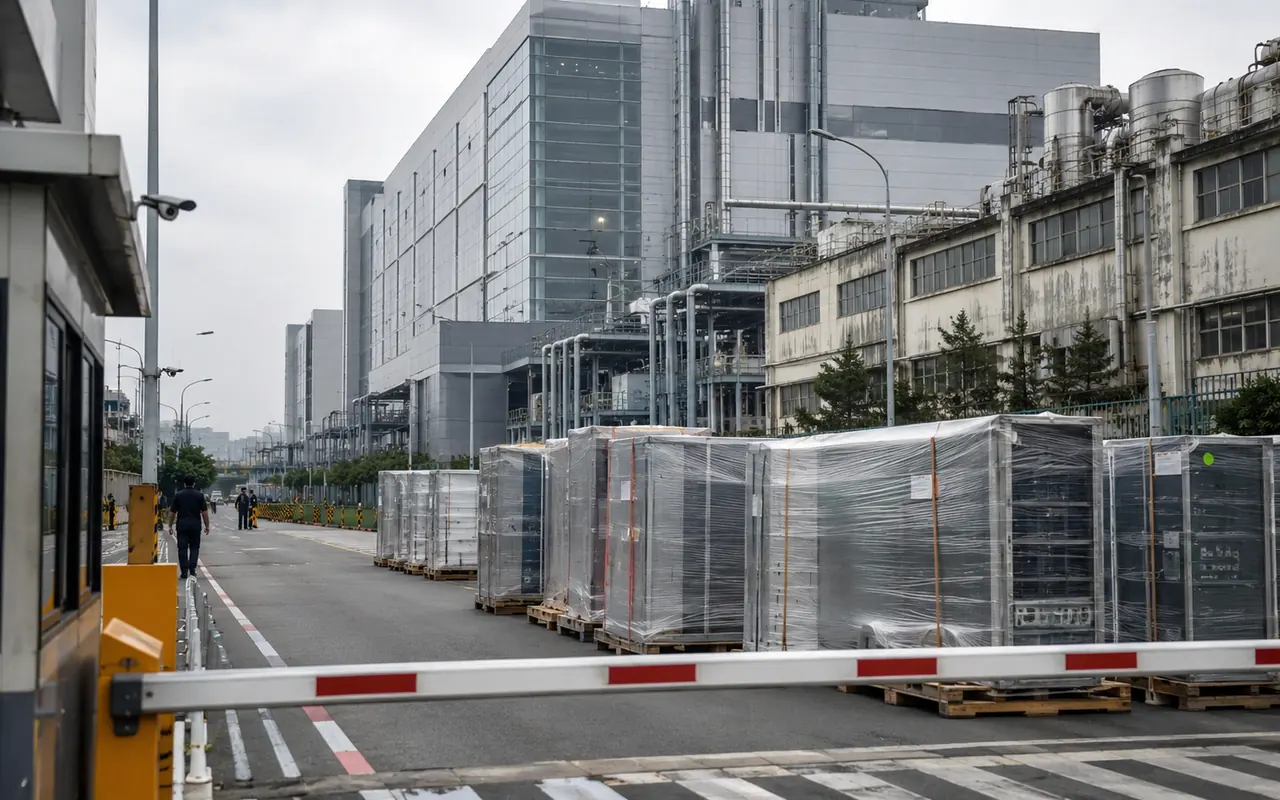
Article contents01 / 09
- 'Taiwanese firms win across the board' is too easy a conclusion: lay the industry flat and it's at least three layers — advanced process (HBM/AI accelerators), mature process (28nm-plus/packaging and testing), and supply-chain cost structure — and the same blade of controls cuts opposite ways on different layers.
- Advanced process's moat gets lifted higher by the controls (scarcer, more pricing power) = upside; mature process faces Chinese domestic substitution and price wars = downside: SMIC has slashed its 28nm wafer quote from about $2,500 to $1,500 (versus TSMC/UMC's current $3,000–4,000 range), and China's mature-process capacity share is set to rise from 29% to 33% by 2027; but 2026 saw a one-off reversal (Nexchip raised prices 10%), showing the price war isn't one-directional.
- The real swing factor is 'timing': whether the long-term picture is upside or downside hinges entirely on how fast China's advanced process can self-supply at scale — the evidence over the next 1–3 years does not support that happening, and the further out you look, the less certain it gets. Short-to-medium term, the net effect leans upside overall, but it is not evenly shared.
“The Chip Chokehold” reports that SMIC Slashes Its 28nm Wafer Quote From About $2,500 to $1,500。 TSMC/UMC currently around $3,000–4,000 — a mature-process price war。
“The Chip Chokehold” reports that China's Mature-Process Capacity Share Set to Reach 33% by 2027 (Estimate)。 Up from 29% — eating into Taiwanese firms' mature-process base [6][10]。
“The Chip Chokehold” reports that Same Industry, Different Floors: Advanced (Upside) / Mature (Downside) / Supply Chain (Cost)(Three Floors)。 The blade cuts in opposite directions — don't lump them together [2]。
“The Chip Chokehold” reports that Advanced Process's Moat Gets Lifted Higher by the Controls(EUV Wall)。 HBM is an officially recognized bottleneck [5]; EUV is likewise a multi-year industry consensus, hard to break in 1–3 years。
“The Chip Chokehold” reports that Mature Process Reverses Course in 2026, Prices Rise (SMIC/Hua Hong at Full Capacity)(+10%)。 The price war isn't one-directional — it has a rhythm [7]。
“The Chip Chokehold” reports that The Long-Term Direction Rests on How Fast China's Advanced Process Can Self-Supply at Scale(The Swing Factor)。 Hard to happen in 1–3 years, and the further out, the less certain [5]。
The market likes a clean story: when Washington tightens the valve on AI chips to China again, the first instinct is "America squeezes China, orders shift to Taiwan, Taiwanese firms cash in." But pull "Taiwan's semiconductor industry" apart, and it's actually standing on both ends of the scale at once — one end lifted higher by the controls, the other end being eaten away by domestic substitution. What decides the long-term outcome is a variable that hasn't happened yet.
"Taiwanese Firms Win Across the Board" Is Too Easy a Conclusion
The market likes a clean story, but this version squeezes three different things into one.
Lay the industry flat, and it's at least three layers: advanced process (the cutting edge, HBM and AI accelerators), mature process (the broad base of 28nm and above, IC design and packaging/testing), and beneath that, the supply-chain and cost structure. The blade of controls cuts these layers differently — and produces opposite results. Upside and downside aren't happening to different companies — they're happening on different floors of the same industry. This is also why Western and European think tanks, when assessing "Chinese mature-process overcapacity," keep stressing that you can't generalize from a single metric — you have to look layer by layer, tool by tool [2].
“The Chip Chokehold” reports that Same Industry, Different Floors: Advanced (Upside) / Mature (Downside) / Supply Chain (Cost)(Three Floors)。 The blade cuts in opposite directions — don't lump them together [2]。
In terms of direction of impact: advanced process (HBM/AI accelerators) is a net upside; mature process (28nm-plus/packaging and testing) leans downside; supply-chain cost (moving to the U.S./risk premium) is a deduction. Sort these three layers out clearly, and you won't be fooled by the phrase "good for the industry."
Why Do You Have to Look Layer by Layer?
Thinking of the semiconductor industry as "one company" is the most common mistake. In fact, "Taiwan's semiconductors" span a huge spectrum — from a few nanometers to a few hundred, from design to fabrication to packaging and testing, from wafers costing tens of thousands of dollars each to ones costing a few hundred. Along this spectrum, different companies and different processes face wildly different situations when confronted with the variable called "China."
Here's an analogy: export controls are like a sudden downpour. For someone living on the top floor selling premium umbrellas (advanced process), the rain is actually good for business — everyone needs his exclusive good umbrella even more. But for someone in the basement selling cheap raincoats (mature process), the water leaking down from upstairs (China's low-price competition) is slowly flooding his shop. The same rain makes one person rich and drowns another. Adding these two groups together and saying "rain is good for the umbrella business" is both inaccurate and likely to lead to bad decisions. That's why judging the fate of Taiwan's semiconductor industry requires looking floor by floor.
The Top Floor: Advanced Process, Where Controls Actually Lift the Moat Higher
Start with the most cutting-edge layer. The logic here is a little counterintuitive: the stricter the controls, the thicker Taiwan's advanced-process moat gets.
The reason is scarcity. When the U.S. still bans Nvidia's top-tier Blackwell-series AI chips from being sold into China (though the next-tier H200 shifted to case-by-case approval for sale in 2026), and continues to ban China from acquiring EUV lithography machines and high-end HBM, the world's places capable of "making the most advanced AI chips" become even more concentrated in TSMC's hands. It isn't Taiwan that gets stuck — it's the rivals trying to route around Taiwan. The EUV that advanced process depends on (supplied globally by ASML alone) and the highest-end EDA software — both of which are the editorial team's synthesis of public industry information — along with HBM high-bandwidth memory [5], are all walls China cannot climb in the short term (see "How Far Has China's Chips Caught Up? Ascend, SMIC, and the Thickness of the Silicon Shield") — and this is exactly what makes Taiwan's advanced process scarcer, and more able to set its own price, under the controls.
“The Chip Chokehold” reports that Advanced Process's Moat Gets Lifted Higher by the Controls(EUV Wall)。 HBM is an officially recognized bottleneck [5]; EUV is likewise a multi-year industry consensus, hard to break in 1–3 years。
The Western Eye red team therefore cautions against overstating the "feeding the tiger" worry: what Taiwanese firms sell into China is mostly compliant, mature-process product; the real cutting edge is being held by the controls, and that held cutting edge is Taiwan's most valuable chip.
Another Room on the Top Floor: Advanced Packaging
Besides "shrinking the transistor" (process scaling), there's another room on this advanced-process floor that matters more and more — "advanced packaging." As Moore's Law slows, cleverly "packaging" together multiple chips and HBM memory has become the key to squeezing more AI compute out of the process, and TSMC's CoWoS technology is the dominant player in this field (see "Silicon Shield in Depth").
The dividend from this room is lifted higher by the controls, just like the rest of advanced process: every AI accelerator maker in the world is scrambling for CoWoS capacity, and that capacity is almost entirely in Taiwan and in short supply. Even if China someday catches up on "process scaling," it will still have to catch up on "advanced packaging" too — and that hurdle adds one more lock to Taiwan's irreplaceability. For Taiwan, holding advanced packaging matters just as much as holding the most advanced process — they are two rooms on the top floor that neither can be given up.
The Basement: Mature Process, Being Eaten Away by a Price War
But in the basement of the same building, the story is exactly the opposite.
28nm is known in the industry as the "eternal node" — cheap enough, good enough, and the base layer for cars, appliances, and industrial equipment. And this is exactly the main battlefield where China is "racing for volume." China's mature-process capacity share is projected to rise from 29% all the way to 33% by 2027 (estimate) [6][10]; more brutal still is price: SMIC has slashed its 28nm wafer quote from about $2,500 all the way down to $1,500 (a quoted/estimated figure, not an apples-to-apples comparison), while TSMC and UMC currently quote 28nm in the range of roughly $3,000 to $4,000 (figures vary by report) — SMIC's $1,500 works out to roughly 30 to 40 percent of the Taiwanese quote.
“The Chip Chokehold” reports that SMIC Slashes Its 28nm Wafer Quote From About $2,500 to $1,500。 TSMC/UMC currently around $3,000–4,000 — a mature-process price war。
“The Chip Chokehold” reports that China's Mature-Process Capacity Share Set to Reach 33% by 2027 (Estimate)。 Up from 29% — eating into Taiwanese firms' mature-process base [6][10]。
This price blade cuts exactly at Taiwan's UMC, Vanguard, and other mature-process makers, as well as the broad base of small and mid-sized packaging/testing and IC-design firms. SMIC has now overtaken UMC and GlobalFoundries to become the world's third-largest foundry; China and Taiwan together hold about 80% of capacity in the 20–45nm range — and the two sides are colliding head-on at this layer. The Eastern Eye red team's warning holds here: the Chinese orders Taiwanese firms are picking up in mature process today may be funding their rival's learning curve; once China clears the bar on self-sufficiency, this layer faces structural share loss.
That said, there's a common misjudgment to correct here too: the price war is not one-directional. In 2026, mature process reversed course for a stretch — China's third-largest foundry, Nexchip, announced a 10% price hike starting in June, and SMIC and Hua Hong also raised prices on some nodes by about 10% while running at full capacity [7]. Behind this is the fact that SMIC and Hua Hong have still been aggressively building new mature-process fabs these past few years, stacking on more capacity [8]. This shows that the script of "China dumps, Taiwanese firms are doomed" is too simplistic; the real mature-process market is a long game with ups and downs, decided by whoever has more staying power.
“The Chip Chokehold” reports that Mature Process Reverses Course in 2026, Prices Rise (SMIC/Hua Hong at Full Capacity)(+10%)。 The price war isn't one-directional — it has a rhythm [7]。
The Real Swing Factor: A Timeline That Hasn't Happened Yet
Put the top floor's upside together with the basement's downside, and you find that the real disagreement between the two red teams isn't actually a clash of values — it's a clash of evidence. What they're arguing about is the answer to the same question: how fast can China build its own advanced process, and at what scale can it mass-produce it?
This is a variable whose facts are not yet settled, and the long-term direction of the conclusion rests almost entirely on it. If China breaks through EUV and HBM within 1 to 3 years and scales up advanced-process mass production, then the Eastern Eye's bet of "short-term upside, long-term downside, Taiwanese firms funding their rival" will come true; if that wall takes longer to fall (which the current evidence tends to suggest), then the Western Eye's judgment that "the advanced moat is solid" holds up.
“The Chip Chokehold” reports that The Long-Term Direction Rests on How Fast China's Advanced Process Can Self-Supply at Scale(The Swing Factor)。 Hard to happen in 1–3 years, and the further out, the less certain [5]。
The current evidence shows: within 1 to 3 years, China's advanced process is unlikely to scale up (see the HBM and EUV bottlenecks in "How Far Has China's Chips Caught Up? Ascend, SMIC, and the Thickness of the Silicon Shield"). So in the short-to-medium term, Taiwan overall leans net upside — but this "upside" comes with two caveats: it is not evenly shared (the upside concentrates among a few advanced-process leaders, while the downside is spread across the broad base of mature-process businesses), and it is not permanently guaranteed (if China's timeline accelerates, the direction flips). Models can be distilled; chips can't. Whether the long-term downside holds isn't decided by how much resolve gets talked about — it's decided by how long that EUV wall stays standing.
The Stricter the Controls, the Thicker the Silicon Shield? — A Conditional Proposition
There's a popular claim: "the stricter U.S. controls on China get, the thicker Taiwan's silicon shield gets." This statement is half right.
The half that's right: controls concentrate the most advanced AI chips in Taiwan and make them more irreplaceable, giving the whole world — especially the U.S. — more reason to protect Taiwan as this sole source of supply. The silicon shield's "irreplaceability" really is getting thicker. But the half that gets overlooked is: controls also force Taiwan to pick a side, build fabs in the U.S., and absorb the revenue losses in server-manufacturing outsourcing and the risk of Chinese retaliation. The silicon shield may be thicker, but the price Taiwan pays for that "thicker" is also higher.
More subtly, when Taiwan itself becomes a regulator (see "The Gate Changes Hands"), it both deepens its binding to the U.S., thickening the silicon shield, and drags itself more deeply into the front line of the U.S.-China tech war. So the proposition "stricter controls, thicker silicon shield" needs a caveat: what gets thicker is "the reason for others to protect Taiwan," but what also gets thicker, at the same time, is "the risk of Taiwan being squeezed between two powers." The shield gets thicker, but the hand holding it also gets heavier.
A Layer That Often Gets Overlooked: IC Design and Distribution
Beyond manufacturing, Taiwan also has a strong IC-design industry (MediaTek and others) and a huge network of chip distributors and traders. The impact of controls on this layer is different again: if an IC designer is designing high-end AI chips, it rides the advanced-process tailwind; if it's designing consumer or automotive mature-process chips, it likewise has to face the rise of Chinese competitors and price competition. Distributors and traders, meanwhile, stand right on the front line of "export-control compliance" — who an order gets sold to, how much compute is involved, whether a license is needed — one misstep can break the law (see the criminalization discussed in "The Gate Changes Hands"). And this compliance line is only going to keep tightening: Washington's Section 301 investigation into China's mature-process chips [9][3] reached an affirmative determination in late 2025 and announced a phased tariff — starting at 0% and rising, in mid-2027, to a rate still to be announced [11][12] — effectively handing the supply chain a "countdown" grace period; this layer, mature process, may not have to just keep taking hits passively forever.
This blade of export controls doesn't only cut across manufacturing's three layers — it cuts all the way down through design, packaging/testing, and distribution as well. For Taiwan's semiconductor ecosystem as a whole, it isn't a single "upside" or "downside" question — it's a complex profit-and-loss map that every link in the chain has to work out for itself.
Taiwan's Three Vantage Points
For the state: lock the upside into the structure — since the upside concentrates in advanced process, protect the supply of equipment, talent, and energy, and don't let "diversifying to the U.S." turn into "hollowing out the sacred mountain" (see "Silicon Shield in Depth"). At the same time, put "the timeline of China's semiconductor self-sufficiency" on the list of national-security-level indicators to track: the moment it accelerates, the industry's whole long-term direction has to be recalculated. There's also a political risk worth watching: a structure where the upside is concentrated and the downside is spread out carries its own political danger. When a handful of advanced-process leaders are raking in profits while the broad base of mature-process businesses struggles through a price war, the overall impression that "semiconductors are hugely profitable" may mask the real difficulties of firms lower down the chain. The state's responsibility is to see the "distribution" hidden behind the average number — and aim resources and policy precisely at the layer that's actually getting hurt, rather than being blinded by the halo of "the sacred mountain makes a fortune."
For industry intermediaries (associations and institutes): provide layered guidance — don't dismiss members with one line about "the industry is doing great." For the advanced-process chain, help with negotiating leverage and capacity expansion; for the mature-process chain, give early warning of the price war and help members pivot toward differentiation (specialty processes, automotive, power devices) and non-China markets. Steer members on different floors toward different survival strategies.
For SMEs: first see clearly which floor you're standing on. Those in the advanced-process chain have a tailwind, but are bound to the leader's pace; those in mature process, or with high exposure to China, should treat "losing share in China" as a known risk and start looking for a second growth curve now — don't wait until the price war floods up to your door.
"America squeezes China, Taiwanese firms cash in" is a reassuring story — and a misleading one; the real world is far more complicated than that slogan. The truth is: the same blade of controls makes Taiwan's top floor more valuable while making its basement bleed. The fate of Taiwan's semiconductor industry cannot be summed up as "upside" or "downside" — it's a profit-and-loss statement that has to be read floor by floor, link by link, with a different number and a different fate written in every cell. And the single most critical cell in that statement is the timeline of China's advanced-process self-sufficiency — that EUV wall, still not knocked down: for as long as it stands, Taiwan's net upside stands with it. What Taiwan can do is not pray that the wall never falls, but use the time while it's still standing to turn today's upside into tomorrow's lead, and to catch the businesses on the downside layer before they fall — because real safety was never "the rival can't catch up." It's "even if the rival catches up, I've already run further ahead."
Sources
- CSIS — Legacy Chip Overcapacity in China: Myth and Reality
- CSIS — Evaluating Chip Overcapacity and the Transatlantic Trade Tool Kit
- Rhodium Group — Thin Ice: US Pathways to Regulating China-Sourced Legacy Chips
- EUISS — Curbing China's Legacy Chip Clout
- Council on Foreign Relations (CFR) — China's AI Chip Deficit: Why Huawei Can't Catch Nvidia and US Export Controls Should Remain
- Tom's Hardware — Analysts warn China's aggressive chip fab expansion could lead to future price war
- TrendForce (2026-03) — China's No.3 Foundry Nexchip to Hike Prices 10% as mature node supply tightens
- Mark Lapedus — TSMC, China Foundries Ramp Up New Fabs For Mature Nodes
- TechSoda — Chip Wars Escalate: Section 301 Investigation on China's Legacy Semiconductors
- TrendForce — China's Share in Mature Process Capacity Predicted to Hit 29% in 2023, Climbing to 33% by 2027
- USTR — Section 301: China's Targeting of the Semiconductor Industry for Dominance
- ThompsonHineSmarTrade — USTR Issues Affirmative Determination in China Semiconductor Section 301 Investigation

Taiwan's Two Faces
The whole world depends on Taiwan's chips — and is quietly preparing for the day it might lose them. The same island is both the heart of the supply chain and a geopolitical powder keg. How can Taiwan's companies turn "irreplaceable" into an advantage that lasts?
Japan Takes Economic Security Overseas: Can OESA Bring Taiwan's Supply Chains Into State-Level Financing?
Japan has created OESA, extending policy finance to overseas projects that matter for economic security but are hard for existing tools to carry. Taiwan has an opening, but the law taking effect is not the same as Taiwan already being on the list — the real threshold lies in Japan's own interests, project design, and implementing rules that have yet to be published.