
Exporting Deflation: When the Neighbor Starts Dumping, How Does Taiwan's Factory Survive?
China has posted 39 straight months of producer-price deflation, dumping its surplus steel, EVs, solar panels, and displays onto the world at rock-bottom prices. For Taiwan, this is a tide that cuts industry in two — AI and semiconductors ride the crest, traditional manufacturing is pushed under. The question is not whether China will collapse, but which half of the tide your factory is standing on.
Article contents01 / 07
- China's PPI has been in deflation for 39 straight months (down 1.9% year-on-year in Dec. 2025, -2.6% for the full year), rooted in a real-estate downturn and weak consumption; surplus steel (about 100 million tonnes), EVs (about 5 million units), and solar (about 400 GW) are being dumped onto the world at low prices, prompting even the EU to fire off a string of anti-dumping and countervailing measures.
- For Taiwan this is a 'two-speed shock,' not a single blanket negative: AI/semiconductors benefit from supply-chain restructuring and a surge in exports to the U.S. (up 78% year-on-year in 2025, with a 30.9% share that overtook China/Hong Kong for the first time); but petrochemicals, steel, standard-grade panels, and central-Taiwan traditional manufacturers are squeezed on three sides — by low-price dumping, by third-country anti-dumping spillover (Japan's proposed duty on Taiwanese stainless steel reaches as high as 20.71%), and by the unilateral suspension of the ECFA early harvest. The winners and the losers are not the same people.
- Laying the genuine dispute side by side: PPI turned positive in March 2026 and reached +3.9% in May, and the IMF revised China's growth forecast up to 5.0%/4.5% (the Eastern Eye: the slowdown is overstated, and anti-involution will reduce dumping); but 39 months of deflation, an unresolved real-estate and demographic structure, and a positive PPI print driven largely by base effects and administrative capacity cuts (the Western Eye: this is structurally hard to reverse, and low-price pressure will persist). Taiwan's pragmatic assumption should lean toward the latter.
“Exporting Deflation: When the Neighbor Starts Dumping, How Does Taiwan's Factory Survive?” reports that China's Producer Prices in Continuous Deflation(39 Months)。 Down 1.9% year-on-year in Dec. 2025, -2.6% for the full year — the longest such streak in decades [19][20]。
“Exporting Deflation: When the Neighbor Starts Dumping, How Does Taiwan's Factory Survive?” reports that Taiwan's Share of Exports to China and Hong Kong(28.3%)。 Down from a 2020 peak of 43.9% [9]。
“Exporting Deflation: When the Neighbor Starts Dumping, How Does Taiwan's Factory Survive?” reports that Exports to the U.S. at 30.9% Overtake China/Hong Kong's 26.6%(First Golden Cross)。 Full-year 2025, the first time in 26 years (Ministry of Finance) [13]。
“Exporting Deflation: When the Neighbor Starts Dumping, How Does Taiwan's Factory Survive?” reports that Number of ECFA Early-Harvest Items Suspended(134+34 Items)。 134 industrial items plus 34 agricultural items; about US$1.8 billion in exports to China, 1.3% of the total [6][8]。
“Exporting Deflation: When the Neighbor Starts Dumping, How Does Taiwan's Factory Survive?” reports that China's Share of Large-Size LCD TV Panel Shipments(approx. 70%)。 Taiwan's two panel giants together hold roughly 20-30%, depending on the measurement basis [11]。
“Exporting Deflation: When the Neighbor Starts Dumping, How Does Taiwan's Factory Survive?” reports that Japan's Proposed Anti-Dumping Duty on Taiwanese Stainless Steel(20.71%)。 Up to 45% for China — Taiwan caught in the crossfire [7]。
“Exporting Deflation: When the Neighbor Starts Dumping, How Does Taiwan's Factory Survive?” reports that Taiwan's 2025 Year-on-Year Export Growth to the U.S.(+78%)。 Driven by AI/semiconductors, reaching US$198.27 billion in exports to the U.S. [10]。
“Exporting Deflation: When the Neighbor Starts Dumping, How Does Taiwan's Factory Survive?” reports that China's PPI Deflation Ends(Turned Positive in Mar. 2026)。 +0.5% in March, +3.9% in May, rising for three straight months [2]。
“Exporting Deflation: When the Neighbor Starts Dumping, How Does Taiwan's Factory Survive?” reports that IMF China Growth Forecast(5.0% / 4.5%)。 For 2025/2026, revised up from the previous forecast [3]。
China's producer price index (PPI) has fallen for 39 consecutive months, and its surplus capacity in steel, EVs, and solar keeps searching for an outlet [1][5]. For Taiwan's traditional manufacturers, the most direct pressure doesn't show up in headlines — it shows up on the quotation sheet: a customer holds up the mainland's price and asks, "Can you match it?" As prices keep sliding, Taiwan's factories are no longer just riding a business cycle; they are locked into a long-term contest of forced price-matching.
This is the basic mechanism of "exporting deflation." When an economy falls into prolonged deflation and has built far too many factories, whatever it cannot sell at home has to find an outlet abroad; surplus capacity flows out along shipping lanes and low-ball quotes to the rest of the world, and Taiwan stands at the front of that tide.
This does not mean "China is about to collapse, and Taiwan is doomed." The more accurate way to put it is: this tide will not drown Taiwan whole — it cuts industry in two. Some are pushed up onto the crest; others are pressed under the water. The question is not whether China will collapse, but which half of the tide your factory is standing on.
The Root Cause: A Machine That Can't Stop
To understand this tide, you first have to look at its source.
China's producer price index (PPI) had, by December 2025, fallen for 39 consecutive months — the longest stretch of deflation in decades [1]. It was down 1.9% year on year in December 2025, and down 2.6% for the full year [19][20]. Consumer prices (CPI) have also been lying flat on the ground for a long stretch, up a mere 0.8% in December 2025 [19]. In short: the more that gets made, the deeper prices fall.
“Exporting Deflation: When the Neighbor Starts Dumping, How Does Taiwan's Factory Survive?” reports that China's Producer Prices in Continuous Deflation(39 Months)。 Down 1.9% year-on-year in Dec. 2025, -2.6% for the full year — the longest such streak in decades [19][20]。
The root cause is no mystery. A prolonged real-estate downturn has squeezed local government finances, and ordinary people, lacking confidence in the future, are reluctant to spend [3]. Demand has shrunk on one side, but on the other, years of every province rushing to build out the same industries has produced staggering overcapacity: roughly 100 million tonnes of surplus steel, about 5 million surplus EVs, and roughly 400 GW of surplus solar capacity [5]. When what you can produce far outstrips what you can sell, the only way to survive is to cut prices, then cut them again — this is what Chinese economists call "involution": everyone works themselves to the bone, and no one makes any money.
The machine can't stop, so the surplus goods have to be dumped abroad. The EU was the first to buckle: it imposed average countervailing duties of 20.8% on Chinese EVs (stacked on the existing 10%, for a total of up to about 45%) [4]; from June 2025 it launched provisional tariffs on Chinese solar modules; in 2024 alone the EU opened 12 new trade-remedy investigations against the chemical industry, twice the number of the year before [16]. In a word: what China exports is not just goods, but deflation itself — studies estimate that in recent years China has pulled down overall CPI in advanced economies by roughly 0.3 to 0.5 percentage points [15].
The First Squeeze: Traditional Industry Pushed Under
This tide hits Taiwan first in traditional industry.
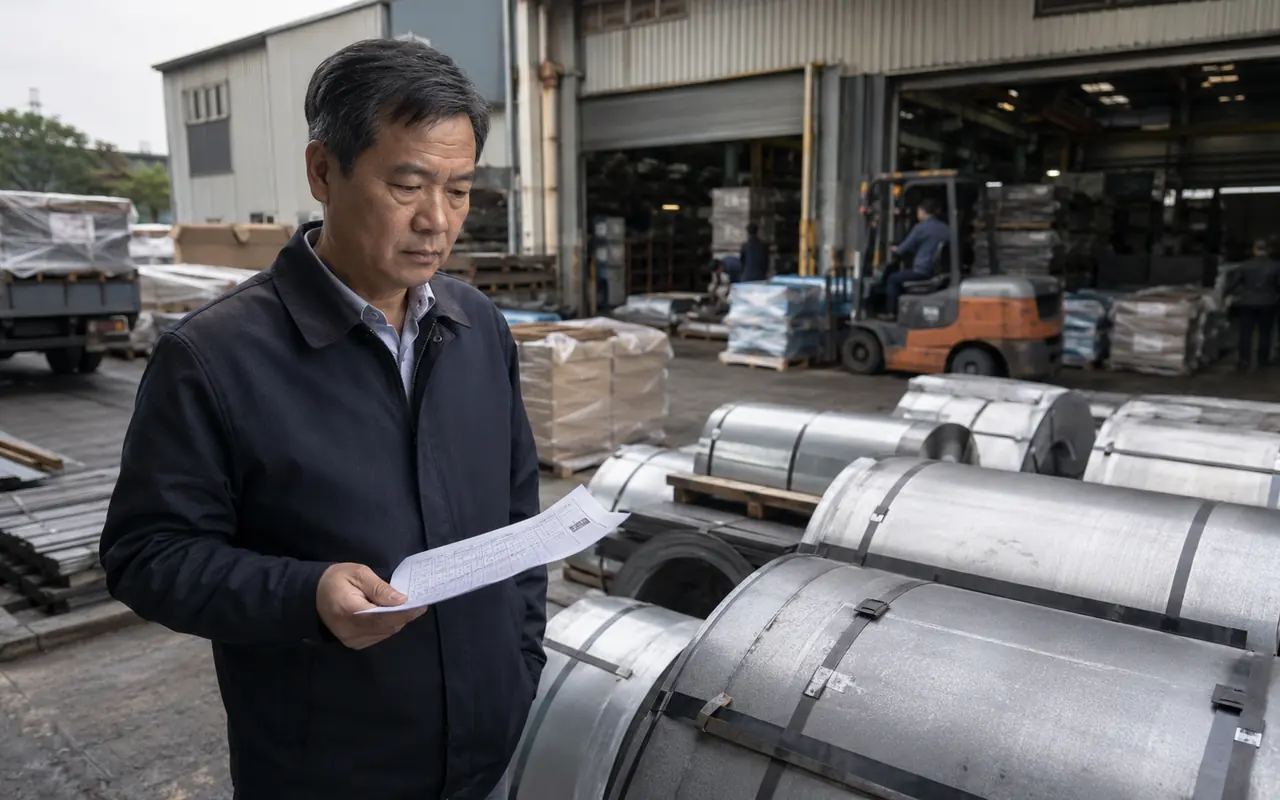
The most direct impact falls on petrochemicals and steel. As mainland Chinese steel and petrochemical feedstocks get dumped below cost, the pricing room for Taiwan's equivalent products keeps getting squeezed. In early 2026, China Steel announced it would cut prices on hot- and cold-rolled products by NT$300 per tonne starting in July, stating in black and white that the reason was "weak market demand and pressure on steel prices" [7]. This is not a problem of Taiwan's own making — it has been dragged into a price war it has no power to set the terms of.
Even more unfair is getting caught in the crossfire — "a fire at the city gate scorches the fish in the moat." When Chinese steel gets dumped cheaply around the world and countries swing the anti-dumping axe, Taiwan often gets cut down along with it. In June 2026, Japan made a preliminary finding that cold-rolled nickel-based stainless steel strip and sheet from both China and Taiwan was being dumped at below-market prices, with anti-dumping duties to take effect as early as July — up to 45% for China, and as high as 20.71% for Taiwan, naming Yieh United Steel and Walsin Lihwa [7]. Taiwan plainly is not the source of the dumping, yet it has to pay this duty all the same — this is exactly the most unreasonable side effect of exported deflation.
“Exporting Deflation: When the Neighbor Starts Dumping, How Does Taiwan's Factory Survive?” reports that Japan's Proposed Anti-Dumping Duty on Taiwanese Stainless Steel(20.71%)。 Up to 45% for China — Taiwan caught in the crossfire [7]。
The Second Contraction: Exports to China and the ECFA Early Harvest
The second transmission channel is the contraction of the China market itself for Taiwan.
The good news is that Taiwan's buffer is actually far thicker than it was five years ago. The share of exports going to China and Hong Kong has slid all the way from its 2020 peak of 43.9% to 28.3% in the first quarter of 2025 [9]. A lower degree of dependence means that when the mainland economy sneezes, Taiwan won't catch as bad a cold as before.
“Exporting Deflation: When the Neighbor Starts Dumping, How Does Taiwan's Factory Survive?” reports that Taiwan's Share of Exports to China and Hong Kong(28.3%)。 Down from a 2020 peak of 43.9% [9]。
More symbolically significant is a "golden cross" in 2025: according to Ministry of Finance statistics, Taiwan's share of exports to the U.S. jumped to 30.9% for full-year 2025, exceeding the 26.6% share going to China and Hong Kong for the first time in 26 years, making the U.S. Taiwan's largest export market [13]. (A note on the figures: the 28.3% cited above is a first-quarter-2025 number, while 26.6% is a full-year number; both are accurate, but they cover different periods.)
“Exporting Deflation: When the Neighbor Starts Dumping, How Does Taiwan's Factory Survive?” reports that Exports to the U.S. at 30.9% Overtake China/Hong Kong's 26.6%(First Golden Cross)。 Full-year 2025, the first time in 26 years (Ministry of Finance) [13]。
But the pain of this contraction is concentrated in specific product lines. Over the past two years, Beijing has unilaterally suspended tariff concessions under the ECFA early-harvest list: it started with 12 tariff lines in Taiwan's petrochemical sector at the end of 2023, expanded in May 2024 to a total of 134 items spanning petrochemicals, textiles, machinery, steel, and metals, and in September 2024 removed duty-free treatment for a further 34 agricultural items [6][8]. The Ministry of Economic Affairs estimates the affected items accounted for about US$1.8 billion in exports to China from January to November 2024, or about 1.3% of exports to China; the Executive Yuan, for its part, has stressed that ECFA accounts for less than 4% of Taiwan's exports and that the overall impact is "very limited" [6].
“Exporting Deflation: When the Neighbor Starts Dumping, How Does Taiwan's Factory Survive?” reports that Number of ECFA Early-Harvest Items Suspended(134+34 Items)。 134 industrial items plus 34 agricultural items; about US$1.8 billion in exports to China, 1.3% of the total [6][8]。
The macro numbers really are limited, but there is a crucial warning hidden here: averages can lie. Petrochemical early-harvest goods sold to the mainland account for about 43% of total exports of petrochemical early-harvest products, representing an annual tariff benefit of US$320–480 million [8]. For a central-Taiwan petrochemical plant heavily dependent on exports to China, that "overall share" of 1.3% offers no comfort whatsoever — what it actually feels is a real, tangible drop in orders.
The Third Erosion: The Red Supply Chain Catches Up
The third chain is the step-by-step advance of the red supply chain in the "mature" segment.
The clearest example is display panels. China's BOE is now one of the world's largest LCD panel makers by shipment volume [11]. China's share of large-size LCD TV panel shipments has climbed to around 70%, with Taiwan's two panel giants together holding roughly 20 to 30%, depending on the measurement basis [11]. In effect, state capital and overcapacity are being used to push the price of standard mature-process products down to a level Taiwanese makers can no longer sustain.
“Exporting Deflation: When the Neighbor Starts Dumping, How Does Taiwan's Factory Survive?” reports that China's Share of Large-Size LCD TV Panel Shipments(approx. 70%)。 Taiwan's two panel giants together hold roughly 20-30%, depending on the measurement basis [11]。
But here, the first glimmer of light appears. Taiwan's two panel giants have not gone head-to-head in a price war; instead, they have pivoted to advanced packaging for the AI era — applying panel-makers' technology to fan-out panel-level packaging (FOPLP) for semiconductors [11]. This offers an important clue: whichever segment stays parked on standard products is always the one the red chain catches up to; a segment that can move toward higher value and toward AI can instead shake off the price war. The same pressure that is crushing some players is forcing others to transform.
The Counter-Wave: Some Are Rising to the Surface
Having said all that, it's necessary to be honest and turn to the other side. For some Taiwanese firms, this tide is not a drowning — it is a lift.
In 2025, Taiwan's total exports surged to US$640.75 billion, up 34.9% year on year and a record high; of that, exports to the U.S. reached US$198.27 billion, up as much as 78% [10]. The pace accelerated further into 2026, with exports to the U.S. reaching a 33.5% share and 98.9% year-on-year growth in the first quarter [14]. The pull is concentrated in two high-tech industries: exports of information/communications and audiovisual products surged 89.5% in 2025, and electronic components grew 25.8% [14].
“Exporting Deflation: When the Neighbor Starts Dumping, How Does Taiwan's Factory Survive?” reports that Taiwan's 2025 Year-on-Year Export Growth to the U.S.(+78%)。 Driven by AI/semiconductors, reaching US$198.27 billion in exports to the U.S. [10]。
The essence of this force is the restructuring of global supply chains under geopolitics — AI orders and "de-China" supply chains are pulling the center of gravity toward Taiwan. The same phenomenon of "China slowing down, the map being redrawn" is a low-price-dumping nightmare for a petrochemical boss, but a feast of full order books for the AI server supply chain.
This is the most important judgment of this piece: this is, in fact, a tide that cuts industry in two. The winners are the TSMC supply chain and AI electronics; those caught in the squeeze are petrochemicals, steel, standard-grade panels, and small and medium-sized traditional manufacturers in central Taiwan. Adding the two together and calling it "Taiwan's net gain" hides the cruelty of the distribution — even as the country celebrates record export highs, a whole row of factories is suffocating beneath the surface.
Seeking the Truth: Is China Headed for a "Structural Collapse"?
So will this tide recede? This is exactly the point where the genuine disagreement in this case should be laid side by side.
The Eastern Eye would say: the West loves to talk China down. Look at the data — China's PPI turned positive in March 2026 (+0.5%), and reached +3.9% in May, rising for three straight months, ending the longest deflationary stretch in decades [2]; the IMF has also revised up its China growth forecast, to 5.0% for 2025 and 4.5% for 2026, citing effective stimulus and tariffs coming in lower than expected [3]. And Beijing's "anti-involution" push is not empty talk: an amendment to the Anti-Unfair Competition Law took effect on October 15, 2025, with Xi Jinping personally singling out provinces for their rush to pile into AI and EVs [17][18]. If Beijing really does shut down surplus capacity, dumping abroad will instead decrease, which would be good news for Taiwan's traditional industry.
[[fig:8]] [[fig:9]]
The Western Eye counters: don't be fooled by the official numbers. The PPI turning positive rests on a base-effect comparison and administrative measures forcibly cutting capacity, not a real return of domestic demand — CPI is still hovering around 1% [19]. The IMF itself also warns that China's medium-term growth will keep slowing because of a shrinking labor force, diminishing returns on investment, and slowing productivity, with the biggest risk being that a deeper real-estate contraction entrenches deflation and deepens reliance on exports [3]. And relying on exports means continuing to dump onto the world. "Anti-involution" will be even harder to implement in practice: local governments, protecting jobs and tax bases, have weak incentives to cut capacity — round after round of solar-sector rectification meetings have been held, and the capacity is still sitting there.
Viewed neutrally: China's deflation is real and is the longest in decades, but there has indeed been a policy-driven upturn since early 2026; whether this amounts to a structural reversal, the evidence so far is insufficient to conclude (under observation; medium confidence). As for the claim that "anti-involution will significantly reduce dumping abroad," that is an inference, with low confidence, and should not be treated as a premise for Taiwan's policy. For Taiwan, the most pragmatic assumption is: low-price pressure will persist over the long run — don't bet on Beijing shutting down factories on your behalf.
Three Stances
The state: don't let the good news of "record export highs" cover up the lower half of the distribution. When the aggregate numbers look great while a whole row of traditional manufacturers is suffocating underwater, the policy priority should not be celebration but targeted support for the weak. It needs to build an anti-dumping early-warning mechanism for petrochemicals, steel, and standard-grade panels caught in the three-way squeeze, and help firms respond early to "crossfire"-style anti-dumping actions from third countries such as Japan; at the same time, it should direct industrial-upgrade resources toward helping traditional manufacturers move from "standard products" toward "higher-value/AI-related" ones. On China, it should pragmatically assume that low-price pressure will persist over the long run, and have trade-remedy tools fully in place rather than hoping Beijing restrains itself.
Industrial intermediaries (trade associations/institutes): you are the ones best placed to translate the "lie of averages." When officials say "the impact is limited," what associations should do is break the macro shares down to the real exposure of their own members — which items have 43% of their sales going to the mainland, which are on a third country's anti-dumping list. Help members with two things: first, coordinate collectively on anti-dumping responses (jointly building evidence, sharing legal costs); second, build a bridge for transformation, replicating the panel giants' path of pivoting to advanced packaging — "escaping the price war" — for more mature industries caught in the squeeze.
SMEs: start by honestly asking yourself one question — "Is what I make a standard product, or something others find hard to replace?" If it's the former, you are standing on the half being pushed under the water, and no amount of effort will let you out-compete rivals engaged in blood-letting dumping. There are only three ways out, and you need to pursue all of them at once: diversify markets (don't put all your eggs in a single basket of either China or the U.S.), move toward higher value (even if it's just a small step of differentiation), and preserve cash flow (to survive the long winter of persistent low-price pressure). Don't wait for policy to come to the rescue — give yourself room to turn around first.
Exported deflation is not a news event that will simply "pass" — it is a tide that will keep coming and going. Taiwan cannot order that machine on the other side of the Strait to stop, but it can decide which half of the water it stands in. Those pushed under should not be drowned out by the cheers over "record export highs"; those riding the crest should not forget that others are struggling in the same sea. A mature economy has never measured itself by how beautiful its averages look, but by how many factories are still standing when the tide goes out — and standing taller than before it came in.
Sources
- IMF — 2025 Article IV Consultation with China (Executive Board concludes, 2026-02-18)
- CNA (Central News Agency) — Ministry of Finance: Taiwan's 2025 Export Share to the U.S. Reaches 30.9%, First Time Surpassing China/Hong Kong (26.6%) in 26 Years
- CNIPA (China National Intellectual Property Administration) — Anti-Unfair Competition Law of the People's Republic of China (2025 Amendment; Article 41 Sets October 15, 2025 as the Effective Date)
- CNA (Central News Agency) — Xi Jinping Rarely Criticizes Provinces for Rushing Into AI and New-Energy Vehicles (2025-07-18)
- National Bureau of Statistics of China — Reading the December 2025 CPI and PPI Data (Dong Lijuan)
- National Bureau of Statistics of China — 2025 CPI Broadly Stable, PPI Recovers from Low Levels (Wang Youjuan)
- CSIS — Slamming the Brakes: The EU Votes to Impose Tariffs on Chinese EVs
- The News Lens — China Announces Suspension of ECFA Tariff Concessions: 12 Products, About 70% of Which Are Sold to China
- Straits Exchange Foundation (SEF) Cross-Strait Economic and Trade Network — Mainland China Studying the Possible Impact of and Response to Suspending ECFA Early-Harvest Preferences
- Atlantic Council — As China's Surpluses Become Unbearable, the EU Is Edging Toward Its Own Section 301
- Economic Daily News (UDN Money) — Strong Demand for ICT/Audiovisual and Electronic Components
- Capital Economics — The Advanced Economy Impact of China's Deflation
- Ashurst — Annual Report on EU Trade Defence: Activities Reach Record High in 2024
- CNBC — China Consumer Inflation Hits Near Two-Year High Despite Deeper-Than-Expected Producer Deflation (2025-12-10)
- Trading Economics — China Producer Prices Change (including the March/May 2026 turn to positive)
- FreightAmigo — China's Overcapacity Challenge: Navigating the Global Supply Chain Landscape 2025
- CTEE (Commercial Times) — Japan's Anti-Dumping Blow Names Two Taiwanese Firms, Top Rate 20.71%
- MacroMicro — Taiwan's Export Share by Country
- TechNews — Taiwan's 2025 Exports Hit US$640.7 Billion, Overtaking Singapore
- Wantrich (China Times) — Samsung Display Joins the Red Supply Chain; Taiwan's Panel Giants AUO and Innolux Face a Tough Fight Ahead (Red Supply Chain's Panel Market Share)

Taiwan's Two Faces
The whole world depends on Taiwan's chips — and is quietly preparing for the day it might lose them. The same island is both the heart of the supply chain and a geopolitical powder keg. How can Taiwan's companies turn "irreplaceable" into an advantage that lasts?
Japan Takes Economic Security Overseas: Can OESA Bring Taiwan's Supply Chains Into State-Level Financing?
Japan has created OESA, extending policy finance to overseas projects that matter for economic security but are hard for existing tools to carry. Taiwan has an opening, but the law taking effect is not the same as Taiwan already being on the list — the real threshold lies in Japan's own interests, project design, and implementing rules that have yet to be published.