
Paid For, Not Delivered: Taiwan's US$19 Billion Arms-Sales Backlog Is a Deterrence Black Hole
Taiwan has already paid out more than US$19 billion in arms-sales deposits — F-16V deliveries keep slipping, the Harpoon Coastal Defense System, though now prioritized, will not be fully delivered until 2028, and the exact quantity of PAC-3 MSE missiles has never been officially disclosed — weapons that exist only on paper deter no one. In the highest-risk window for the Taiwan Strait, Taiwan's core problem is not just chasing deliveries — it is having to redefine its own security logic.
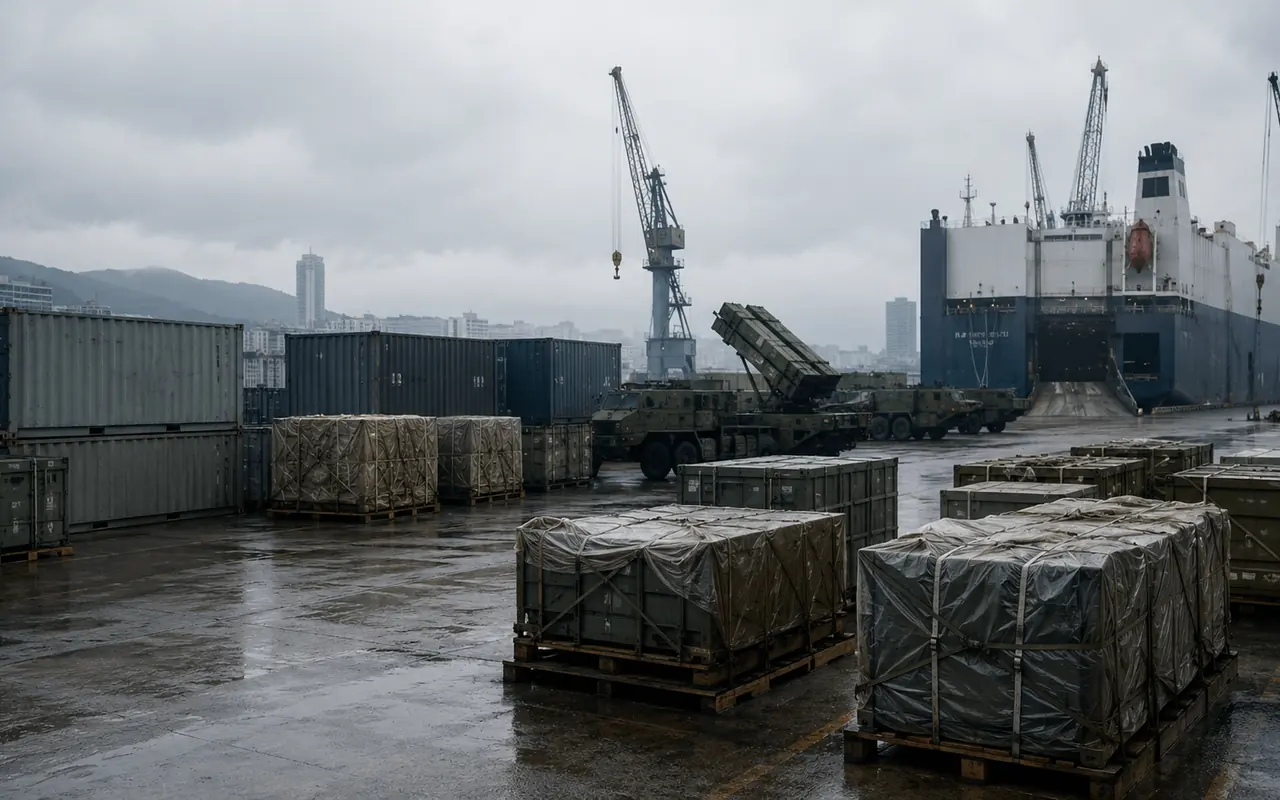
Article contents01 / 04
- By March 2026, Taiwan's arms-sales backlog had climbed from a figure once exceeding US$19 billion to roughly US$31.7 billion — measured against Taiwan's fiscal year 2026 defense budget, that is now equivalent to about a full year of defense spending; delivery has picked up pace in recent years but still runs well behind the pace of approvals (estimate).
- After the war in Ukraine broke out, the United States rushed stockpiles to Ukraine mainly through Presidential Drawdown Authority (PDA) rather than the FMS channel Taiwan uses, but this still crowded out US industry's restocking and new-production scheduling — Taiwan's F-16V, PAC-3 MSE, and other orders have continued to slip, landing squarely inside the highest-risk window for the Taiwan Strait.
- The backlog's roots are not entirely on the American side: Taiwan's own procurement strategy has favored heavy conventional platforms over asymmetric weapons that can be delivered quickly, and its pace of transformation has fallen far behind the rate at which the threat is rising.
“Paid For, Not Delivered: Taiwan's US$19 Billion Arms-Sales Backlog Is a Deterrence Black Hole” reports that Taiwan's US Arms-Sales Backlog vs. Estimated Annual Delivery Rate(US$19 billion)。 Total backlog once exceeded US$19 billion (on a 2022–2024 basis); tracking organizations put the figure at roughly US$31.7 billion by March 2026. The US$1 billion average annual delivery estimate reflects a pre-2024 basis (medium confidence); the actual pace of delivery from 2024–2026 has picked up. Source: CRS [1]; tracking update [5]。
“Paid For, Not Delivered: Taiwan's US$19 Billion Arms-Sales Backlog Is a Deterrence Black Hole” reports that Approved-Value Distribution Across Four Major Arms Deals (US$100M, value at time of approval)(F-16V: US$8.0B)。 Figures reflect each deal's value at the time of approval, not real-time delivery status: F-16V about US$8.0B (still delayed; first aircraft to arrive in Taiwan as early as September 2026 at the earliest); Harpoon HCDS about US$2.4B (first batch delivered mid-2025, prioritized ahead of Saudi Arabia, full order complete by 2028); M1A2T about US$2.0B (all 108 units fully delivered as of April 2026; about US$2.2B combined with a separate Stinger missile case); remaining items (including PAC-3 MSE, quantity never officially disclosed) estimated at about US$6.6B. Source: DSCA notifications [2][3][4]; delivery progress [5][12][13][10]。
In December 2024, after a five-year wait, Taiwan's first batch of M1A2T Abrams main battle tanks arrived at port. Taiwan had ordered 108 of them, but what arrived was only the first batch: there was an order on the books, but the force in the field still did not have the full capability.
This is not just an M1A2T problem. According to estimates from the US Congressional Research Service (CRS) and tracking organizations, Taiwan's backlog of arms sales from the United States once exceeded US$19 billion (on a 2022–2024 basis); by March 2026, tracking organizations put the figure at roughly US$31.7 billion. [1][5] Measured against Taiwan's fiscal year 2026 defense budget (NT$949.5 billion, or about US$31 billion), the backlog is now roughly equivalent to a full year of Taiwan's defense spending; some orders have had deposits paid, some contracts have been signed, but for most of the equipment there is still no firm delivery date. [11]
As the urgency of the Taiwan Strait situation keeps rising in discussions on all sides, and one window frequently cited falls between 2026 and 2028, this backlog problem takes on another, heavier name: a deterrence black hole.
“Paid For, Not Delivered: Taiwan's US$19 Billion Arms-Sales Backlog Is a Deterrence Black Hole” reports that Taiwan's US Arms-Sales Backlog vs. Estimated Annual Delivery Rate(US$19 billion)。 Total backlog once exceeded US$19 billion (on a 2022–2024 basis); tracking organizations put the figure at roughly US$31.7 billion by March 2026. The US$1 billion average annual delivery estimate reflects a pre-2024 basis (medium confidence); the actual pace of delivery from 2024–2026 has picked up. Source: CRS [1]; tracking update [5]。
The Scale of the Backlog: The Weight of $19 Billion
US$19 billion (now having climbed past US$30 billion) is a big number, but its meaning only becomes clear once it is placed against a few reference points.
Taiwan's fiscal year 2026 defense budget is set at NT$949.5 billion — 3.32% of GDP, up 22.9% from the prior year — or roughly US$31 billion. [11] That denominator is more than double the older figure commonly cited elsewhere (NT$400 billion, or about US$13 billion) — and the backlog, per the latest tracking-organization figures, has likewise climbed from US$19 billion to roughly US$31.7 billion. [5] Calculated on the latest basis for both numbers, the backlog is now roughly equivalent to a full year of Taiwan's defense spending, not the "year and a half" often cited under the older basis; in other words, the backlog problem has not been meaningfully diluted by the recent sharp rise in the defense budget — it has simply taken a different form. Or, more precisely, annual actual deliveries have long fallen short of the scale of the backlog. Analysts, using a pre-2024 basis, estimate that actual annual deliveries over the past few years have run at around US$1 billion (medium confidence; not traceable to a single official document); however, the actual pace of delivery from 2024 to 2026 — the full arrival of the M1A2Ts, the first Harpoon batch, and multiple drone shipments — has clearly outpaced that estimate. If that pace holds, the time needed to clear the backlog could come in under fifteen years, though it will still take several years at least.
Breaking the backlog down, a few of the largest cases best illustrate the nature of the problem.
F-16V fighter jets, 66 aircraft. Approved in August 2019, with a total value exceeding US$8 billion, including a full package of logistics, training, and spare parts. [2] The original schedule called for the first two aircraft to arrive in 2023, the rest in batches through 2024–2026, with full delivery by the end of 2026. [5] In practice, though, the first aircraft's acceptance check flight (ACF) kept slipping and was not completed at the Lockheed Martin production line until March 2026, with Defense Minister Wellington Koo saying it might not reach Taiwan until September at the earliest — full delivery has now definitively missed its target. [5] For Taiwan's air force, the F-16V is not just a matter of numbers — it is central to whether air superiority over the Taiwan Strait can be sustained. When all 66 aircraft are fully in place directly affects the credibility of deterrence.
M1A2T Abrams main battle tanks, 108 units. Ordered in July 2019, with the tank deal itself valued at about US$2.0 billion (about US$2.2 billion combined with a separate Stinger missile case approved the same day). [3] Three batches arrived — 38 units in December 2024, 42 in July 2025, and 28 in April 2026 — bringing all 108 units into place, roughly one beat behind the original schedule. [12] The delay in this deal's delivery has also raised another question: the Abrams excels at frontal armored engagements on open terrain, while Taiwan's battlefield terrain is highly fragmented and densely urbanized — how much value can 108 sixty-eight-ton behemoths actually deliver in the Taipei Basin or on Taiwan's western coastal plain? That question has become more pressing since the lessons of the Ukrainian battlefield emerged.
Harpoon Coastal Defense System (HCDS), 100 sets. Approved in October 2020, valued at about US$2.4 billion. [4] Taiwan plans to deploy this system at coastal positions to form a strong anti-access barrier against vessels attacking across the strait — the strategic logic is quite direct. The first batch of five launcher vehicles and one radar vehicle arrived in Taiwan in late June 2025, and US officials confirmed in congressional testimony that Taiwan's delivery priority ranks ahead of Saudi Arabia's; but relative to expectations at the time of the 2020 approval, the full order will not be completely delivered until 2028. [5][13]
PAC-3 MSE missiles. The exact quantity has never been officially disclosed (unverified reports have mentioned an additional purchase of 102 units), and delivery progress still lags behind Taiwan's air-defense needs. Taiwan's current air-defense system has a numerical gap, and the pace at which PAC-3 MSE stocks are replenished is constrained by the production schedule of the manufacturer, Lockheed Martin — not Raytheon, as is often mistakenly reported — whose line produced about 620 units in 2025, with the company planning to expand to an annual rate of 2,000 within seven years. [10]
“Paid For, Not Delivered: Taiwan's US$19 Billion Arms-Sales Backlog Is a Deterrence Black Hole” reports that Approved-Value Distribution Across Four Major Arms Deals (US$100M, value at time of approval)(F-16V: US$8.0B)。 Figures reflect each deal's value at the time of approval, not real-time delivery status: F-16V about US$8.0B (still delayed; first aircraft to arrive in Taiwan as early as September 2026 at the earliest); Harpoon HCDS about US$2.4B (first batch delivered mid-2025, prioritized ahead of Saudi Arabia, full order complete by 2028); M1A2T about US$2.0B (all 108 units fully delivered as of April 2026; about US$2.2B combined with a separate Stinger missile case); remaining items (including PAC-3 MSE, quantity never officially disclosed) estimated at about US$6.6B. Source: DSCA notifications [2][3][4]; delivery progress [5][12][13][10]。
Stacked together, these orders form the heaviest stones on Taiwan's backlog list. They share a common feature: all are large, complex, conventional platforms that depend heavily on US manufacturing capacity. That feature is also the key to understanding what causes the backlog.
Three Clogged Pipelines
Understanding the backlog requires first understanding how it came about. The cause is not singular — it is three pipelines clogged at the same time, stacking on top of each other and making Taiwan's wait for its weapons longer and longer.
Pipeline One: America's Own Production-Capacity Bottleneck
After the Cold War ended, America's defense-industrial base kept shrinking. Under the logic of a "peace dividend," manufacturers consolidated and production lines were scaled back; the whole system was designed on the assumption that fast, large-scale production was not really necessary. That assumption was thoroughly disproved after Russia's 2022 invasion of Ukraine, but the immediate trouble is this: capacity is not a switch you can just flip on.
Take the F-16 as an example: Lockheed Martin's production line in Greenville, South Carolina is the only F-16 production base in the world (the old Fort Worth line switched to producing F-35s after 2017), and even running at full capacity, annual output does not exceed a certain ceiling — and this same line must also serve the US Air Force's own procurement, arms sales to other allies, and various upgrade and retrofit tasks. Taiwan's 66 aircraft are queued in a globally shared line, and they have never been at the front of it. [5]
The situation with the PAC-3 MSE is equally severe. Lockheed Martin's PAC-3 production line was already strained after the pandemic and supply-chain shocks, and it must also meet urgent replenishment demand from NATO allies in Europe; even though capacity has been expanded in recent years, it still struggles to absorb orders flooding in from multiple countries at once. [10] The supply chains for strategic weapons are often far more "artisanal" than people imagine — key components come from concentrated sources, skilled workers cannot be trained overnight, and capacity is not something that investment alone can double in the short term.
Pipeline Two: The Ukraine Factor — When Taiwan's Number Falls Behind Ukraine's
Russia's full-scale invasion of Ukraine in February 2022 rewrote global priorities in the logic of arms allocation. US military aid to Ukraine has flowed mainly through Presidential Drawdown Authority (PDA), which rapidly transfers active-duty stockpiles — ammunition, air-defense systems, anti-tank weapons — rather than through the Foreign Military Sales (FMS) channel that Taiwan uses; America's defense industry has then been asked to work overtime to replenish the stockpiles handed out this way. [6]
But there is still a hidden crowding-out effect here: when production lines are made to prioritize replenishing the stock handed to Ukraine, new-build orders that were supposed to be produced on schedule and delivered to other countries, including Taiwan, can get forced back; the demand to restock Ukraine's inventory does compete with Taiwan's new orders for the same production line and component supply chain. [6]
That crowding-out narrative, however, has a clear counter-argument: analysis from War on the Rocks points out that FMS accounts for less than five percent of the channels through which US aid to Ukraine has flowed, that Taiwan's backlog had already reached about US$14 billion before the Russia-Ukraine war began (by the end of 2021), and that the items Taiwan has purchased — such as the F-16V and M1A2T tanks — barely overlap with what Ukraine actually needs. The crowding-out effect may be overstated; the backlog's roots lie more in capacity bottlenecks within America's defense-industrial base itself. [6]
Whether or not the crowding-out effect is overstated, the logic itself remains unsettling: if the next conflict breaks out somewhere else first, will Taiwan's place in line get pushed back again? In a conflict that has not yet broken out, Taiwan still has to prepare its own industrial resilience and alternatives for a war that is already under way.
Pipeline Three: The Bureaucratic Maze — Seven Checkpoints From Approval to Delivery
Even setting aside production-line bottlenecks and the Ukraine factor, a US foreign military sale is, on its own, a long bureaucratic path from political approval to physical delivery. Roughly speaking, it must pass through at least seven checkpoints: letter of request and price-and-availability confirmation (LOR/P&A) → Defense Security Cooperation Agency (DSCA) review → State Department approval → congressional notification (a thirty-day no-objection period, applicable to Taiwan) → letter of offer and acceptance (LOA) → production scheduling → delivery. [7]
Every link in this chain can get jammed, and every jam happens silently. Taiwan does not usually make a loud fuss about the delay of a particular arms order, because that involves sensitive diplomatic and security calculations. As a result, the backlog quietly grows inside a black box, only occasionally exposed at the edges in annual budget reports or US congressional hearings.
These three pipelines being clogged at the same time have produced today's situation. But pinning all the blame on the American side is a convenient but dishonest explanation. Taiwan's own strategic choices are also part of the problem — and that is the core question of the next section.
Numbers on the Books Are Not Combat Power: Taiwan's Strategic Blind Spot
Before laying out the criticism, one common misunderstanding needs to be cleared up first: an arms-sales backlog does not equal zero combat power. Taiwan has already paid deposits, and the orders are on the books; once delivered, they become immediately usable combat capability. In that sense, the backlog is "guaranteed future combat power," not "pure loss."
But the problem is "when." Deterrence is a present-tense proposition, not a future one. If the most critical window falls within the next three years, and the most important batches of weapons still have not arrived by then, then the combat power on the books really is just on the books. You cannot deter anyone with a purchase order.
The Problem With Procurement Strategy: Heavy on Platforms, Light on Asymmetry
Looking back at Taiwan's arms-purchase list over the past fifteen years, there is a clear tilt: large conventional platforms — fighter jets, main battle tanks — account for the largest share of procurement spending. This purchasing logic is inherited from the Cold War-era framework of "conventional regular-force confrontation," and it is worth re-examining in a strait conflict scenario that has already become highly asymmetric.
Ukraine offers the latest lesson from the field. Ukraine has used TB2 drones to strike deep into Russian logistics, HIMARS to precisely hit supply lines, and cheap one-way attack drones to burn through Russia's expensive air-defense munitions — at relatively low cost, continuously imposing disproportionate costs on its opponent. Taiwan's terrain and strategic situation differ clearly from Ukraine's, but the core logic carries over: making an invader pay the highest cost while still on the strait is far more effective than waiting for the opponent to land and then fighting it out with main battle tanks. [8]
Under this logic, asymmetric weapons that are "numerous, dispersed, cheap, and hard to destroy all at once" fit Taiwan's real needs better than conventional platforms that are "few, expensive, concentrated, and require heavy maintenance."
The Problem of Transformation Speed: The Threat Has Risen, but the Pace Has Not Kept Up
It is not that Taiwan is unaware of the importance of asymmetric capability. The "Overall Defense Concept" (ODC), put forward by former Chief of the General Staff Lee Hsi-min in 2017, explicitly called for countering a possible invasion through asymmetric, decentralized means; the Chien Hsiang anti-radiation drone, the Hsiung Feng III supersonic anti-ship missile, and the expansion of mine-warfare capability were all program items under this concept. The term "ODC" has become less common in the Ministry of National Defense's formal documents in recent years, but its core case for asymmetric defense still carries through in the current defense concept. [9]
But there is a huge gap between what is planned and what is actually in place. The allocation of the defense budget is structurally tilted toward large procurement programs (because these programs enjoy strong political and bureaucratic support), while the priority given to mass-producing asymmetric weapons remains low. Taiwan's annual production rate for the Hsiung Feng IIE cruise missile has never had an official public figure (not traceable to a source). If annual output stays at an extremely low level, then even if the United States delivered every single F-16V tomorrow, Taiwan's deterrence architecture would still have a fundamental gap: convincing an adversary that "the cost of attacking Taiwan is extremely high, and extremely certain."
Action recommendations (amber alert) - Immediately accelerate mass production of asymmetric capability: Prioritize an annual-output target for the Hsiung Feng IIE cruise missile, rapid deployment plans for drone swarms, and expansion of coastal mine-warfare capability — these weapons do not depend on US production lines, can be delivered quickly, deliver deterrence directly, and are harder to destroy in a single strike. - Build redundant domestic production capacity for key weapons: Domestic production is not just industrial policy — it is a strategic necessity for "controlling your own delivery schedule." Milestones for annual output at AIDC and the National Chung-Shan Institute of Science and Technology should be set, with progress made public on a regular basis to strengthen the credibility of deterrence. - Bring civil-defense resilience into the deterrence calculation: Letting a potential invader know that Taiwan can keep society functioning after the first wave of strikes is key to reducing the incentive for a "quick decisive victory" — preparation on this front should begin immediately, as a systematic build-out of society-wide resilience.
The Problem Is in Taiwan, and So Is the Solution
At this point, something that is often avoided when discussing Taiwan's arms-sales backlog needs to be said: Taiwan itself bears half the responsibility for this problem.
America's production-line bottlenecks, Ukraine's crowding-out effect, and the bureaucratic friction of FMS are all real external factors. But Taiwan's procurement strategy chose to buy large numbers of high-end conventional platforms that are hard to produce quickly; Taiwan's political logic makes news like "we bought F-16s" politically eye-catching, while news like "accelerating Hsiung Feng IIE production" is politically far less glamorous; and Taiwan's asymmetric-capability transformation remains slow and still disputed to this day. These are all choices Taiwan made itself.
Asymmetric Transformation: Speed Is Now the Most Expensive Resource
Taiwan's deterrence logic should be to make a potential invader calculate clearly, at the moment of decision, that the cost of attacking Taiwan outweighs any possible gain, and that this cost is certain and immediate — not something that only holds true "once all the F-16Vs have been delivered."
Concretely, the priority order of several things must be rearranged:
First, until the US backlog arrives, domestically produced asymmetric weapons are the only option for filling the gap. The Hsiung Feng III supersonic anti-ship missile already delivers considerable deterrent effect, the Chien Hsiang anti-radiation drone can effectively suppress enemy radar, and the Hsiung Feng IIE cruise missile forms a second wave of deterrence against targets in depth — the mass-production scale of these systems should become a national-security-level indicator.
Second, expanding mine-warfare capability is Taiwan's most underrated asymmetric tool. The hydrographic conditions of the Taiwan Strait are well suited to mine warfare. Deploying mines in large numbers can sharply raise the cost of invasion at the very first checkpoint of a cross-strait assault, and the production cost of mines is far lower than the value of the vessels they can sink. [8]
Third, large-scale deployment of drones is the increment of deterrence Taiwan can achieve in the shortest amount of time. Modifying commercial drones, rapidly deploying unmanned vessels, and building AI-assisted surveillance networks can substantially raise the coverage density of Taiwan Strait defense without depending on foreign production lines.
The Strategic Meaning of Domestic Production: Your Own Gun, on Your Own Schedule
Placed in this context, "domestic production" means more than industrial policy or national pride — it serves a purely strategic function: delivery that does not depend on anyone else's schedule.
If Taiwan can raise the annual production capacity of the Hsiung Feng IIE cruise missile by an order of magnitude, its deterrent effect would be more immediate and certain than the 100 Harpoon sets that, on the books, will not be fully delivered until 2028. And that lies entirely within Taiwan's own decision-making power — it requires waiting for no foreign production-line schedule, going through no US congressional notification period, and no ranking of priority between Ukraine and Taiwan.
Civil Defense: The Neglected Third Leg
Taiwan's deterrence architecture has long been missing a third leg: civil defense and society-wide resilience.
A social system that lets the main island keep functioning in the early stages of a conflict, keeps military logistics from being paralyzed, and keeps public morale from collapsing after the first wave of strikes is, in itself, part of deterrence — it tells a potential invader: a quick, decisive victory will not hold, and the cost of a prolonged war of attrition will keep rising without limit.
Finland and Sweden treat Total Defence as a core component of national security: underground shelters, emergency food and energy reserves, a rapidly mobilizable volunteer network, and nationwide training that lets every citizen know their own role. Taiwan's preparation on the civil-defense front is, frankly, clearly disproportionate to the scale of the threat. This gap cannot be filled by however many F-16s or M1A2Ts arrive.
The US$19 billion backlog is future combat power that Taiwan is waiting for. Before it arrives, the real challenge Taiwan faces is not how to more effectively press the US side to speed up delivery (though continuing to push through diplomatic channels remains necessary) — it is how, while waiting, to actively fill the deterrence gap with the tools already in its own hands.
Deterrence is not bookkeeping arithmetic. It is making sure that, at the moment of decision, your adversary sees the guns already in your hands — not the numbers on your order list.
Sources
- US Congressional Research Service (CRS) — Taiwan Defense Issues for Congress (R48044)
- US Defense Security Cooperation Agency (DSCA) — F-16V Approval Notification (August 2019)
- US Defense Security Cooperation Agency (DSCA) — M1A2T Approval Notification (July 2019)
- US Defense Security Cooperation Agency (DSCA) — Harpoon Coastal Defense System Approval Notification (October 2020)
- George Mason University Taiwan Security Monitor — Taiwan Arms Sale Backlog, March 2026 Update
- War on the Rocks — The Real Reasons for Taiwan's Arms Backlog (Kavanagh & Cohen, 2023)
- US Congressional Research Service (CRS) — Arms Sales: Congressional Review Process (RL31675)
- War on the Rocks — Hope on the Horizon: Taiwan's Radical New Defense Concept (asymmetric defense and mine-warfare section, Thompson, 2018)
- War on the Rocks — Hope on the Horizon: Taiwan's Radical New Defense Concept (Overall Defense Concept/ODC section, Thompson, 2018)
- The Aviationist — Lockheed Martin to Bring PAC-3 MSE Production to 2,000 per Year (2026)
- Taiwan FactCheck Center (TFC) — What Breaking 3% of GDP Means for Taiwan's Defense Budget, and the Challenges Still Ahead
- Liberty Times Net (LTN) Military Affairs — Final Batch of 28 M1A2T Main Battle Tanks Arrives in Taiwan (2026-04-27)
- Army Recognition — First Five U.S. Harpoon Systems Arrive in Taiwan (2025)
September 11: The Loophole Clock Starts Ticking — How the EU CRA's 24/72-Hour Rule Rewrites Taiwan's Hardware Exports
The reporting obligations of the EU's Cyber Resilience Act take effect early, on September 11, 2026. They do not require every vulnerability to be disclosed within a day — they require the legal manufacturer of a product to issue a 24-hour early warning, a 72-hour notification, and a follow-up final report once it becomes aware of an actively exploited vulnerability or a severe security incident. The real impact on Taiwan is that brand owners will push that statutory clock backward onto their ODMs, component suppliers, and software supply chains.

Viral Data Goes In — Do Vaccines Come Out? Taiwan's Gap in the PABS Negotiations
The WHO Pandemic Agreement was adopted by the World Health Assembly in 2025, but its core annex on pathogen access and benefit-sharing is still under negotiation; the seventh round did not conclude, and the eighth round is set for September. Taiwan's real risk is not whether it can upload a sequence — it is that there is no single, publicly verifiable, end-to-end pathway linking data contribution, notification of use, manufacturer contracts, and actual access to vaccines and diagnostics.