
The Taiwan Strait's Ten-Trillion-Dollar Fault Line
A Taiwan Strait conflict could wipe out ten trillion dollars from the global economy and erase 10% of world GDP — a bigger hit than the Russia-Ukraine war, the pandemic, or the 2008 financial crisis each caused on their own. For Taiwan, this number isn't a scare tactic — it's a chip for deterrence, and a risk that has to be managed with a cool head.
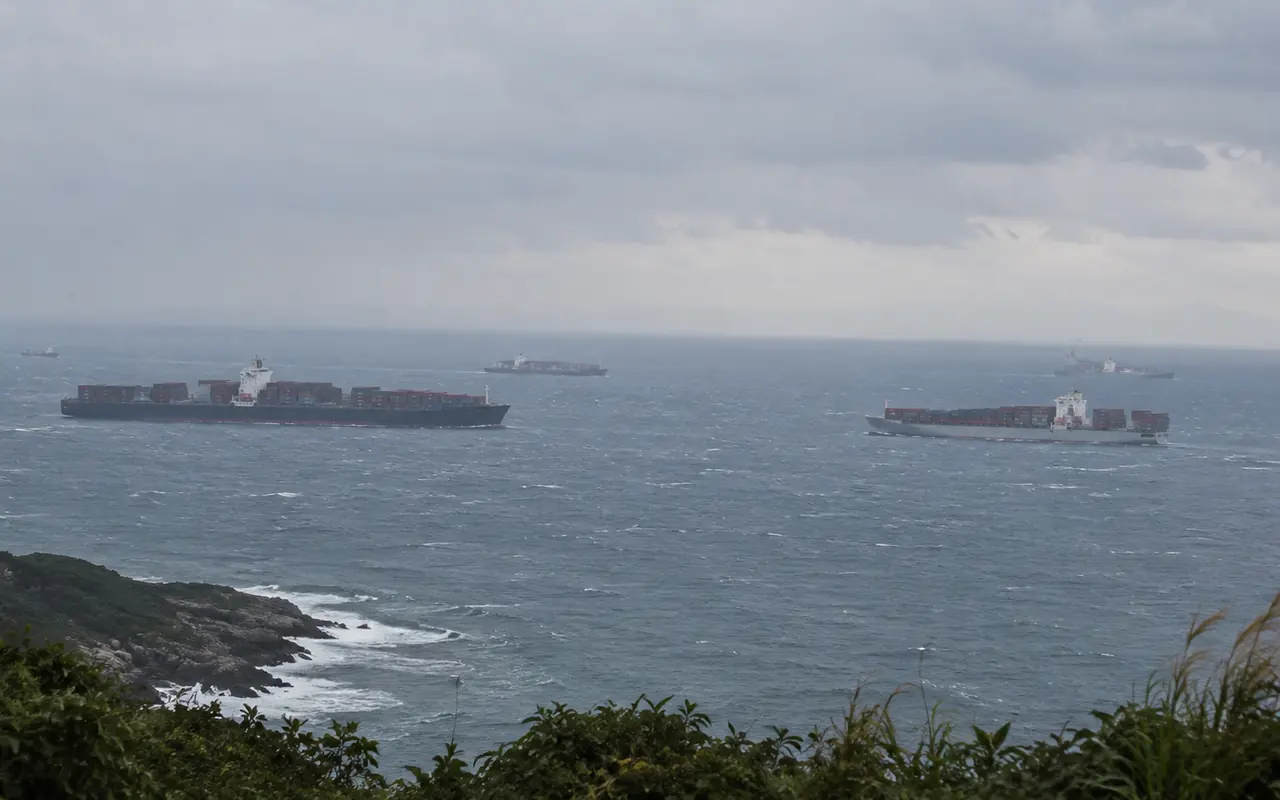
Article contents01 / 07
- A war scenario could wipe out about US$10 trillion from the global economy in the first year, erasing 10% of GDP; a blockade scenario, about 5% — the Taiwan Strait is the world economy's most fragile fault line.
- The biggest line item on the bill always reads Taiwan (−12.2% in the first year of a blockade), but China, the one initiating it, is also badly hurt (−8.9%) — the symmetry of the cost is itself a form of deterrence.
- Taiwan's path forward comes down to three verbs: deter, endure, broadcast. The Silicon Shield is a shield that must be continually reinforced, not an insurance policy you can rest easy on.
“The Taiwan Strait's Ten-Trillion-Dollar Fault Line” reports that A War Could Erase a Tenth of Global GDP(10%)。 Bloomberg Economics [1]。
“The Taiwan Strait's Ten-Trillion-Dollar Fault Line” reports that Economic Damage to Each Side Under a Blockade Scenario(-12.2%)。 Taiwan is hit hardest [5]。
“The Taiwan Strait's Ten-Trillion-Dollar Fault Line” reports that Global GDP Losses Under War vs. Blockade($10 trillion)。 Bloomberg's two scenarios [1]。
“The Taiwan Strait's Ten-Trillion-Dollar Fault Line” reports that An Invasion Scenario Erases Global Output(9.6%)。 Updated estimate: US$10.6 trillion [2]。
Lay the world economy out as a map, and its most fragile fault line isn't on Wall Street, and it isn't in the Persian Gulf — it's in a strait only about 130 kilometers wide.
Bloomberg Economics has modeled a scenario nobody wants to see: if war breaks out in the Taiwan Strait, the global economy would lose about US$10 trillion in the first year alone — equivalent to 10% of world GDP. That figure is larger than the impact caused by the Russia-Ukraine war, the COVID-19 pandemic, or the 2008 financial crisis, each considered on its own [1].
“The Taiwan Strait's Ten-Trillion-Dollar Fault Line” reports that A War Could Erase a Tenth of Global GDP(10%)。 Bloomberg Economics [1]。
And this may even be an underestimate. A more recent estimate pushes the number higher: a conflict triggered by an invasion could erase US$10.6 trillion in the first year alone — about 9.6% of global output [2].
“The Taiwan Strait's Ten-Trillion-Dollar Fault Line” reports that An Invasion Scenario Erases Global Output(9.6%)。 Updated estimate: US$10.6 trillion [2]。
An island of just 23 million people has its security bound up with a tenth of the world's wealth. This is Taiwan's heaviest burden — and also the leverage it most needs to understand, and to use well.
This report, written from Taiwan's own vantage point, calmly takes apart the economics behind this fault line, layer by layer.
What Does Ten Trillion Dollars Actually Mean
Once a number gets large enough, it can actually lose all meaning. Let's first put it back into scale.
US$10 trillion is roughly equal to the combined GDP of Germany and Japan. The wealth it would wipe out in one go is greater than the losses caused, respectively, by the 2008 financial crisis, the 2020 pandemic lockdowns, or the Russia-Ukraine war [3]. Converted into a unit closer to home for Taiwan, one estimate puts the global cost at a scale of roughly NT$311 trillion [6].
But this isn't the loss of any single country — it's the chain reaction of global supply chains, financial markets, and trade all breaking down at once.
The reason it far exceeds the Russia-Ukraine war lies in Taiwan's role: it isn't just a coordinate on a map, it's an irreplaceable parts supplier for modern industry. Taiwan-U.S. bilateral trade in goods and services alone exceeded US$185 billion in 2024, and Taiwan is deeply embedded in a global trade and technology network centered on the United States [12]. This is the key to understanding the entire fault line.
That 10% won't be spread evenly across every country — it will travel down the nerves of the supply chain.
Once Taiwan's fabs stop running, the global auto, consumer-electronics, data-center, and defense industries would feel a parts shortage within weeks; financial markets would react even faster — the mere panic of "the world's factory going dark" would be enough to send them into violent swings.
This is also why many models find that the impact of a Taiwan Strait conflict would spread faster and wider than the Russia-Ukraine war — it strikes the single most concentrated node in modern industry.
There's another fact that's often overlooked: markets don't wait for the first shot to be fired before reacting.
A mere rise in conflict risk is enough to send shipping insurance premiums soaring, prompt some capital to withdraw early, and lead customers to demand backup capacity outside Taiwan (observation). These "costs of a war that hasn't happened yet" are quietly accumulating all the time.
Ten trillion dollars is the ceiling of an extreme scenario; but on the road toward that ceiling, Taiwan is already paying the price for the risk itself.
A Blockade Is More Likely Than War, and Not Necessarily Cheaper
War is the most extreme scenario, but it isn't necessarily the most likely one.
Compared with the enormous risk of a landing operation, many analyses see a blockade as the pressure tactic Beijing is more likely to use. Bloomberg has also modeled this scenario: if China blockades Taiwan, the global economy would lose about 5% of GDP in the first year [1].
“The Taiwan Strait's Ten-Trillion-Dollar Fault Line” reports that Global GDP Losses Under War vs. Blockade($10 trillion)。 Bloomberg's two scenarios [1]。
But "cheaper" is an illusion. Zoom in, and the impact of a blockade on each party is highly asymmetric: Taiwan takes a 12.2% hit in the first year, mainland China 8.9%, and the United States 3.3% [5].
“The Taiwan Strait's Ten-Trillion-Dollar Fault Line” reports that Economic Damage to Each Side Under a Blockade Scenario(-12.2%)。 Taiwan is hit hardest [5]。
In other words, whether it's war or a blockade, the biggest victim is always Taiwan itself.
This is exactly why Taiwan's desire to "avoid conflict" has to be stronger, and more pragmatic, than that of any outside commentator.
A blockade is also tricky because it falls into a legal and military gray zone. It may not cross a clear "war" red line, yet it's still enough to choke an island economy — Taiwan's energy, food, and most raw materials all depend on maritime imports.
So Taiwan's resilience preparations — wartime stockpiles, energy diversification, holding the sea lines of communication — matter just as much as military deterrence. Being able to hold out long enough is itself a form of deterrence: as long as the adversary knows "a blockade won't necessarily bring a quick win," its incentive to act is reduced.
For Taiwan, peace isn't an ideal — it's the highest form of economic rationality.
Why It's So Expensive: Everything Comes Down to Chips
Why does a Taiwan Strait conflict cost so much more than other regional conflicts?
The answer is hidden inside a piece of silicon the size of a fingernail. More than 90% of the world's most advanced-process chips, and the most critical advanced-packaging capacity, are concentrated in Taiwan [7]. From smartphones and servers to cars and AI data centers, there's almost no part of modern industry that can route around it.
Once this supply chain is disrupted by conflict, the damage wouldn't stop at the electronics industry — global manufacturing and financial markets would seize up together [4].
More critically, this irreplaceability "cannot be solved in the short term."
Advanced-process manufacturing is bottlenecked by an entire row of narrow chokepoints — EUV lithography machines, high-end EDA tools, HBM memory. Even if other countries poured in vast sums of money, replacing Taiwan's entire set of production capacity would still have to be measured in years.
This is the technical foundation on which the Silicon Shield still holds for the foreseeable future. But looked at the other way, once this capacity is damaged by conflict, finding a replacement worldwide would likewise take years — and that is exactly where the trillion-dollar-scale cost comes from.
Comparing this with the Russia-Ukraine war makes the Taiwan Strait's uniqueness even clearer. The Russia-Ukraine conflict has mainly hit the world's food and energy; a Taiwan Strait conflict would choke off the "brain" of almost every electronic product. One makes the world more expensive; the other would make the world stop.
This Blade Wounds the Attacker Too
The logic of deterrence isn't only "someone else protects you" — it's also "the adversary itself can't afford it either." This is the point in Taiwan Strait economics most easily drowned out by emotion, and yet most in need of being seen clearly.
The numbers cited earlier already made this clear: under a blockade scenario, mainland China's own economy would also take an 8.9% hit in the first year [5]. Analysis from the United States Institute of Peace (USIP) puts it even more directly — China's various military options against Taiwan often end up "backfiring" on its own strategic and economic interests [8].
For an economy that depends heavily on exports, foreign investment, and global supply chains, deliberately detonating this fault line would mean driving the other end of the blade into itself.
This doesn't mean conflict won't happen — history has no shortage of examples of countries going to war "knowing full well the cost would be high."
But it does tell Taiwan one thing: deterrence doesn't rest on the military alone — it also rests on calculating the "economic cost of conflict" clearly and spelling it out plainly. Making sure everyone sees that ten-trillion-dollar bill is itself a form of defense. The more countries that realize "if the Taiwan Strait erupts, I get badly hurt too," the more stable the international coalition for preserving the status quo becomes.
Calculating the cost clearly, stating it plainly, and spreading the word — this is a defense project with extremely low cost and extremely high payoff.
It's worth adding that this "broadcasting" project can't be aimed only outward — Taiwan needs to do it at home too. A society that only picks up fragments of "the Taiwan Strait is dangerous" from news alerts can easily swing between fear and numbness — indifferent in normal times, then over-panicking and falling into disarray at the first sign of trouble. The real value of clearly explaining this ten-trillion-dollar bill isn't to scare ourselves — it's to build a "calm risk awareness" across Taiwanese society, business, and capital markets: knowing exactly how bad the worst case would be makes people more willing to invest in resilience, support deterrence, and avoid conflict — rather than facing it through avoidance or wishful thinking. A society that understands its own situation, yet isn't paralyzed by it, is itself the line of defense hardest for cognitive warfare to break through.
The Cost of Not Going to War: Slow Bleeding in the Gray Zone
War and blockade are tail risks: low probability, but extremely high impact. What Taiwan actually faces every day is a different, more invisible cost — attrition in the gray zone.
The constant incursions by military aircraft, maritime friction, cognitive warfare, and diplomatic pressure won't trigger that ten-trillion-dollar bill, but they do drive up Taiwan's "geopolitical risk premium" bit by bit: insurance gets more expensive, some foreign capital and talent apply an extra discount when weighing Taiwan, and supply-chain customers demand "Taiwan+1" backup capacity (inference; medium confidence).
These costs are diffuse and silent, but they are a real, chronic bleeding.
This also shows that Taiwan's security cannot be left to the military alone.
Economic resilience — stockpiles of energy and food, the financial system's stress tolerance, backup capacity for critical supply chains — is itself part of national defense. The more a Taiwan is able to "keep functioning as usual" under a blockade or harassment, the less worth attacking it becomes, because the "quick-win payoff" the adversary hopes for is sharply reduced.
But resilience also has its limits, and that has to be faced honestly. No amount of stockpiling, no degree of energy diversification, can hold off an adversary determined to apply pressure indefinitely regardless of cost. What resilience can do is stretch "how long we can hold out" from weeks to months, buying time for diplomatic mediation and international involvement.
Resilience buys time, not immunity.
The Silicon Shield, Reexamined
So we return to that famous concept: the Silicon Shield.
Its logic is this: precisely because the entire world cannot do without Taiwan's chips, any move that upends the Taiwan Strait would come at the cost of paralyzing the global economy — and that layer of deterrence ends up protecting Taiwan. The ten-trillion-dollar bill is exactly the most powerful numerical footnote to the Silicon Shield.
But the Silicon Shield is not a cure-all — it has at least two cracks.
Crack one is dilution. As TSMC builds fabs in the United States and Japan, and advanced capacity gradually disperses, will this shield grow thinner? Current evidence shows the most cutting-edge processes are still staying in Taiwan, but this is a variable that has to be watched closely over the long term.
Crack two is the assumption of rationality. The Silicon Shield deters "an adversary that carefully calculates costs"; once an adversary acts on political will and doesn't behave entirely according to economic rationality, its protective power is discounted (this publication's own analysis).
So rather than arguing over "whether the Silicon Shield actually works," it's more useful to ask "how do we make it thicker." Concretely: hold the line that the most advanced processes and R&D stay on home soil, make sure that building fabs in the U.S. and Japan is "diversifying risk" rather than "hollowing out the mother site," and keep strengthening that row of technological chokepoints that make Taiwan irreplaceable.
The Silicon Shield is real, but it is a shield that must be continually reinforced — not an insurance policy you can rest easy on.
Three Stances: Turning the Economics of Peace Into Action
From Taiwan's own vantage point, the homework this fault line assigns falls on three kinds of actors.
For the state, the task is to advance on two tracks at once: on one hand, strengthen deterrence (military capability, plus calculating and clearly stating the economic cost, plus reinforcing the Silicon Shield); on the other, build up resilience (wartime endurance for energy, food, finance, and critical materials). At the same time, treat "the pace and proportion of advanced capacity moving offshore" as a national-security-grade indicator to monitor — because it directly determines how thick or thin the Silicon Shield is [13].
For industry intermediaries, the task is to turn "geopolitical risk" from a slogan into operational preparation: help member companies build business continuity plans (BCP), map out single-point exposure, and plan credible offsite backup, so that "Taiwan+1" becomes diversification led by Taiwan, rather than a passive drain outward.
For SMEs, the most practical piece of advice is: factor geopolitical risk into pricing and positioning, but don't let it paralyze you. Excessive panic will self-fulfillingly drive orders away; excessive complacency will leave you nowhere to turn when a tail risk arrives. The rational approach is to diversify markets, keep key inventory on hand, buy the right insurance, and then put your energy back into running the business well.
The ten-trillion-dollar fault line is a geographic fate Taiwan never got to choose; but how to deter, endure, and broadcast along that line is a strategy Taiwan can lead and choose entirely on its own. Understanding the cost was never about fear — it's about holding, with clearer eyes and firmer footing, the line that keeps that bill from ever having to be paid.
Sources
- Bloomberg — A Taiwan Strait conflict could cost the world US$10 trillion
- Bloomberg (2026-02-10) — The $10 Trillion Fight: Modeling a US-China War Over Taiwan ($10.6 trillion / 9.6% of global output, first year)
- Black Dawg Research — Comparing the scale of Bloomberg Economics' impact estimates
- Defence Connect — Assessing the true cost of a Taiwan conflict
- Pluralia — War would cost 10% of world GDP / impact on each side under a blockade
- Taiwan News — A Chinese invasion of Taiwan could cost the world NT$311 trillion
- CommonWealth — TSMC and Taiwan's share of advanced-process and packaging capacity
- USIP — How China's military options against Taiwan could backfire on itself
- economy.ac — An invasion scenario would erase US$10 trillion in global output
- CSIS — Export controls and the US-China AI/chip race
- CFR — Taiwan semiconductors' critical position in the global supply chain
- USTR — Taiwan-U.S. trade and economic relations (background on interdependence)
- FPRI — The impact of geopolitical risk on Taiwan's economy
September 11: The Loophole Clock Starts Ticking — How the EU CRA's 24/72-Hour Rule Rewrites Taiwan's Hardware Exports
The reporting obligations of the EU's Cyber Resilience Act take effect early, on September 11, 2026. They do not require every vulnerability to be disclosed within a day — they require the legal manufacturer of a product to issue a 24-hour early warning, a 72-hour notification, and a follow-up final report once it becomes aware of an actively exploited vulnerability or a severe security incident. The real impact on Taiwan is that brand owners will push that statutory clock backward onto their ODMs, component suppliers, and software supply chains.

Viral Data Goes In — Do Vaccines Come Out? Taiwan's Gap in the PABS Negotiations
The WHO Pandemic Agreement was adopted by the World Health Assembly in 2025, but its core annex on pathogen access and benefit-sharing is still under negotiation; the seventh round did not conclude, and the eighth round is set for September. Taiwan's real risk is not whether it can upload a sequence — it is that there is no single, publicly verifiable, end-to-end pathway linking data contribution, notification of use, manufacturer contracts, and actual access to vaccines and diagnostics.