
Rehearsal at Scarborough Shoal: The Philippines Is Practicing China's Gray-Zone Playbook for Taiwan
China placed a manned structure at Scarborough Shoal, sent four warships to encircle a Philippine frigate, and then quietly withdrew the structure two weeks later. Taiwan also claims this reef — and when Beijing rehearses its script of 'plant a structure, encircle, claim to have driven the intruder off' here, the Philippines is the first test subject. Watching from the audience, does Taiwan see a list of moves, or its own tomorrow?
Article contents01 / 09
- The tactical playbook is the same one: China's sequence at Scarborough Shoal — plant a structure, encircle with warships, claim to have driven the intruder off, information warfare — is the same script used against Taiwan and against the Dutch frigate De Ruyter (see "Gray Zone Full Field Guide") — the Philippines has handed Taiwan a free wargame.
- The strategic situation cannot simply be equated: Taiwan is the main stage of this drama, with its own military strength and semiconductor leverage, but the United States has no mutual defense treaty with Taiwan and maintains strategic ambiguity — the model of U.S.-Philippines Mutual Defense Treaty (MDT) support cannot simply be applied to Taiwan, and this difference works against Taiwan.
- Taiwan is in fact also a claimant to Scarborough Shoal, and on June 2 it stated it would coordinate with Japan and the Philippines on fishing rights; what Taiwan should learn is the Philippines' formula of assertive transparency plus internationalization plus alliance coordination that throws the cost back onto Beijing — not demote itself into 'the next Philippines.'
“Rehearsal at Scarborough Shoal: The Philippines Is Practicing China's Gray-Zone Playbook for Taiwan” reports that China Has Controlled Scarborough Shoal Since 2012。 Taiwan (as Minzhu Jiao, or Democracy Reef) and the Philippines also each claim it [8]。
“Rehearsal at Scarborough Shoal: The Philippines Is Practicing China's Gray-Zone Playbook for Taiwan” reports that China Placed a Floating Structure in the Lagoon for the First Time in Late May, Removed It on June 16(About 6 Meters)。 Fitted with an antenna; foreign media said it may be a monitoring platform; the Philippines lodged a diplomatic protest [3]。
“Rehearsal at Scarborough Shoal: The Philippines Is Practicing China's Gray-Zone Playbook for Taiwan” reports that Four Chinese Warships Encircled a Philippine Navy Frigate on June 20–22(4 Ships)。 Coinciding with the conclusion of the more-than-7,000-troop Salaknib multinational exercise [4]。
“Rehearsal at Scarborough Shoal: The Philippines Is Practicing China's Gray-Zone Playbook for Taiwan” reports that Taiwan Says It Will Coordinate With Japan and the Philippines, Insists on Fishing Rights(June 2)。 Taiwan is also a claimant to Scarborough Shoal [10]。
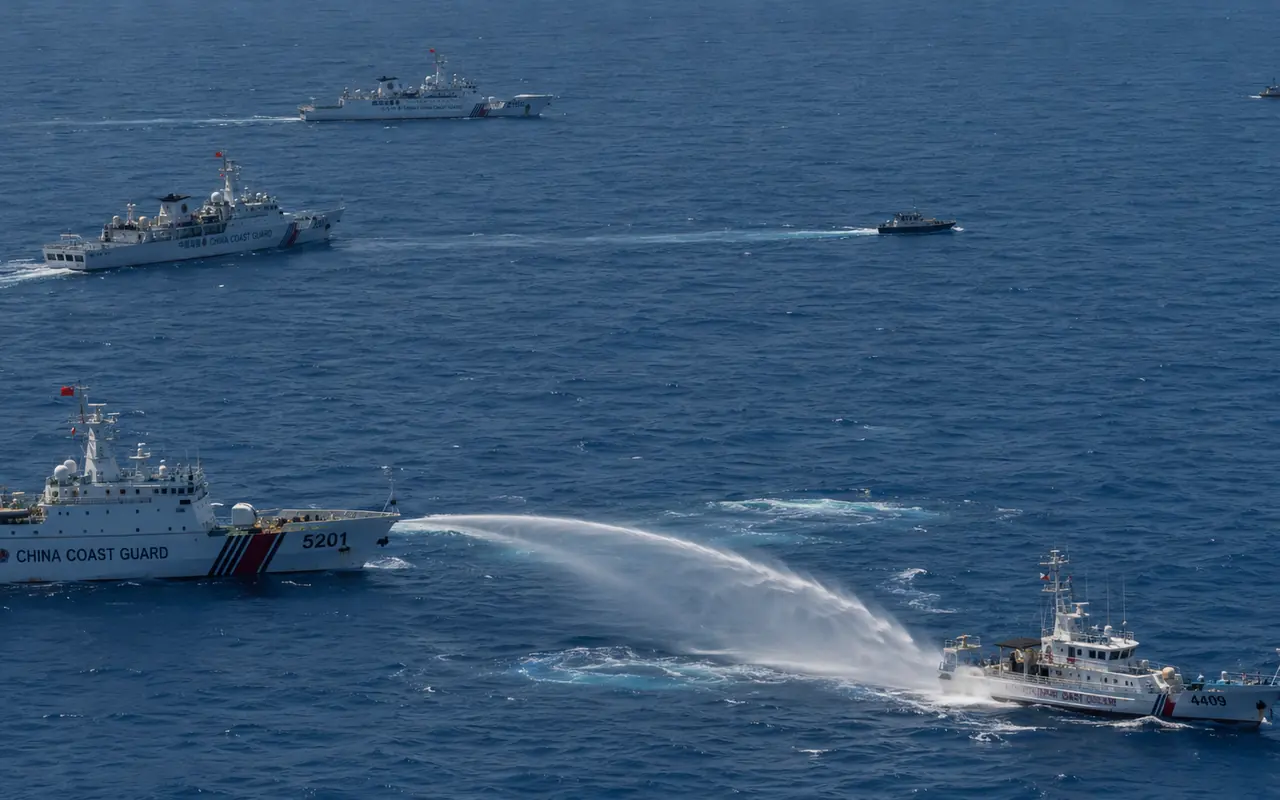
In late May 2026, a floating structure about 6 meters long, fitted with an antenna (foreign media said it may be a monitoring platform), quietly appeared in the lagoon at Scarborough Shoal in the South China Sea. China placed it; the Philippines protested [3]. On June 16, China quietly removed the structure [2]; less than a week later, between June 20 and 22 — just as the Salaknib 2026 multinational exercise drew to a close — four Chinese warships encircled the Philippine Navy's missile frigate BRP Diego Silang near Scarborough Shoal, with both sides shouting "leave immediately" across the water at each other [4].
Plant it, withdraw, encircle, claim — the whole sequence unfolded in one smooth motion, like a rehearsed play. For most people, this is a South China Sea news item. For Taiwan, it should be a script: because Taiwan also claims this reef, and every move Beijing rehearses here feels eerily familiar.
“Rehearsal at Scarborough Shoal: The Philippines Is Practicing China's Gray-Zone Playbook for Taiwan” reports that China Has Controlled Scarborough Shoal Since 2012。 Taiwan (as Minzhu Jiao, or Democracy Reef) and the Philippines also each claim it [8]。
One Playbook, Used Everywhere
Scarborough Shoal (called Minzhu Jiao, or Democracy Reef, by Taiwan; Bajo de Masinloc by the Philippines) has been under China's actual control since 2012 [8]. This round in 2026 played out China's "gray-zone playbook" with unusual completeness, breaking down into four standard moves:
- Plant a structure — establishing a fact on the ground in disputed waters (the manned structure in late May), testing the other side's and the international community's limits of tolerance.
- Encircle with warships — coast guard and naval vessels patrol routinely, and when necessary several ships surround one, using overwhelming numbers to project deterrence without firing the first shot [6][4][9].
- Claim to have driven the intruder off — a standard line Beijing has used again and again in South China Sea incidents. In this standoff, China's foreign ministry had not commented publicly as of the time of reporting [4], but judging from past cases (including multiple incidents in 2024 and 2026), its eventual response can be expected to keep to the familiar formula of "lawfully expelling" an "infringing and provocative" intruder.
- Information warfare — broadcasting a victory narrative of "we drove off the intruder" at home and abroad, seizing the interpretive high ground in public opinion.
“Rehearsal at Scarborough Shoal: The Philippines Is Practicing China's Gray-Zone Playbook for Taiwan” reports that China Placed a Floating Structure in the Lagoon for the First Time in Late May, Removed It on June 16(About 6 Meters)。 Fitted with an antenna; foreign media said it may be a monitoring platform; the Philippines lodged a diplomatic protest [3]。
This playbook is the same one we saw in "The European Warships Have Arrived" — China using electronic warfare against the Dutch frigate De Ruyter, then claiming to have "driven it off" — and it follows the same logic behind the harassment Taiwan's air and sea forces face every day, and the six layers in "Gray Zone Full Field Guide." The Philippines is not a special case — it is a test subject. Every time Beijing successfully tests a move here, it can potentially replicate it around the Taiwan Strait.
What the Philippines Got Right: Painting the Gray Black
But in this drama, the Philippines also performed a counter-script worth Taiwan taking notes on, built around four words: assertive transparency.
Over the past few years, the Philippines changed its old approach of "swallowing the loss quietly and handling it low-key," shifting instead to filming, publicizing, and pulling international media and allies into view of every Chinese move — planting a structure, encircling, firing water cannons — in real time. This has a double effect: at home, it lets citizens see the truth and builds consensus; abroad, it turns China's gray-zone advantage of "no shots fired, hard to prove" into the political cost of "the whole world sees it bullying." This standoff, notably, coincided with the conclusion of the U.S.-Philippines-Japan-New Zealand-Australia "Salaknib" multinational exercise involving more than 7,000 troops, meaning Manila staged this drama on a stage with many allies already present [4].
“Rehearsal at Scarborough Shoal: The Philippines Is Practicing China's Gray-Zone Playbook for Taiwan” reports that Four Chinese Warships Encircled a Philippine Navy Frigate on June 20–22(4 Ships)。 Coinciding with the conclusion of the more-than-7,000-troop Salaknib multinational exercise [4]。
The Philippines has demonstrated: in the face of the gray zone, silence and forbearance only let the adversary take whatever it wants; only by laying every cut out in the sunlight can the salami-slicer be made to pay a price. This is a living lesson in the "Paint it black" move from "Gray Zone Full Field Guide."
Why Now? Reading Beijing's Choice of Timing
Beijing's choice to escalate pressure at Scarborough Shoal at this particular moment is no accident. On one hand, after the Trump-Xi summit, U.S.-China relations entered a delicate phase of "negotiating while contesting" (see "Transactional Ambiguity"), and Beijing wants to probe how far it can push the South China Sea red line forward while the United States is busy dealmaking and wavering on commitments to allies. On the other hand, pressuring the Philippines is also a "demonstration lesson" staged for Taiwan and the whole region to watch — showing that "even with the United States as a treaty ally, there's no guarantee of timely rescue when you're being encircled," thereby shaking regional confidence in America's security commitments.
The audience for this drama at Scarborough Shoal was never just Manila. It is a probe staged for Washington to watch, an intimidation staged for Taipei to watch, and a lesson on "the cost of picking a side" staged for the whole of Southeast Asia to watch. Understood this way, Taiwan will not treat it as a distant South China Sea sideshow, but will see the message aimed at itself within it.
Why Taiwan Should Especially Care
Two reasons make Scarborough Shoal more than "someone else's problem."
First, Taiwan is also a claimant. Scarborough Shoal is part of the Republic of China's historical claims; on June 2, 2026, a Taiwan government spokesperson made a rare statement that Taiwan would coordinate with Japan and the Philippines to insist on protecting Taiwan's fishing rights [10]. This is a rare signal of "Taiwan being drawn into the South China Sea" — the same reef, with Beijing, Manila, and Taipei each telling a different story.
“Rehearsal at Scarborough Shoal: The Philippines Is Practicing China's Gray-Zone Playbook for Taiwan” reports that Taiwan Says It Will Coordinate With Japan and the Philippines, Insists on Fishing Rights(June 2)。 Taiwan is also a claimant to Scarborough Shoal [10]。
Second, the South China Sea and the Taiwan Strait are two ends of the same theater. Strengthening control over Scarborough Shoal helps China monitor and deter air and sea traffic across the entire South China Sea; any escalation would draw on Chinese assets and logistics that span both regions. The Global Taiwan Institute warns even more directly that the coercive methods China perfects in the South China Sea are very likely to spill over onto Taiwan next [7]. If something happens in the Taiwan Strait, the pieces in the South China Sea will not sit out; conversely, every advance in the South China Sea is a warm-up for the script that will play out in the Taiwan Strait.
A Difference That Works Against Taiwan: No Treaty
But a brake needs to be applied here, or else Taiwan falls straight into the cognitive warfare Beijing would most welcome: treating every South China Sea friction as "Taiwan's tomorrow" is itself a form of amplifying panic on the adversary's behalf.
The Eastern Eye's red-team warning holds up: Scarborough Shoal is a territorial and fishing-rights dispute, while for Taiwan the goal is political reunification — fundamentally different in nature. China's voluntary withdrawal of the structure on June 16 shows it is "managing," not "detonating," the situation — and applying the analytical frame Fulcrum (ISEAS) has used for the recurring pattern at Scarborough Shoal, what such confrontations tend to leave behind is more deterrence and less trust [5]. Equating the Philippines' experience directly with Taiwan's own demotes Taiwan to "the next Philippines."
But the Western Eye's counter-punch also holds up: "different in nature" does not mean "safe to relax." The fact that the playbook is the same carries real early-warning value on its own — and there is one key difference to see clearly, and it runs against Taiwan: the Philippines and the United States have a Mutual Defense Treaty (MDT); the United States has no such treaty with Taiwan, and maintains strategic ambiguity instead (see "Transactional Ambiguity"). So when the Philippines is encircled, it can legitimately invoke its "treaty ally" and pull the United States into the picture; if Taiwan faced the same kind of gray-zone encirclement, it could not assume the same automatic rescue. The Philippines has a "treaty" safety net; beneath Taiwan's feet is only the thin ice of "strategic ambiguity."
The overlap between the two sides is a clear-headed positioning: the Philippines is Taiwan's "rehearsal stage," not Taiwan's "same show." What should be learned is the script and the countermeasures, not a fatalistic sense of being next in line.
Taiwan's "Home Field" Is Both an Advantage and a Pressure
Compared with the Philippines, Taiwan has one fundamental difference: Taiwan is the "home field" of this whole drama. The Taiwan Strait is Taiwan's own front doorstep; Taiwan has its own air and naval forces, has the semiconductor card the whole world cares about, and has overall strength deeper than the Philippines'. This is an advantage — Taiwan is not a small country that can only passively absorb blows.
But "home field" also means greater pressure: precisely because Taiwan is the ultimate target of Beijing's "reunification," the intensity of gray-zone pressure it bears far exceeds that faced by any South China Sea claimant; the daily volume of harassment sorties Taiwan's air and sea forces face (see "Gray Zone Full Field Guide") is on a scale the Philippines can hardly imagine. So the statement "Taiwan is not the next Philippines" carries two layers of meaning: the good layer is "Taiwan has more leverage," and the bad layer is "what Taiwan faces is a bigger, more sustained show." Advantage and pressure are two sides of the same "home field."
Don't Forget the Fishermen: Ordinary People on the Front Line
In the grand narrative of great-power rivalry, the people most easily overlooked are those actually out on the water — fishermen. Taiwanese and Philippine fishermen have long worked these contested waters, yet increasingly face being chased off, sprayed with water cannons, or even having their boats seized by the China Coast Guard. For them, this is really a question of livelihood: can I go out to sea today, and will I get home safely?
Behind Taiwan's rare June 2 statement insisting on protecting fishing rights lies precisely the situation these people are in. The pressure of the gray zone ultimately lands on the ordinary people at the front line; and only a state that can protect its own fishermen and back them up earns its people's trust. This is also a reminder that national security has never been only about warships and missiles — it is also about the specific people at the fishing harbor, on the boats.
The Homework Really Worth Copying
Pulling all of this together, what the Philippines got right this round is, in fact, an entire replicable methodology: assertive transparency plus internationalization plus alliance coordination. Expose every Chinese move in real time, pull it into international view, combine it with U.S.-Japan-Australia multinational exercises, and throw the political cost of the gray zone back onto Beijing. Regional dynamics are on this side too — Japan, the Philippines, and other nearby claimant states are turning toward coordination (in late May, for example, Japan and the Philippines announced talks on delineating their EEZ boundary), and Japan is playing an ever-larger security role [2].
This is the homework Taiwan should actually copy: not anxiety over "am I next," but taking apart, move by move, China's playbook and the international response sheet, and preparing countermeasures and narrative contingencies for each one in advance. When Beijing someday "plants a structure" or "encircles a ship" around the Taiwan Strait, Taiwan should not be scrambling — it should be like someone who has already watched the full dress rehearsal, already knowing what comes next and already ready for how to respond.
There is a deeper lesson still: Taiwan, the Philippines, Japan, and even Vietnam are, in truth, a "community of shared fate" facing the same adversary and the same set of tactics. Rather than fighting alone, it is better to link together each other's experience, intelligence, and countermeasures — when every country under pressure from China's gray-zone tactics publicizes and shares its own experience, Beijing's calculation of "picking off targets one at a time" falls apart. Taiwan actively participating in this region's "information and experience sharing network" is, in itself, a low-cost, high-return form of self-protection.
Three Taiwan Perspectives
The state: treat the Philippines as a free wargame — study every step of "plant a structure → encircle → claim to have driven the intruder off → information warfare" and the international response to each, and build a Taiwan-specific set of countermeasures and narrative contingencies; continue the direction set on June 2 by deepening maritime-domain awareness and fishing-rights coordination with Japan and the Philippines, building "assertive transparency" into standard operating procedure. But stay clear-eyed: the United States has no treaty with Taiwan and maintains strategic ambiguity, so rescue cannot be assumed — which means Taiwan must invest earlier and more heavily than the Philippines in resilience it can rely on by itself.
Industry (fisheries/shipping): rising risk along South China Sea shipping lanes and fishing grounds affects operational safety and insurance premiums; major maritime users should factor gray-zone scenarios into risk assessments and plan alternative routes and notification mechanisms.
Society: the information warfare of "China claims to have driven the intruder off, the other side denies it" will move to the waters around the Taiwan Strait — and when that day comes, what floods in first is often information impossible to verify as true or false. Media literacy and not being swept along by narrative-steering are the first line of civil defense, and the key to making the adversary's "information warfare" move fail — after all, what the gray zone ultimately aims to conquer is not some reef, but a society's ability to judge calmly and not be led by fear.
The structure at Scarborough Shoal was placed, then removed — like a rehearsal testing a red line. The Philippines stands on the stage; Taiwan sits in the audience — but a smart audience doesn't just watch the plot, it notes every blocking, every line, every lighting change. Watching the Philippines is not watching your own fate — it is watching the adversary's moves; and whoever understands the moves will not be frightened by the same script on the day they themselves take the stage. The structure at Scarborough Shoal may already be gone, but the script it left behind for Taiwan is worth studying closely — because the next time this same drama plays out, it may well be right on Taiwan's own doorstep, and by then, Taiwan will no longer just be sitting in the audience.
Sources
- Ministry of Foreign Affairs of China — Press conference remarks on sovereignty over Scarborough Shoal
- AEI (2026-06-18) — China & Taiwan Update
- Washington Post (2026-06-09) — Philippines protests China's floating 'structure' at Scarborough Shoal
- SCMP — China and Philippines have rare naval stand-off near Scarborough Shoal
- FULCRUM (ISEAS) — Scarborough Shoal Standoff: More Deterrence, Less Trust
- FDD (2026-04) — China Restricts Access and Expands Reach in the South China Sea
- Global Taiwan Institute (2026-05) — China's Next Target in the South China Sea: Taiwan?
- Wikipedia — Scarborough Shoal standoff (2012 control and background)
- The Standard (HK) — China patrols Scarborough Shoal after Philippines warns of threat
- Taiwan News (2026-06-02) — Taiwan's foreign ministry to coordinate with Japan and the Philippines, insisting on protecting fishing rights
September 11: The Loophole Clock Starts Ticking — How the EU CRA's 24/72-Hour Rule Rewrites Taiwan's Hardware Exports
The reporting obligations of the EU's Cyber Resilience Act take effect early, on September 11, 2026. They do not require every vulnerability to be disclosed within a day — they require the legal manufacturer of a product to issue a 24-hour early warning, a 72-hour notification, and a follow-up final report once it becomes aware of an actively exploited vulnerability or a severe security incident. The real impact on Taiwan is that brand owners will push that statutory clock backward onto their ODMs, component suppliers, and software supply chains.

Viral Data Goes In — Do Vaccines Come Out? Taiwan's Gap in the PABS Negotiations
The WHO Pandemic Agreement was adopted by the World Health Assembly in 2025, but its core annex on pathogen access and benefit-sharing is still under negotiation; the seventh round did not conclude, and the eighth round is set for September. Taiwan's real risk is not whether it can upload a sequence — it is that there is no single, publicly verifiable, end-to-end pathway linking data contribution, notification of use, manufacturer contracts, and actual access to vaccines and diagnostics.