
The Stone Xi Jinping Placed in Pyongyang: What His Silence on Denuclearization Means for Taiwan
Met Trump in May, met Putin in May, met Kim Jong Un in June. Xi Jinping's first visit to Pyongyang in seven years never mentioned denuclearization — and that silence says more than any statement could. For Taiwan, the real danger isn't a three-way alliance; it's how many places the United States can actually be, when three fronts catch fire at once.
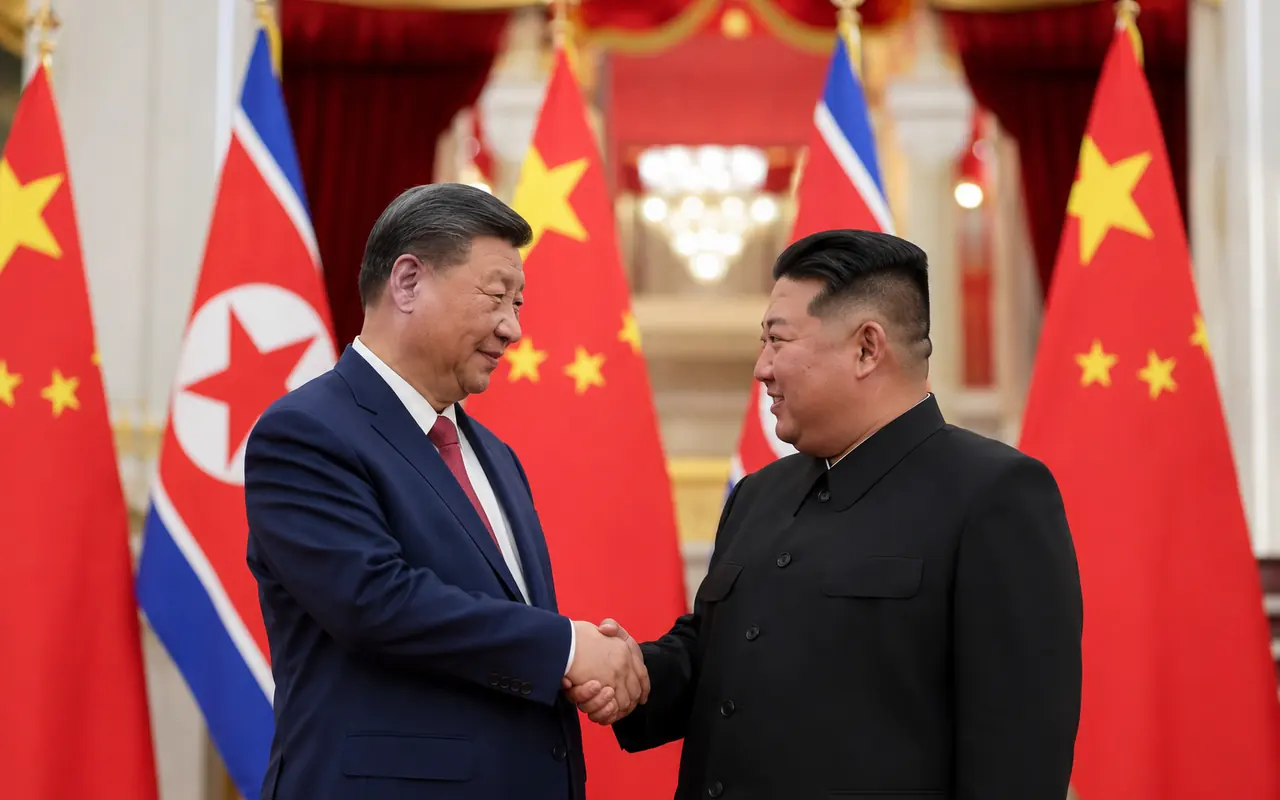
Article contents01 / 08
- On June 8–9, 2026, Xi Jinping made his first visit to Pyongyang in seven years, choosing North Korea as his first foreign destination of 2026; the summit's public statement dropped the word "denuclearization" entirely — Carnegie scholar Tong Ye calls this Beijing's "most significant policy shift" in accepting the reality of a nuclear-armed North Korea.
- The substance of China-North Korea-Russia military ties has to be split into three layers: the Russia-North Korea layer runs deepest (North Korea has supplied Russia with 6–12 million artillery shells and sent 11,000–12,000 troops to Kursk, in exchange for satellite and air-defense technology); the China-North Korea layer is more economic and political; the China-Russia layer is a "comprehensive strategic partnership" with no formal military obligation — CRINK is not NATO, but the fact that "three fronts are burning at once" spreading U.S. forces thin is structural.
- What Taiwan actually faces is three structural pressures that warrant continued attention (some still inferential, with varying levels of confidence): South Korea faces a second-front constraint from the Korean Peninsula in any Taiwan Strait crisis, multiple fronts may be diluting U.S. attention (inference; medium confidence), and North Korea's nuclear arsenal continues to expand (SIPRI estimates roughly 60 assembled warheads in 2026; whether it has achieved MIRV capability remains observation/inference, low confidence) — stacked together, these are risk factors that warrant continued attention in the Taiwan Strait deterrence environment.
“The Stone Xi Jinping Placed in Pyongyang: What His Silence on Denuclearization Means for Taiwan” reports that Xi Jinping's Chain of 2026 Diplomacy: 22 Days, Trump → Putin → Kim Jong Un(3 summits)。 May 14 Trump summit → May 20 Putin in Beijing → June 8 Pyongyang (first visit in 7 years) [3][4][5]。
“The Stone Xi Jinping Placed in Pyongyang: What His Silence on Denuclearization Means for Taiwan” reports that Estimated Assembled North Korean Nuclear Warheads (SIPRI 2026)(60 warheads)。 Up from 50 in 2025; South Korea estimates up to 290 by 2035 [22]。
“The Stone Xi Jinping Placed in Pyongyang: What His Silence on Denuclearization Means for Taiwan” reports that Estimated Artillery Shells North Korea Has Supplied to Russia(4–12 million)。 About 50–60% of Russia's usage in Ukraine [10][11]。
“The Stone Xi Jinping Placed in Pyongyang: What His Silence on Denuclearization Means for Taiwan” reports that Casualty Rate Among North Korean Troops Sent to Russia (UK Intelligence Assessment)(50%)。 11,000–12,000 sent to Kursk; about 5,000 casualties within three months [12]。
Lay out the 2026 diplomatic calendar, and Xi Jinping met with Trump, Putin, and Kim Jong Un in succession within 22 days. May 14–15 was the Xi-Trump summit, May 20 was the Xi-Putin meeting, and June 8–9 was his first visit to North Korea in seven years — also his first foreign trip of 2026 [3][4][5].
This sequence is worth noting, but it doesn't need to be read straight off as a "chain of orchestration." The more confirmable signal is this: at the summit, Xi Jinping and Kim Jong Un publicly expressed hopes for deepening China-North Korea relations, and the word "denuclearization" did not appear in the statement [2][7].
“The Stone Xi Jinping Placed in Pyongyang: What His Silence on Denuclearization Means for Taiwan” reports that Xi Jinping's Chain of 2026 Diplomacy: 22 Days, Trump → Putin → Kim Jong Un(3 summits)。 May 14 Trump summit → May 20 Putin in Beijing → June 8 Pyongyang (first visit in 7 years) [3][4][5]。
The clearest detail isn't what Xi Jinping said — it's what he didn't say: the word "denuclearization" is nowhere to be found in the summit statement.
Tong Ye, a scholar at the Carnegie Endowment for International Peace, calls this Beijing's "most significant policy shift." Having publicly backed denuclearization of the Korean Peninsula for years, Beijing has quietly moved from "pushing to eliminate North Korea's nuclear weapons" to "managing the behavior of a nuclear-armed North Korea" — accepting a nuclear North Korea as a fait accompli [13].
For Taiwan, the implications of this silence are bigger than any agreement or statement.
One Deleted Word, and Why It Matters So Much
Pause on this detail first, because it's the most underrated move on the entire board.
For the past three decades, "denuclearization of the Korean Peninsula" has been China's standard external line — no matter who sat in the White House, no matter whether the Six-Party Talks were running or stalled, Beijing would always recite those words in public. It didn't necessarily mean Beijing was genuinely pushing for it, but "at least paying lip service" was itself a diplomatic asset: it let Beijing play, between Washington and itself, the role of the responsible power that says "we don't want North Korea to have nuclear weapons either, we're on the same side."
The June 2026 Pyongyang statement removed those words entirely [2][13]. This is exactly why Carnegie's Tong Ye calls it Beijing's "most significant policy shift": leaving it out wasn't an oversight, it was a choice not to say it anymore. Beijing has effectively announced to the world that it has quietly accepted "a nuclear-armed North Korea" as a fait accompli, and that what comes next is "managing" a nuclear-armed neighbor, not "eliminating" its nuclear weapons [13][14].
For Taiwan, what makes this silence frightening is the chain reaction it sets off: once Beijing stops helping Washington diplomatically restrain North Korea's nuclear ambitions, the United States has to face, on its own, a Pyongyang whose warhead count is expanding rapidly — and that extra burden of nuclear deterrence will, in the end, dilute the strategic resources and attention the United States can devote to the Taiwan Strait. The disappearance of a single word has quietly rewritten the deterrence math for all of Northeast Asia.
Seven Years in the Making: Why Go Now
Xi Jinping's last visit to Pyongyang was in June 2019. What happened in between?
First, the pandemic. North Korea sealed its borders starting January 22, 2020, maintaining what may be the most extreme lockdown in the world for nearly five years, and direct China-North Korea passenger rail service only resumed in March 2026. During this stretch, an in-person leader visit was simply not possible.
But there's another thread — the more important one. Under the cover of pandemic lockdowns, North Korea and Russia quietly became military partners. After Russia's full-scale invasion of Ukraine in 2022, Kim Jong Un began sending Putin artillery shells, then soldiers, then more artillery shells. What did North Korea get in return? Satellite technology, air-defense missiles, and possibly submarine technology as well. Pyongyang had found a great-power partner more willing than Beijing to provide substantive military support.
This has left Beijing uneasy. The core mission of Xi's trip was not "showcasing the great friendship of the China-North Korea alliance" — it was pulling Kim Jong Un back from Russia's orbit. In the words of The New York Times, "Xi needs to court Kim Jong Un" [24]. This is also why Beijing chose this particular moment to revisit Pyongyang, rather than earlier or later [6].
The groundwork for 2026 had already been laid: Kim Jong Un visited Beijing in September 2025, his first in six years; Li Qiang visited Pyongyang in October 2025, a top-level visit; and direct rail service resumed in March 2026. The summit's timing, around the 65th anniversary of the Sino-North Korean Treaty of Friendship, Cooperation and Mutual Assistance, carried political intent [3][5].
Three Threads, Looked at Separately: What's Real and What's Theater
The "China-North Korea-Russia axis" framing gets used constantly in the media, but too crudely. To understand its real impact on Taiwan, it has to be broken into three layers.
Layer one: Russia and North Korea, the deepest and most concrete.
“The Stone Xi Jinping Placed in Pyongyang: What His Silence on Denuclearization Means for Taiwan” reports that Estimated Artillery Shells North Korea Has Supplied to Russia(4–12 million)。 About 50–60% of Russia's usage in Ukraine [10][11]。
The artillery shells North Korea has supplied to Russia are estimated by Reuters (via Euromaidan Press) at roughly 4 to 6 million, while South Korea's Defense Intelligence Command puts the figure as high as 12 million — accounting for roughly 50–60% of the shells Russian forces have used in Ukraine [10][11]. At the same time, North Korea has sent about 11,000 to 12,000 troops to Russia's Kursk region. British intelligence assesses that within three months, casualties had reached about 5,000, a casualty rate of roughly 50% — a brutal price [12].
“The Stone Xi Jinping Placed in Pyongyang: What His Silence on Denuclearization Means for Taiwan” reports that Casualty Rate Among North Korean Troops Sent to Russia (UK Intelligence Assessment)(50%)。 11,000–12,000 sent to Kursk; about 5,000 casualties within three months [12]。
In exchange, Russia has transferred the technology North Korea needs most: satellites, air-defense equipment, electronic-warfare systems, plus possibly submarine technology [15][16]. This is the payoff from the two countries' 2024 Comprehensive Strategic Partnership Treaty being ratified and put into practice. This axis has already been battle-tested in Ukraine, making it the most operationally mature bilateral relationship among the four CRINK members.
Layer two: China and North Korea, more political than military.
China maintains "tactical ambiguity" toward Russia-North Korea military cooperation — not publicly endorsing it, not privately stopping it either. On this trip, Xi Jinping agreed to expand trade, agricultural, and technological cooperation, hinting at future shipments of food and fertilizer. There is no routine weapons integration between China and North Korea comparable to that between Russia and North Korea; the only trilateral military interaction on record so far is North Korea's participation, as an observer, in Russia's 2024 "Ocean-2024" naval drills (in which China also took part) — this has not yet developed into an institutionalized trilateral exercise mechanism. At the September 2025 Beijing military parade, leaders from all three countries were in attendance, but no trilateral or quadrilateral meeting between them was recorded [17].
Layer three: China and Russia, strategic partners without obligations.
China and Russia issued a joint statement on "further strengthening comprehensive strategic coordination" [1]; independent think-tank tracking shows the two countries have conducted more than a hundred joint military exercises since 2003 — CSIS ChinaPower counted at least 113 as of June 2025, and rising [25]. But a "comprehensive strategic partnership" is not a formal military alliance — there is no NATO Article 5-style mutual-defense obligation between China and Russia.
Bottom line: CRINK is not NATO. But "not an alliance" does not mean "no impact on Taiwan."
What Taiwan Actually Needs to Worry About Isn't "a Three-Way Alliance"
Now for the most important part — three structural pressures that warrant continued attention, ones that would exist regardless of whether the three countries ever form a formal alliance.
Pressure one: South Korea is structurally constrained, and its capacity to assist Taiwan is uncertain.
In any Taiwan Strait scenario, South Korea would simultaneously face the risk of North Korea opening a "second front" on the Korean Peninsula — the core mission of U.S. Forces Korea (USFK) is defending the Korean Peninsula. Small Wars Journal's analysis argues that Washington should institutionalize and operationally test a trilateral U.S.-Japan-South Korea mechanism to handle a Taiwan Strait contingency and a peninsula contingency at once — which implies that South Korea's force posture has to prioritize peninsula deterrence first, and whether it has anything left over to assist Taiwan depends on the situation at the time and on coordination with Washington, rather than being structurally impossible by default [18].
South Korea has in recent years continued to control about 70% of the world's DRAM production capacity, along with a large share of HBM supply. But in a Taiwan Strait crisis, this semiconductor powerhouse would be an absorber of supply-chain shock, not a source of assistance.
Pressure two: multi-front dilution gives China a wider window in the Taiwan Strait (inference; medium confidence).
U.S. forces are under simultaneous pressure on three fronts: the Russia-Ukraine front (NATO), the Korean Peninsula (USFK), and the Middle East (the Strait of Hormuz and the Israel-Iran conflict). CFR's 2026 conflict assessment lists a Taiwan Strait crisis as a high-impact event that's "close to a coin flip," and has elevated North Korea to a top-tier threat [23]. In this publication's own assessment, the traditional assumption of immediate reinforcement may no longer hold firm in an era when multiple strategic crises stack up at once — a potential structural weakness in the Taiwan Strait deterrence architecture (inference; medium confidence).
China's gain here is passive: it doesn't need to "coordinate" Russia and North Korea to tie down U.S. forces — it just needs to let them keep doing so on their own. In this publication's own analysis, U.S. attention split across three fronts may give China a wider window for action against Taiwan (inference; medium confidence).
Pressure three: North Korea's nuclear expansion adds yet more to the nuclear-deterrence burden.
“The Stone Xi Jinping Placed in Pyongyang: What His Silence on Denuclearization Means for Taiwan” reports that Estimated Assembled North Korean Nuclear Warheads (SIPRI 2026)(60 warheads)。 Up from 50 in 2025; South Korea estimates up to 290 by 2035 [22]。
SIPRI's 2026 yearbook estimates North Korea has now assembled about 60 nuclear warheads, up from 50 in 2025, with enough fissile material on hand for more than 30 additional warheads. South Korea estimates the number could reach 290 by 2035 [21][22]. North Korea's ICBMs are reported to have continued progressing beyond the Hwasong-18 and Hwasong-19 tested in 2023–2024; the newer model's specific characteristics — whether it is solid-fueled and road-mobile, with range covering the continental United States — and whether it possesses MIRV (multiple independently targetable reentry vehicle) capability are, for now, all observation/inference, low confidence.
The U.S. Defense Intelligence Agency's 2025 report is even more direct: North Korea's nuclear test site has been restored and it "could conduct a seventh nuclear test at any time" [22]. Xi Jinping's silence has already told the world that Beijing will no longer diplomatically help the United States block North Korea's nuclear hand. For the U.S. military, this means nuclear-deterrence calculations now have to reckon with two nuclear-armed states, China and North Korea, simultaneously — spreading nuclear forces and diplomatic resources thinner. In this publication's assessment, that may in turn lower the density of deterrence available toward the Taiwan Strait (inference; medium confidence) [13][14].
What China Got, What North Korea Got
Understanding this summit also means understanding what was traded.
China: reaffirmed its influence over Pyongyang, positioning itself as an unavoidable intermediary at a moment when Trump appears ready to restart Trump-Kim diplomacy. Xi carried the latest content of his talks with Trump to Pyongyang — effectively telling Kim Jong Un that any contact with the United States has to clear Beijing first.
North Korea: without giving up an inch on its nuclear weapons, received the biggest diplomatic gift of all — an in-person visit by China's leader is, in itself, international legitimacy. In the diplomatic groundwork ahead of the summit, Kim Jong Un deliberately expressed "support" for China's positions on Taiwan and toward Japan — that is his bargaining chip, not a sincere conviction (inference; medium confidence) [8].
An analysis from the Stimson Center points to a chain worth remembering: "Beijing's diplomatic consolidation — Trump first, then Putin, then Kim Jong Un — is a test of Washington, probing where the Trump administration's red line actually sits on Taiwan." [19] The regional chain reaction set off by the entire Pyongyang summit has also stirred the calculations of every party across Northeast Asia [9].
How Taiwan Is Responding
Taiwan already has a concrete policy response to this broader deterioration in geopolitical risk: according to public reporting, Taiwan has in recent years earmarked a multi-year special defense budget for arms procurement from the United States, and President Lai Ching-te has repeatedly reaffirmed a goal of continuing to raise defense spending as a share of GDP — but the specific amount, the budget's time frame, and the exact share of GDP still need to be verified against an official announcement, so precise figures are not given here (low confidence).
The logic behind this policy direction is clear: Taiwan's policymakers know that the deterrence environment is systematically deteriorating. But numbers cannot substitute for analysis.
Two Warning Signals for Business to Watch
For businesses making decisions under geopolitical risk, rather than worrying over whether "CRINK will formally become an alliance," it's more useful to keep close watch on two more direct early-warning indicators:
Indicator one: North Korea's seventh nuclear test. The DIA has already said it "could happen at any time." Once it's triggered, the United States, Japan, and South Korea would immediately move into a state of high tension, large-scale military exercises could resume, and geopolitical tension indices would spike in tandem. This is an indirect amplifier of Taiwan Strait risk.
Indicator two: the Taiwan Strait median line being systematically breached once again. The PLA conducted naval patrols near the Taiwan Strait in parallel with Xi Jinping's Pyongyang visit — pairing diplomatic softness with military assertiveness is a familiar grammar of coercion for China. Once median-line crossings shift from occasional incidents into a sustained pattern, that is a far more direct escalation signal than any statement.
These two indicators are worth tracking on a weekly basis far more than questions like "when will Xi Jinping visit Pyongyang again" or "has CRINK issued a joint statement."
From Taiwan's Own Vantage Point: Three Recommended Actions
The state: don't treat the narrative of Xi Jinping "trying to manage Kim Jong Un" as some kind of implicit protection — how tightly or loosely that "management" is applied is determined by China's own interests. Deterrence has to be built independently, not rely on Beijing's goodwill. Accelerate capability-building (asymmetric, undersea, unmanned) and diplomatic resilience (diversifying away from dependence on any single ally).
Industry (semiconductors, advanced manufacturing): "the Taiwan and South Korea supply chains under pressure at the same time" is the most severe tail scenario — if TSMC and Samsung face a crisis simultaneously, the global semiconductor stack has no backup. This scenario needs to be explicitly flagged in supply-chain resilience planning, not left out of stress tests that only cover a "Taiwan-alone" scenario.
Businesses (decision-making in practice): multi-front geopolitical risk isn't something you can wait to react to until "the dust settles" — early-warning tracking needs to be institutionalized (setting indicator thresholds, setting triggered response procedures), rather than deciding based on a gut feeling from the news each time.
Sources
- Ministry of Foreign Affairs of the People's Republic of China — China-Russia Joint Statement on Further Strengthening Comprehensive Strategic Coordination
- Ministry of Foreign Affairs of the People's Republic of China — Official statement on the Xi-Kim summit
- CNN — China's Xi Jinping calls for strengthened strategic cooperation with North Korea
- CNBC — China's Xi to visit North Korea for first time in seven years
- Al Jazeera — China's Xi, North Korea's Kim pledge to boost ties at rare Pyongyang summit
- Al Jazeera — Why is Chinese President Xi Jinping visiting North Korea now?
- NPR — Xi and Kim express hopes for greater ties between China and North Korea
- 38 North — Xi Jinping's Visit to Pyongyang: Regional Roundup
- Stimson Center — Xi Jinping's Visit to Pyongyang: Regional Roundup
- Reuters (via Euromaidan Press) — North Korea has supplied half of Russia's ammunition, 6 million shells
- Bloomberg — North Korea Supplies Russia With 12 Million Shells, South Korea Says
- 38 North — North Korea's Military Intervention in Kursk: A High Casualty Learning Curve
- NPR — China re-centers North Korea ties as nuclear silence reshapes balance
- Brookings — China, North Korea, and the Xi-Kim Summit
- Axios — Russia may share advanced satellite tech with North Korea, Blinken warns
- Asia Society — Russia-North Korea Military Cooperation in Response to China's Tactical Ambiguity
- CSIS — CRINK Security Ties: Growing Cooperation, Anchored by China and Russia
- Small Wars Journal — A CRINK in the Armor of Deterrence: The Axis of Upheaval in the Indo-Pacific
- Stimson Center — The Trust Deficit: Will US-Taiwan Frictions Weaken Deterrence?
- Wikipedia — 2026 state visit by Xi Jinping to North Korea
- SIPRI Yearbook 2026 Summary — World Nuclear Forces
- CRS — North Korea's Nuclear Weapons and Missile Programs (IF10472)
- CFR — Conflicts to Watch in 2026
- United Daily News (UDN) — A rare visit to Pyongyang after seven years: The New York Times says Xi Jinping needs to court Kim Jong Un
- CSIS ChinaPower — China-Russia Joint Military Exercises (tracking database)
September 11: The Loophole Clock Starts Ticking — How the EU CRA's 24/72-Hour Rule Rewrites Taiwan's Hardware Exports
The reporting obligations of the EU's Cyber Resilience Act take effect early, on September 11, 2026. They do not require every vulnerability to be disclosed within a day — they require the legal manufacturer of a product to issue a 24-hour early warning, a 72-hour notification, and a follow-up final report once it becomes aware of an actively exploited vulnerability or a severe security incident. The real impact on Taiwan is that brand owners will push that statutory clock backward onto their ODMs, component suppliers, and software supply chains.

Viral Data Goes In — Do Vaccines Come Out? Taiwan's Gap in the PABS Negotiations
The WHO Pandemic Agreement was adopted by the World Health Assembly in 2025, but its core annex on pathogen access and benefit-sharing is still under negotiation; the seventh round did not conclude, and the eighth round is set for September. Taiwan's real risk is not whether it can upload a sequence — it is that there is no single, publicly verifiable, end-to-end pathway linking data contribution, notification of use, manufacturer contracts, and actual access to vaccines and diagnostics.