
Ten Years On, Did the Law Win? The South China Sea Arbitration and Taiwan's Taiping Island Dilemma
Ten years ago, the Hague arbitration struck a heavy blow against Beijing's nine-dash line — and also ruled that Taiping Island, the feature Taiwan controls, is a "rock" that cannot generate an exclusive economic zone. Taiwan wants to uphold the rules, yet cannot pretend it wasn't hurt; the real solution is neither wholesale acceptance nor wholesale rejection, but separating sovereignty, maritime entitlements, and historic claims into distinct questions.
Article contents01 / 09
- The tribunal did not rule on who holds sovereignty over South China Sea islands and reefs, but it did rule that high-tide features in the Spratlys, including Taiping Island, cannot on their own generate a 200-nautical-mile exclusive economic zone.
- Taiwan was not a party to the case and was not formally allowed to participate, giving it real procedural and rights-based grounds to reject the ruling; but if Taiwan follows Beijing's model of vague historic rights, it would also damage the very rule-consistency Taiwan needs most.
- Taiwan can adopt "precise reservation, deliberate separation": reserve its objection to Taiping Island's status, explicitly cut away historic-rights claims that go beyond UNCLOS, and instead build substantive participation through humanitarian rescue, science, fisheries, and maritime transparency.
“Ten Years On, Did the Law Win? The South China Sea Arbitration and Taiwan's Taiping Island Dilemma” reports that South China Sea Arbitration Ruling Issued(2016.07.12)。 The tribunal rejected historic resource rights extending beyond UNCLOS and ruled that high-tide features in the Spratlys cannot generate an exclusive economic zone [1]。
“Ten Years On, Did the Law Win? The South China Sea Arbitration and Taiwan's Taiping Island Dilemma” reports that What the Taiping Island Dispute Actually Turns On(12 nm vs 200 nm)。 As a "rock" under Article 121(3), it has only a territorial sea, not an exclusive economic zone generated by the feature alone; this is not a ruling on sovereignty [1]。
“Ten Years On, Did the Law Win? The South China Sea Arbitration and Taiwan's Taiping Island Dilemma” reports that Tenth-Anniversary Restatement(14 countries + EU)。 On July 12, 2026, multiple countries reaffirmed the ruling's finality and binding force; China again refused to accept it [5][6][7]。
“Ten Years On, Did the Law Win? The South China Sea Arbitration and Taiwan's Taiping Island Dilemma” reports that Sovereignty, feature entitlement, historic rights(Three Things to Separate)。 Taiwan's effective control of Taiping Island does not mean the feature necessarily generates a 200-nautical-mile EEZ, nor does it mean any vague historic-rights claim is automatically valid。
On July 12, 2026, Manila once again brought the 2016 South China Sea Arbitration ruling back onto the international agenda.
Fourteen countries issued a joint statement, and the EU spoke separately: the ruling is final and binding on the parties. Beijing's answer was the same as ten years ago — it does not accept, does not recognize, and calls the ruling "illegal and void." [5][6][7]
This dispute is not distant from Taiwan. The ruling touches on the legal status of Taiping Island, and it also affects whether Taiwan can assert its own maritime rights and security interests without being forced to pick a side.
If the story stopped here, Taiwan would look like a bystander. It is not.
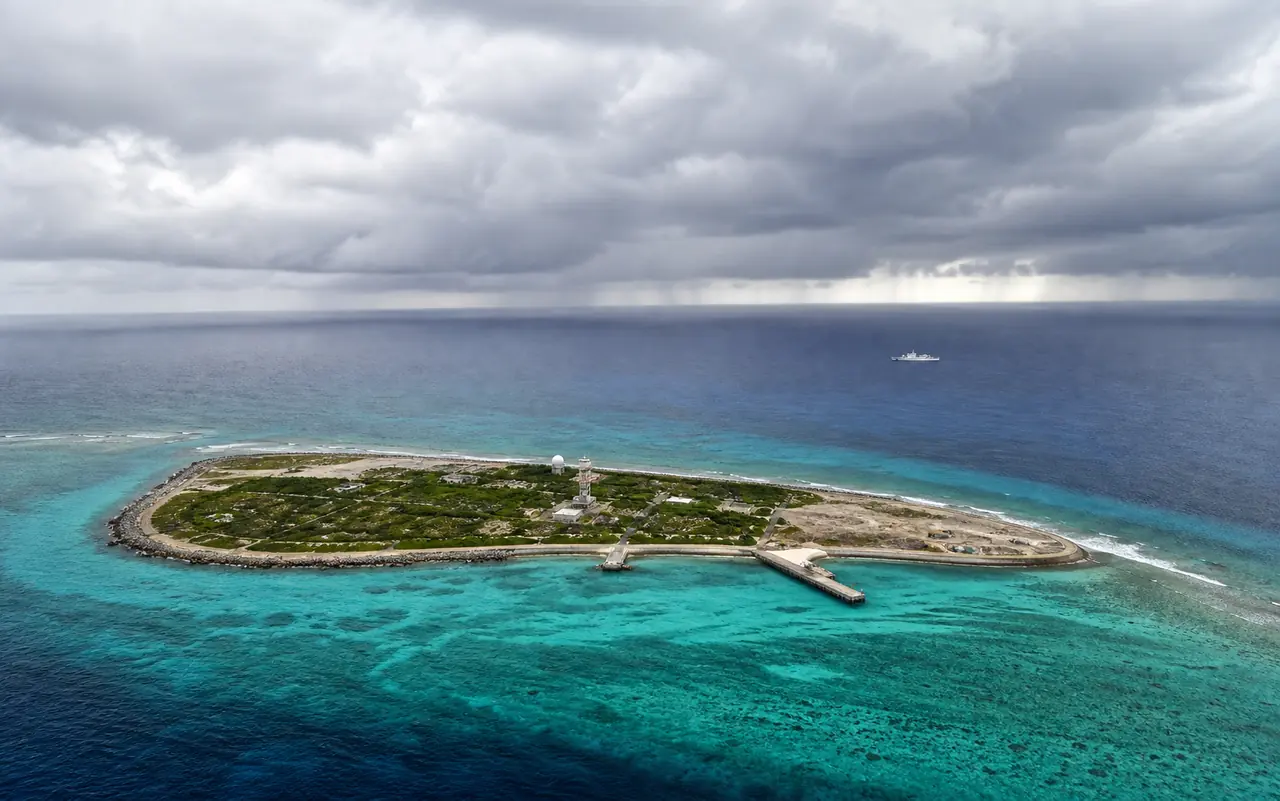
Ten years ago, that ruling cut away historic resource rights within Beijing's nine-dash line that go beyond the United Nations Convention on the Law of the Sea (UNCLOS), while also ruling that Taiping Island, which Taiwan actually controls, is a "rock" under Article 121(3) of UNCLOS: it can have a 12-nautical-mile territorial sea, but it cannot on its own generate a 200-nautical-mile exclusive economic zone or continental shelf. [1]
The law struck Beijing, and it also bruised Taipei.
What makes this more awkward is that the diplomatic language Taiwan needs most today is precisely "a rules-based international order." Facing Chinese coast guard ships, maritime militia, military exercises, and gray-zone actions, Taiwan wants its allies to believe that maritime rights cannot be decided by whoever has the bigger ships and more guns. Yet when it comes to Taiping Island, Taiwan also has to say: this ruling, which many democracies treat as the legal benchmark for the South China Sea, is one I cannot accept.
This is not a contradiction that can be papered over with a single line about "standing firm."
“Ten Years On, Did the Law Win? The South China Sea Arbitration and Taiwan's Taiping Island Dilemma” reports that South China Sea Arbitration Ruling Issued(2016.07.12)。 The tribunal rejected historic resource rights extending beyond UNCLOS and ruled that high-tide features in the Spratlys cannot generate an exclusive economic zone [1]。
Let's Be Clear First: The Tribunal Did Not Award Taiping Island to Anyone
The most common misunderstanding about the South China Sea Arbitration is treating it as a "lawsuit over island sovereignty."
It was not.
The case was brought by the Philippines under Annex VII of UNCLOS, heard by an arbitral tribunal, with administrative support from the Permanent Court of Arbitration. The tribunal explicitly stated that it does not decide which country ultimately owns any piece of land in the South China Sea, and it does not delimit a maritime boundary between China and the Philippines. [1]
What it addressed was a different set of questions: can the "historic rights" claimed within the nine-dash line exceed what UNCLOS allows? Which features are above water at high tide? Can these features generate only a 12-nautical-mile territorial sea, or can they also generate a 200-nautical-mile exclusive economic zone? Do China's land reclamation, fishing interference, and law-enforcement conduct in the relevant waters violate the Convention?
So two statements that appear to conflict can in fact both be true at once:
First, the tribunal did not award Taiping Island to the Philippines, nor did it negate Taiwan's actual control over Taiping Island.
Second, the tribunal ruled that Taiping Island cannot on its own generate a 200-nautical-mile exclusive economic zone.
Sovereignty and maritime entitlement are two different pieces of paper. Who owns the island is one; how large a maritime zone that island can draw is the other. Stack the two papers together, and the argument can never be resolved.
“Ten Years On, Did the Law Win? The South China Sea Arbitration and Taiwan's Taiping Island Dilemma” reports that What the Taiping Island Dispute Actually Turns On(12 nm vs 200 nm)。 As a "rock" under Article 121(3), it has only a territorial sea, not an exclusive economic zone generated by the feature alone; this is not a ruling on sovereignty [1]。
Taiping Island Has Fresh Water — So Why Was It Still Ruled a "Rock"?
Before the ruling, Taiwan's government put considerable effort into proving that Taiping Island was not merely a rock where seabirds land to rest.
The Ministry of Foreign Affairs argued that the island's wells can supply drinking water, and that it has conditions for agriculture, construction, and long-term habitation; Taiwan also invited foreign scholars and officials to visit the island, hoping to demonstrate that it is capable of sustaining human habitation. [3]
But the tribunal's question was stricter. Article 121(3) does not look only at whether people are present now, but at whether the feature, in its natural condition, can sustain a stable community of people or an economic life of its own. Habitation that depends primarily on outside supply, government stationing, and strategic purpose does not necessarily amount to full island status. [1]
Taiwan's objection is not without basis.
Taiwan was not a party to this case and did not sit formally in the tribunal to make its case; the arbitral documents also referred to Taiwan as "Taiwan Authority of China." The Ministry of Foreign Affairs therefore argues that the tribunal ruled on Taiping Island's status without asking Taiwan or letting Taiwan fully present evidence, that both the procedure and the terminology harmed Taiwan, and that the ruling has no legal binding force on the Republic of China. [2]
A clear line has to be held here: Taiwan can question how the tribunal assessed Taiping Island, and it can protest being excluded — but it cannot therefore say the entire ruling has no legal meaning at all. Whether the ruling binds China and the Philippines, and whether it produces direct legal effect on Taiwan, are two different questions.
"It does not formally bind me" is not the same as "the world will not use it to judge me."
Beijing and Taipei Both Object, But Not to the Same Thing
On the day the ruling was announced, Beijing called it illegal, void, and non-binding; ten years later, China's Ministry of Foreign Affairs is still using exactly the same language. [4][5]
Taiwan also says it cannot accept it.
So the easiest narrative appears: the two sides of the strait are standing together on the South China Sea.
That statement is only half right.
The core of Beijing's objection is that the tribunal rejected historic resource rights that go beyond UNCLOS, and that it refused to accept the Philippines submitting part of the dispute to compulsory arbitration. Beijing holds that territorial and maritime disputes should be negotiated directly between the parties concerned, and it does not accept a result imposed by a third party. [4]
Taiwan's objection, by contrast, contains at least three layers: being excluded from the proceedings, being referred to improperly, and damage to Taiping Island's legal status. [2]
The key point is that Taiwan, after the ruling, did not follow Beijing's path completely.
The Tsai Ing-wen administration put forward "four principles, five actions," emphasizing peaceful resolution of disputes in accordance with UNCLOS, upholding freedom of navigation and overflight, bringing Taiwan into multilateral mechanisms, and positioning Taiping Island as a base for humanitarian rescue, scientific research, and regional public goods. Researchers have also noted that, in practice, Taiwan has downplayed the U-shaped line and vague historic rights, shifting toward language more compatible with modern law of the sea. [8][9][10]
This difference cannot be erased.
But the difference also cannot live only inside the government's own mind. If Taiwan still cannot clearly explain, to the outside world, the boundary between Taiping Island's sovereignty, the feature's maritime entitlement, and historic rights, what others will still see is: Beijing objects, and Taipei objects too.
Two Red Teams, Two Costs Taiwan Cannot Avoid
From a rights-first perspective, Taiwan has no reason to voluntarily swallow a judgment it could not participate in and that clearly damages its maritime rights, just to please its democratic partners.
This camp would ask: if an international mechanism can decide the legal status of a feature Taiwan controls while Taiwan is absent, is it Taiping Island today, and some other right tomorrow? The United States itself is not a party to UNCLOS [12], yet it still often demands that China comply with rulings made under the Convention — which also weakens the moral force of that demand. If Taiwan rushes to cut itself off from Beijing, what it may cut off first is its own right to be heard.
This point stands.
But from a rules-alliance perspective, Taiwan's greatest maritime risk is not the loss of a ring of exclusive economic zone it has not actually developed — it is Beijing gradually turning coast guard patrols, ship boardings, maritime militia, and historic-rights claims into the new normal. Taiwan needs the Philippines, Japan, Australia, Europe, and the United States to jointly oppose this order in which "wherever the ships go, the law follows."
If Taiwan still relies on an ambiguous U-shaped line to carry forward its old claims, it will make its partners suspect: is Taiwan objecting to Beijing's coercive methods, or does it actually also want to preserve the same kind of vague maritime claim, just without as many ships as Beijing has?
This point also stands.
What matters is which cost is harder to bear — not which side loves Taiwan more.
Ten Years On, Did the Law Actually Win?
If you look only at the ships at sea, the law has not fully won.
China has not withdrawn from the South China Sea, nor has it stopped coast guard patrols, land reclamation, or pressure on Philippine vessels because of the ruling. Even holding the ruling in hand, the Philippines still needs coast guard operations, released footage, allied patrols, and diplomatic mobilization to keep the rights on paper from being washed away by water cannons.
If you look at how countries speak, the law has indeed left something behind.
Ten years later, fourteen countries and the EU are still willing to jointly reaffirm the ruling; Japan and the Philippines, in their 2026 joint statement, again placed UNCLOS and lawfully rendered rulings into the regional order. [6][7][11] It has not made China comply, but it has provided a shared ruler. Whenever a coast guard vessel, a water cannon, or maritime militia appears, the Philippines no longer has to say only "I think this is mine" — it can say "there is already a legal determination on these maritime rights."
The law has not made the weaker side's ships bigger, but it has made it harder for the stronger side to present its power as simply self-evident.
“Ten Years On, Did the Law Win? The South China Sea Arbitration and Taiwan's Taiping Island Dilemma” reports that Tenth-Anniversary Restatement(14 countries + EU)。 On July 12, 2026, multiple countries reaffirmed the ruling's finality and binding force; China again refused to accept it [5][6][7]。
What Taiwan Needs Is Not to Pick a Side, But to Speak Precisely
Taiwan is often presented with two wrong options.
The first is total acceptance: since Taiwan wants to stand on the side of a rules-based order, it should simply admit that Taiping Island is just a rock and stop arguing.
The second is total rejection: since the ruling harmed Taiwan, it should just throw the whole thing in the trash alongside Beijing.
Both paths are too crude.
The steadier approach is "precise reservation, deliberate separation."
Precise reservation means preserving Taiwan's substantive objection to the tribunal's Article 121 determination on Taiping Island, and also preserving its protest over being excluded from participation, being improperly named, and denied procedural justice. This, in essence, protects Taiwan's own right to speak.
Deliberate separation means clearly stating that Taiwan will not use vague historic-rights claims that exceed UNCLOS to endorse Beijing's expansion across the entire South China Sea on its behalf. The dispute over Taiping Island's status should not be used to carry forward the nine-dash line, nor should it become a justification for Chinese coast guard enforcement inside other countries' exclusive economic zones.
Then, move Taiping Island's value away from "how big a circle can be drawn" and back toward what Taiwan can actually do: maritime search and rescue, meteorological observation, scientific research, environmental conservation, fisheries coordination, and transparency around incidents at sea. These public goods will not win Taiwan a formal seat, but they can make it harder for neighboring countries to treat Taiwan as merely a silent party to a dispute. [8][9]
Two Hundred Nautical Miles Sounds Big, But It Is Not a Check That Can Be Cashed Immediately
"Twelve nautical miles or two hundred" looks like a simple arithmetic problem: the latter's radius is more than sixteen times larger, and the sea area it could cover is worlds apart. So political language easily turns into: if Taiwan accepts that Taiping Island is a rock, Taiwan will "lose a huge stretch of sea."
That sentence is missing several important conditions.
An exclusive economic zone is not territory, and it is not something that excludes everyone else the moment a line is drawn. It is a zone in which the coastal state holds specific sovereign rights over fisheries, energy, and other natural resources; other states still retain freedoms such as navigation, overflight, and laying submarine cables. What's more, the waters around the Spratlys sit close to the coasts of multiple countries and to other features; even if Taiping Island were found capable of generating an exclusive economic zone, the actual extent could still overlap with claims by the Philippines, Vietnam, and others, ultimately requiring negotiation or delimitation.
So a theoretical 200-nautical-mile circle cannot simply be converted into an asset Taiwan already controls, already fishes in, or already extracts resources from.
This does not mean legal entitlement does not matter. Entitlement changes the starting point of negotiations, and it affects fishing rights, resource cooperation, and maritime delimitation. But policy discussion has to separate "the right that might be claimed" from "the benefit actually in use today" — otherwise an exaggerated map of loss could end up hijacking a far larger national-security decision.
Turning Taiping Island Into a Public Good Is Not Abandoning Sovereignty
Some may ask: does talking about humanitarian rescue, scientific research, and environmental conservation soften the sovereignty question, or even use good deeds to disguise a retreat?
Quite the opposite.
What Taiwan lacks most in the South China Sea is not another line about being "since ancient times" — it is giving neighboring countries an everyday reason to acknowledge Taiwan's existence and want its cooperation. If Taiping Island can provide maritime search and rescue, meteorological data, coral-reef monitoring, medical evacuation, and fisheries information, its value will no longer exist only in Taiwan's own statements — it will enter other countries' actual workflows.
This can also reduce reliance on a single path of militarization. Taiping Island is far from Taiwan's main island, with a long supply line; simply adding more weapons will not automatically add security. If neighboring countries come to see it only as one more forward military outpost, it could instead become an easier target for isolation during a crisis. Public goods cannot replace defense, but they can create a legitimacy for its presence broader than weapons alone.
The most practical way to measure this is not "how much more sea was drawn today," but three questions: can Taiwan participate more in regional ocean governance as a result? Do fishermen and shipping gain more stable information and coordination? When allies oppose Beijing's coercion, does it become easier for them to include Taiwan in the same conversation?
If the answers gradually turn positive, Taiping Island will no longer be merely a feature defined by a ruling — it will be a node Taiwan has defined through its own actions.
“Ten Years On, Did the Law Win? The South China Sea Arbitration and Taiwan's Taiping Island Dilemma” reports that Sovereignty, feature entitlement, historic rights(Three Things to Separate)。 Taiwan's effective control of Taiping Island does not mean the feature necessarily generates a 200-nautical-mile EEZ, nor does it mean any vague historic-rights claim is automatically valid。
The State, Industry, and Business See Three Different Risks
For the state, the most important task is to put Taiwan's maritime claims down on paper. Sovereignty over Taiping Island, the 12-nautical-mile territorial sea, the possible exclusive-economic-zone claim, the U-shaped line, and historic rights can no longer be blurred together into a single line about an old map and "since ancient times." The more Taiwan demands that Beijing speak clearly, the more it should first speak clearly itself.
For the fisheries, shipping, and maritime industries, what is needed is not more slogans but usable maritime risk maps, incident-reporting procedures, coast-guard liaison points, and insurance information. Where legal disputes actually land on industry is usually not a sudden "loss of 200 nautical miles" one day, but fishing boats afraid to go out, rising premiums, riskier shipping routes, and more law-enforcement friction.
For ordinary SMEs, the South China Sea Arbitration is not news that will rewrite tomorrow's orders. Its impact has to travel through shipping, energy, insurance, and regional security before it reaches them. Companies should watch whether gray-zone incidents are raising route and supply costs — not mistake "Taiping Island ruled a rock" for Taiwan suddenly losing a market it is actively using.
Ten years ago, Taiwan did not sit in the arbitral tribunal, yet it was written into the ruling.
Ten years later, Taiwan cannot simply repeat that year's protest. A mature ocean policy neither hides the injury nor rejects the entire set of rules because of that injury; it knows which part must be argued for on the merits, which part must be cut away from Beijing, and which part has to be won back — position by position, through public action carried out at sea every day.
The law will not win by itself.
But if Taiwan speaks precisely for itself, at least it need not testify for someone else in someone else's legal war.
Sources
- Permanent Court of Arbitration — South China Sea Arbitration award and press release
- Ministry of Foreign Affairs, Republic of China (Taiwan) — Position on the "South China Sea Arbitration"
- Ministry of Foreign Affairs, Republic of China (Taiwan) — Further statement on Taiping Island and the arbitration case
- Ministry of Foreign Affairs of China — 2016 statement on the South China Sea Arbitration ruling (Party position, Grade A)
- Ministry of Foreign Affairs of China — Response ahead of the 2026 tenth anniversary (Party position, Grade A)
- Associated Press — Fourteen countries and the EU reaffirm the 2016 ruling
- Philippine News Agency — Philippines marks tenth anniversary of the ruling
- National Bureau of Asian Research — Taiwan's policy evolution after the South China Sea Arbitration
- Asia Maritime Transparency Initiative — Taiwan's South China Sea policy evolution
- Oxford Academic — The Tsai Ing-wen administration's South China Sea policy
- Ministry of Foreign Affairs of Japan — 2026 Japan-Philippines Comprehensive Strategic Partnership joint statement
- Congressional Research Service — The United States' relationship with UNCLOS

September 11: The Loophole Clock Starts Ticking — How the EU CRA's 24/72-Hour Rule Rewrites Taiwan's Hardware Exports
The reporting obligations of the EU's Cyber Resilience Act take effect early, on September 11, 2026. They do not require every vulnerability to be disclosed within a day — they require the legal manufacturer of a product to issue a 24-hour early warning, a 72-hour notification, and a follow-up final report once it becomes aware of an actively exploited vulnerability or a severe security incident. The real impact on Taiwan is that brand owners will push that statutory clock backward onto their ODMs, component suppliers, and software supply chains.

Viral Data Goes In — Do Vaccines Come Out? Taiwan's Gap in the PABS Negotiations
The WHO Pandemic Agreement was adopted by the World Health Assembly in 2025, but its core annex on pathogen access and benefit-sharing is still under negotiation; the seventh round did not conclude, and the eighth round is set for September. Taiwan's real risk is not whether it can upload a sequence — it is that there is no single, publicly verifiable, end-to-end pathway linking data contribution, notification of use, manufacturer contracts, and actual access to vaccines and diagnostics.