
Gray Zone Full Field Guide: China's 'Salami-Slicing' Against Taiwan — No Single Cut Reaches War, but Together They Bleed It Dry
Chinese military aircraft and ships harass Taiwan almost daily — more than 4,000 sorties into the ADIZ in just the first nine months of 2025. Coast guard vessels 'enforce the law' around Kinmen and Matsu, undersea cables keep 'accidentally' snapping, farm and fishery products get banned, and disinformation floods social media. Looked at one at a time, none of it crosses the threshold of war, so Taiwan keeps telling itself to 'bear with it.' But laid out on one map, they reveal the same strategy: salami-slicing and boiling the frog. The goal isn't to invade Taiwan on some given day — it's to wear Taiwan down until it surrenders without a fight.
Article contents01 / 08
- Gray-zone coercion is deliberate, sustained pressure kept below the threshold of war, following the strategic logic of 'salami-slicing plus boiling the frog'; the numbers tell the story: more than 4,000 PLA aircraft sorties into the ADIZ in the first nine months of 2025 (full-year 2024 already topped 3,000, a record at the time), and a monthly average of more than 300 sorties into the ADIZ since Lai took office (double the rate of the previous two years), with sorties crossing the median line simultaneously hitting new records — China has effectively 'erased' the Taiwan Strait median line.
- The full field guide breaks into six layers: military harassment (aircraft and ships harassing Taiwan, crossing the median line, joint exercises read as rehearsals for seizing Taiwan) / maritime paramilitary action (coast guard 'law enforcement' around Kinmen and Matsu, with a first-ever entry into prohibited waters in December 2025) / undersea infrastructure (cables 'accidentally' cut) / cognitive and legal warfare (disinformation, stoking doubt about America, lawfare) / economic coercion (farm and fishery import bans, suspension of ECFA early-harvest items) / airspace and legal maneuvering (balloons, the M503 route).
- The real goal is mostly not to invade Taiwan right now, but to force capitulation — subjugation without a fight; and the intensity can be dialed up or down (a recent drop in sortie numbers is likely just routine-cycle fluctuation, according to research, rather than a stand-down or strategic shift). Taiwan's answer isn't about how hard it reacts to each incident, but about resiliently refusing to be worn down — a tiered response plus an attrition-resistant baseline.
“Gray Zone Full Field Guide: China's 'Salami-Slicing' Against Taiwan — No Single Cut Reaches War, but Together They Bleed It Dry” reports that Gray-Zone Field Guide: Six Tactics Running in Parallel(6 Layers)。 Military / coast guard / undersea cables / cognitive-legal / economic / airspace [6]。
“Gray Zone Full Field Guide: China's 'Salami-Slicing' Against Taiwan — No Single Cut Reaches War, but Together They Bleed It Dry” reports that PLA Aircraft Sorties Into Taiwan's ADIZ: More Than 4,000 in the First 9 Months of 2025 [4](4,000+)。 Full-year 2024 already topped 3,000, a record at the time。
“Gray Zone Full Field Guide: China's 'Salami-Slicing' Against Taiwan — No Single Cut Reaches War, but Together They Bleed It Dry” reports that Since Lai Took Office, a Monthly Average of More Than 300 Sorties Have Entered the ADIZ — Double the Rate of the Previous Two Years [3](Median Line Erased)。 Sorties crossing the median line have simultaneously hit new records; China has effectively erased the Taiwan Strait median line。
“Gray Zone Full Field Guide: China's 'Salami-Slicing' Against Taiwan — No Single Cut Reaches War, but Together They Bleed It Dry” reports that China Coast Guard Patrolled Kinmen 4 Times in December 2025, Entering Prohibited Waters for the First Time on the 18th。 Using 'white hulls' to stay just below the threshold of war [3]。
“Gray Zone Full Field Guide: China's 'Salami-Slicing' Against Taiwan — No Single Cut Reaches War, but Together They Bleed It Dry” reports that The Goal Is Mostly Not to Invade, but to Wear Down the Will to Resist and International Confidence(Subjugation Without a Fight)。 Salami-slicing plus boiling the frog (an editorial metaphor) — changing the status quo without triggering retaliation [1]。
“Gray Zone Full Field Guide: China's 'Salami-Slicing' Against Taiwan — No Single Cut Reaches War, but Together They Bleed It Dry” reports that The Fix: Tiered Response Plus a Resilience Baseline, So No Single Incident Panics or a Steady Retreat Erodes the Line(Attrition-Resistant)。 Runs crosswise to the 2027 'readiness alarm' (see "2027 Is Not a War Bell, It's a Readiness Alarm") [5]。
Every few days, people in Taiwan see a familiar kind of news story: PLA aircraft and ships harassing Taiwan, China Coast Guard vessels "enforcing the law" around Kinmen, undersea cables "accidentally" cut, farm and fishery products banned, or disinformation flooding social media.
Looked at individually, none of these events rises to the level of war. Society can usually only protest, deal with it, and then move its attention to the next headline.
But laid out side by side, these events turn out not to be unrelated, isolated incidents — they are different facets of the same strategy. That strategy is the gray zone.
What Is the Gray Zone? No Single Cut Is Fatal, But It Never Stops Bleeding You
The gray zone means deliberate, sustained coercion kept below the threshold of war. Its essence is not "attack now" but — to borrow a metaphor common in the academic literature — "salami-slicing" and "boiling the frog": each cut is small enough that it isn't worth Taiwan (or the United States) going to war over, but cut after cut, the status quo is changed piece by piece, and Taiwan's readiness, nerves, and international credibility are bled a little at a time — or, as the source itself puts it, the danger lies in the "cumulative effect" of these steps [1][2].
What makes it frightening is not any single event — it is that "no single event is enough to trigger war, but the sum keeps wearing Taiwan down."
“Gray Zone Full Field Guide: China's 'Salami-Slicing' Against Taiwan — No Single Cut Reaches War, but Together They Bleed It Dry” reports that Gray-Zone Field Guide: Six Tactics Running in Parallel(6 Layers)。 Military / coast guard / undersea cables / cognitive-legal / economic / airspace [6]。
The Full Field Guide: Six Layers of Pressure at Once
Gathering the moves scattered across the news into a single field guide, they run roughly six layers deep, all at once:
① Military harassment — and the numbers are spiking. Aircraft and ships harassing Taiwan almost daily is no longer a figure of speech — it is a statistic: in the first nine months of 2025 alone, Taiwan recorded more than 4,000 sorties by Chinese military aircraft into the Air Defense Identification Zone (ADIZ) [4], a significant increase over the same period in 2024; full-year 2024 had already topped 3,000 sorties, itself a record at the time. Even more critical is the "median line": since Lai Ching-te took office in May 2024, Chinese military aircraft have averaged more than 300 sorties a month into Taiwan's Air Defense Identification Zone (ADIZ) — more than double the monthly average of the previous two years [3]; sorties crossing the Taiwan Strait median line have likewise hit new records. This buffer line, tacitly respected by both sides for decades, has been effectively "erased" by China. Large joint exercises (such as the "Joint Sword" series) are read as "rehearsals for seizing Taiwan." What this layer wears down is the nerves and readiness of Taiwan's fighter pilots and naval crews, forced day after day to scramble into the air or put out to sea in response.
“Gray Zone Full Field Guide: China's 'Salami-Slicing' Against Taiwan — No Single Cut Reaches War, but Together They Bleed It Dry” reports that PLA Aircraft Sorties Into Taiwan's ADIZ: More Than 4,000 in the First 9 Months of 2025 [4](4,000+)。 Full-year 2024 already topped 3,000, a record at the time。
“Gray Zone Full Field Guide: China's 'Salami-Slicing' Against Taiwan — No Single Cut Reaches War, but Together They Bleed It Dry” reports that Since Lai Took Office, a Monthly Average of More Than 300 Sorties Have Entered the ADIZ — Double the Rate of the Previous Two Years [3](Median Line Erased)。 Sorties crossing the median line have simultaneously hit new records; China has effectively erased the Taiwan Strait median line。
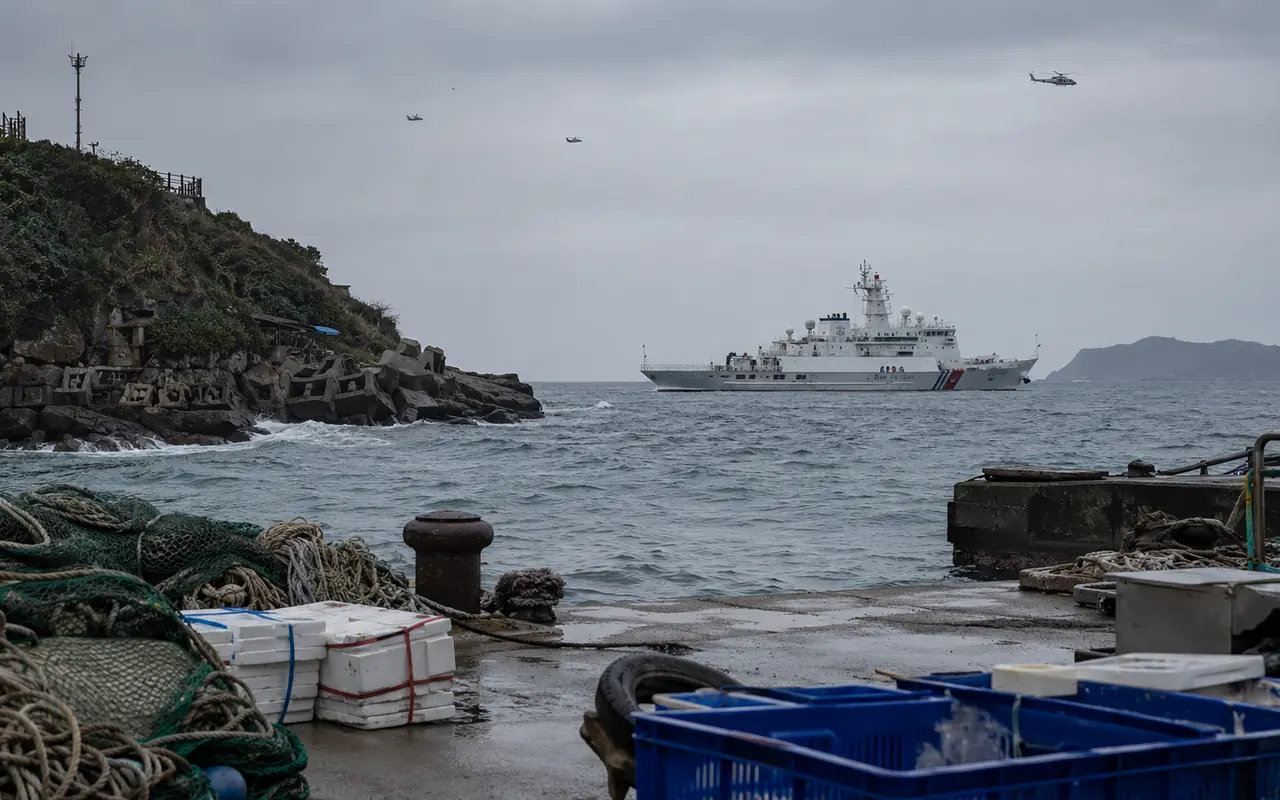
② Maritime paramilitary action. The China Coast Guard patrols the waters around Kinmen and Matsu in the name of "law enforcement"; after the February 2024 Kinmen speedboat incident, this kind of "boarding" pressure became routine. And it keeps escalating: in December 2025 alone, the China Coast Guard carried out four patrols in the waters around Kinmen (on the 11th, 18th, 22nd, and 25th), and on December 18 it entered Taiwan's designated "prohibited waters" for the first time since May 2024 [3]. Using "white hulls" (coast guard vessels) rather than "gray hulls" (warships) sits exactly below the threshold of war — it is hard to open fire on a "law enforcement vessel."
“Gray Zone Full Field Guide: China's 'Salami-Slicing' Against Taiwan — No Single Cut Reaches War, but Together They Bleed It Dry” reports that China Coast Guard Patrolled Kinmen 4 Times in December 2025, Entering Prohibited Waters for the First Time on the 18th。 Using 'white hulls' to stay just below the threshold of war [3]。
③ Undersea infrastructure. Undersea cables keep getting "accidentally" severed (multiple incidents around Matsu and the rest of Taiwan), suspected to involve Chinese-flagged or flag-of-convenience vessels. Any single case is hard to pin down conclusively, but the pattern is already enough to raise alarm (see "Cut One Line, Lose the Network for 50 Days: Taiwan's Invisible Information Lifeline").
④ Cognitive and legal warfare. Disinformation and cognitive warfare stoke doubt about America and defeatist sentiment (see "Doubting America Is Not the Same as Surrendering"); lawfare asserts jurisdiction and frames Taiwan as an "internal affair." This is the "soft" half of the equation, aimed at people's minds — and it is the battlefield that Taiwan's 2025 National Defense Report specifically names as one to counter with resilience against cognitive coercion [8].
⑤ Economic coercion. Targeted import bans on farm and fishery products, and partial suspension of ECFA early-harvest items — treating trade as a political-pressure switch, aimed precisely at specific groups (farmers and fishermen in central and southern Taiwan), applying pressure while also sowing division.
⑥ Airspace and legal maneuvering. Balloons crossing the strait — at least 5 days with a combined 7 balloon sorties recorded in December 2025 alone [3] (historically, a near-daily pace was seen around Taiwan's January 2024 election, a separate pattern from a different point in time). China also unilaterally opened the M503 connector route W121 in July 2025, nibbling away, step by step, at the Taiwan Strait's buffer space and status quo.
The Most Underrated Layer: Economic Coercion That Lands on Farmers and Fishermen
Of the six layers, the one most easily overshadowed by military headlines — yet the most personally felt — is economic coercion. China understands precision strikes well: it doesn't impose a blanket embargo (that would hurt itself too), but instead targets specific items and specific places of origin — a ban on pineapples one year, on grouper another, a suspension of part of the ECFA early-harvest list in yet another. These items tend to concentrate in specific political geographies (such as farming and fishing communities in central and southern Taiwan), so economic coercion achieves two goals at once: it inflicts pain, and it manufactures a divisive sentiment inside Taiwan that "it's the government's fault we can't do business."
The insidiousness of this layer lies in turning "geopolitics" directly into "one fruit grower's income this season." For the farmers and fishermen affected, it means goods sitting unsold in a warehouse. Taiwan's response therefore cannot rely on diplomatic protest alone — it needs market diversification (breaking into Japan, Southeast Asia, Europe, and the United States) and higher value-added products, so that the "ban" card hurts less and less each time. When your goods have no trouble selling, someone else's ban loses its force.
The Intensity Is Adjustable: A Drop Doesn't Mean Beijing Is Letting Go
There is a detail here that is easy to misread and worth flagging specifically: the intensity of the gray zone is adjustable.
Research has observed that PLA sorties harassing Taiwan dropped noticeably for a time in late February and early March 2026 [5]. This is easily read, optimistically, as "China backing off." But the more accurate understanding may be: this is likely just normal fluctuation driven by the PLA's routine mission cycle (such as the "Two Sessions" or the Lunar New Year holiday), not a sign that the threat has lifted or that strategy has shifted. Gray-zone pressure can genuinely tighten and loosen at times, but a single short-term drop is not enough to prove this was deliberate pacing; the overall trend line (the median line erased, harassment normalized) hasn't reversed either. Treating a short-term drop as the threat having lifted could still be a dangerous misjudgment.
What It Wants Is Not "Invading Taiwan" — It's "Subjugation Without a Fight"
Once you understand this picture, it becomes clear: what Beijing wants is mostly not to invade Taiwan on some given day, but to use sustained, low-intensity pressure to "force Taiwan's capitulation" — eroding the will to resist, manufacturing fatigue and panic, and getting the international community gradually used to "China pressuring Taiwan is normal," until "maintaining the status quo" becomes ever more costly and exhausting [1].
“Gray Zone Full Field Guide: China's 'Salami-Slicing' Against Taiwan — No Single Cut Reaches War, but Together They Bleed It Dry” reports that The Goal Is Mostly Not to Invade, but to Wear Down the Will to Resist and International Confidence(Subjugation Without a Fight)。 Salami-slicing plus boiling the frog (an editorial metaphor) — changing the status quo without triggering retaliation [1]。
This also complements the 2027 "readiness alarm" (see "2027 Is Not a War Bell, It's a Readiness Alarm"): the gray zone is "ongoing" day-to-day coercion, while 2027 is the benchmark year for "capability in place" — one horizontal, one vertical, together forming a complete picture of the pressure. And it isn't confined to Taiwan's surroundings, either: if Beijing's pattern against the Philippines in the South China Sea is any guide (see "Rehearsal at Scarborough Shoal"), the two theaters may follow a similar "salami-slicing" logic; but the available analysis suggests Beijing has so far stayed comparatively restrained toward Taiwan around the South China Sea, and has not yet replicated the "plant a structure → encircle → claim to have driven the intruder off" script it used against the Philippines (observation/inference, confidence: medium) [7].
The Dilemma of Response: Overreact and Fall Into the Trap, Underreact and Lose the Status Quo
So what should Taiwan do? There is a genuine dilemma here, and both red-team sides have a point.
The Eastern Eye's warning: don't escalate every incident into "China is about to attack." Overreacting plays straight into Beijing's trap of "manufacturing an incident to justify escalation," and it feeds panic within society — throwing yourself into disarray is exactly what the adversary wants.
The Western Eye's counter: but underreacting is the same as tacitly accepting a new status quo. The median line, the buffer space, undersea-cable safety — every step back can't be taken again; the salami is sliced away piece by piece, the water heated degree by degree.
“Gray Zone Full Field Guide: China's 'Salami-Slicing' Against Taiwan — No Single Cut Reaches War, but Together They Bleed It Dry” reports that The Fix: Tiered Response Plus a Resilience Baseline, So No Single Incident Panics or a Steady Retreat Erodes the Line(Attrition-Resistant)。 Runs crosswise to the 2027 'readiness alarm' (see "2027 Is Not a War Bell, It's a Readiness Alarm") [5]。
The overlap between the two points to a more mature answer: the key is not "how hard to react," but "resiliently refusing to be worn down." What Taiwan needs is neither drawing a blade over every slice of salami (exhausting itself) nor conceding on every slice (losing the status quo), but a tiered response, and training itself into an opponent that cannot be worn down. Borrowing the spirit of the Brookings piece titled "Paint it black" — leaving gray-zone coercion "nowhere to hide, and making it pay a price" [1] — this publication's own view is that the concrete playbook can include exposure, evidence-gathering, and internationalization, to "paint black" every shade of gray.
What Does a "Tiered Response" Actually Look Like?
Talking about a "tiered response" sounds abstract, but on the ground it comes down to a checklist: which gray-zone behaviors should stop at "diplomatic protest plus documentation"? Which should escalate to "public disclosure plus international notification"? Which cross a red line (such as coast guard boarding, or occupying an uninhabited islet or reef) and warrant deploying the coast guard or even a military response?
The key is to "decide in advance, not argue in the moment." When every kind of provocation has a preset, proportionate response script, Taiwan can avoid two extremes: overreacting to every incident and getting dragged into the escalation pace the adversary sets, or tolerating every incident and letting red lines quietly get pushed forward one after another. A clear tiered standard builds consensus at home (everyone knows how the state will react) and sends a deterrent signal abroad (the adversary knows what crossing each tier will cost). This is what turns "resiliently refusing to be worn down" from a slogan into an operable system. And in the end, what Taiwan needs most is not "a more agitated reaction" but "more enduring nerves" — the gray zone is an endurance contest, and the winner is not the side that reacts most violently, but the one that lasts longest, is hardest to provoke, and is hardest to frighten.
Three Taiwan Perspectives
The state: establish "tiered gray-zone response standards" — clearly defining which tier calls for protest, which for evidence-gathering, which for countermeasures, and which for escalation, so as to avoid being either "panicked by every incident" or "retreating again and again." At the same time, build civil defense and the resilience of critical infrastructure (undersea cables, the power grid) together with asymmetric warfare capability (see "A Porcupine on Paper, or a Real One?") into an "attrition-resistant baseline." Internationally, turn every act of coercion into evidence and a diplomatic asset for "exposing Beijing's coercion" — turning the adversary's gray-zone actions into Taiwan's own leverage.
Industry: the "physical resilience" of undersea cables, the power grid, and supply chains is both a matter of national security and a business opportunity (backup cables, monitoring, rapid repair). The economies of outlying islands such as Kinmen and Matsu bear paramilitary pressure directly and need risk diversification and contingency plans.
SMEs and society: cognitive warfare and economic coercion land most directly on farmers, fishermen, and small and mid-sized exporters. Societal resilience is equally critical — being able to identify disinformation and not letting "fatigue and panic" erode the will to resist (see "Living With Fear: What Are Taiwanese People Really Thinking Under the Shadow of War?") is the last line of defense that makes "subjugation without a fight" fail.
The most dangerous thing about the gray zone is that it makes you "get used to it." Today's median line, tomorrow's coast guard, the day after's severed cable — each one gets filed away as "here we go again" until you go numb. But once you see the whole picture clearly, the truth becomes obvious: what really needs guarding against isn't any single cut, but being sliced numb, cut by cut, until you no longer feel it at all. When 4,000 sorties become routine, when the median line vanishing from the map is no longer even news — that is the deepest crisis of all. Taiwan's answer is to train itself into an opponent that can be cut again and again, yet never wears down.
And the final key point — and also this publication's own policy proposal: if "painting the gray black" is done by Taiwan alone, the effect is limited; but if Taiwan, Japan, the Philippines, Lithuania, and every other country under pressure from China's gray-zone tactics publicize their own experiences, share evidence, and compare methods, then Beijing's convenience of "using the same script everywhere" turns into its own weakness — because the world will discover that this is in fact a systematic, recognizable pattern of coercion. Once the gray zone shifts from "cases too hard to attribute" into "an ironclad, pieced-together pattern," it turns from the adversary's advantage into its liability. One of the diplomatic projects Taiwan should invest in most is becoming the connector that "paints all the world's gray black together" — because the most effective counter to a globally reused script is a globally connected network. In this fight over the gray zone, Taiwan will not lose to any single cut; it will only lose at the moment it believes it must fight alone and endure in silence — and the instant it sees clearly that this is a pattern that can be recognized, exposed, and jointly countered, Taiwan has already won half the battle.
Sources
- Brookings — Paint it black: An asymmetric approach to China's gray zone coercion of Taiwan
- The Soufan Center — Beijing's Grey Zone Tactics Present a Growing Threat to Taiwan
- AEI — China & Taiwan Update (ADIZ, the median line, coast guard at Kinmen, balloon statistics)
- Taiwan Security Monitor — All Quiet in the Taiwan Strait? Explaining the Recent Drop in PLA Aircraft Activity
- CSIS ChinaPower — Tracking China's Gray-Zone Coercion against Taiwan
- Global Taiwan Institute (2026-05) — China's Next Target in the South China Sea: Taiwan?
- Irregular Warfare Initiative — Resistance is Victory: Taiwan's 2025 National Defense Report
- TaiwanPlus — Why Does China Intrude Into Taiwan's Air Defense Identification Zone?

September 11: The Loophole Clock Starts Ticking — How the EU CRA's 24/72-Hour Rule Rewrites Taiwan's Hardware Exports
The reporting obligations of the EU's Cyber Resilience Act take effect early, on September 11, 2026. They do not require every vulnerability to be disclosed within a day — they require the legal manufacturer of a product to issue a 24-hour early warning, a 72-hour notification, and a follow-up final report once it becomes aware of an actively exploited vulnerability or a severe security incident. The real impact on Taiwan is that brand owners will push that statutory clock backward onto their ODMs, component suppliers, and software supply chains.

Viral Data Goes In — Do Vaccines Come Out? Taiwan's Gap in the PABS Negotiations
The WHO Pandemic Agreement was adopted by the World Health Assembly in 2025, but its core annex on pathogen access and benefit-sharing is still under negotiation; the seventh round did not conclude, and the eighth round is set for September. Taiwan's real risk is not whether it can upload a sequence — it is that there is no single, publicly verifiable, end-to-end pathway linking data contribution, notification of use, manufacturer contracts, and actual access to vaccines and diagnostics.