
The Island Cut Off From Shipping: How Long Can Taiwan Eat When the Supply Line Breaks
Taiwan's calorie-based food self-sufficiency rate was 30.7% in 2024; rice stood at 102.9%, while wheat and soybeans were only 0.2% each and corn 3.7%. When a shipping cutoff bites, what strains first is usually not white rice, but animal feed, flour, prices, and nutritional structure.
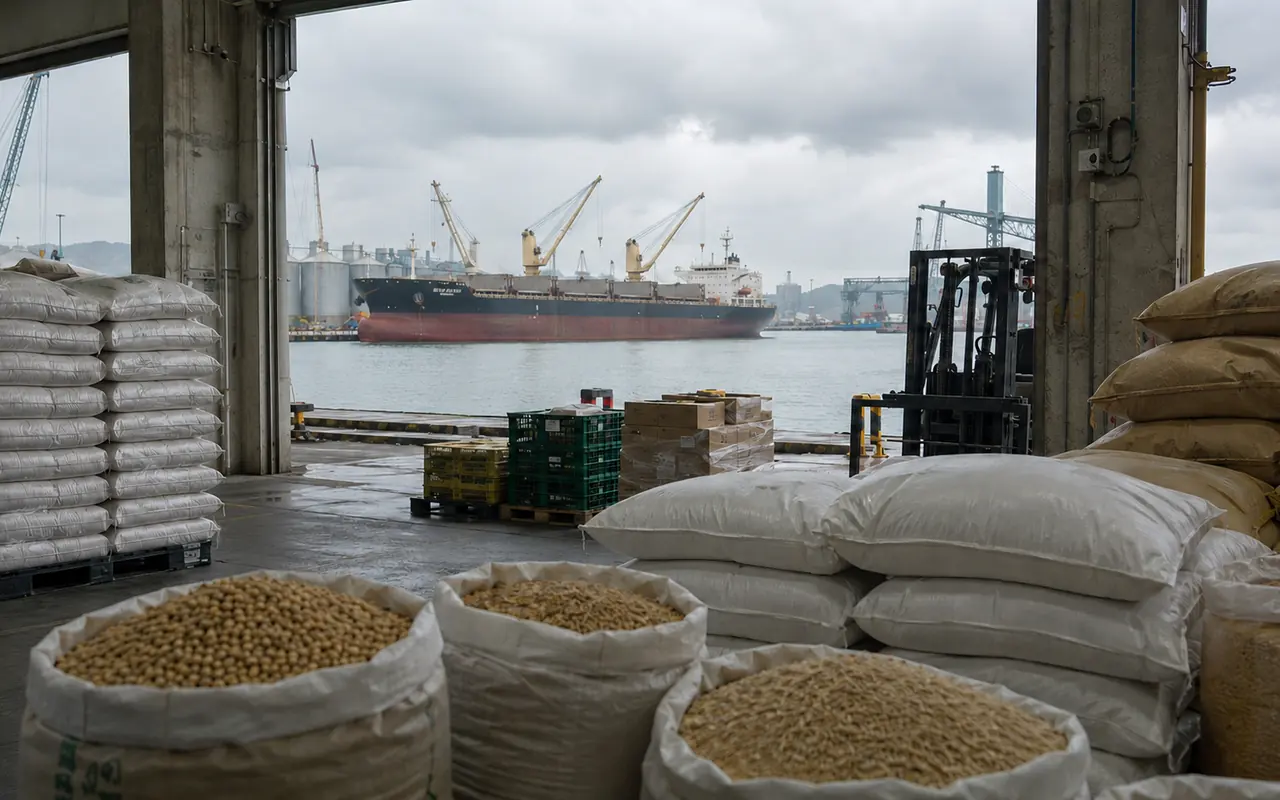
Article contents01 / 07
- Taiwan's calorie-based food self-sufficiency rate was 30.7% in 2024; rice was 102.9%, wheat and soybeans were 0.2% each, and corn was 3.7%. Rice self-sufficiency does not mean the whole table is self-sufficient.
- The 5.5 months cited in March 2025 testimony, the 8 to 9 months after harvest, and the roughly one year including private stocks are all about rice, and they cover different scopes of inventory; none of them can be extrapolated to mean every food category can hold out for a year.
- Chemical fertilizer feedstocks depend heavily on imports; international urea prices briefly rose above US$850 per tonne in April 2026 before falling back to US$453 in June. In April, the Agriculture and Food Agency said stockpiles plus orders on hand could sustain fertilizer production through August to December.
“The Island Cut Off From Shipping: How Long Can Taiwan Eat When the Supply Line Breaks” reports that 2024 Calorie-Based Food Self-Sufficiency Rate(30.7%)。 Ministry of Agriculture, 2024 Food Supply and Demand Yearbook [19][20]。
“The Island Cut Off From Shipping: How Long Can Taiwan Eat When the Supply Line Breaks” reports that Rice Is Self-Sufficient; the Other Three Depend Heavily on Imports(102.9%)。 2024 self-sufficiency rates: rice 102.9%, wheat 0.2%, soybeans 0.2%, corn 3.7% [19]。
“The Island Cut Off From Shipping: How Long Can Taiwan Eat When the Supply Line Breaks” reports that Feed Corn and Soybeans Depend on Imports(Heavily Dependent)。 Historical official feed-composition data must be read together with its data year; in 2024, self-sufficiency for both corn and soybeans was low [21][19]。
“The Island Cut Off From Shipping: How Long Can Taiwan Eat When the Supply Line Breaks” reports that Different Ranges of Rice Reserve Figures(5.5 months)。 Government rice reserves: 5.5 months; post-harvest: 8 to 9 months; including private stocks: about a year [22]。
“The Island Cut Off From Shipping: How Long Can Taiwan Eat When the Supply Line Breaks” reports that Urea Prices Swung Sharply, But Domestic Stocks Provide a Buffer(850→453)。 Urea exceeded US$850 per tonne in April 2026 and fell to US$453 in June; for domestic stock details see [23][24]。
Start with one contrast worth remembering. In 2024, Taiwan's rice self-sufficiency rate was 102.9% [19]; but laid out across the whole table and measured by calories, Taiwan's overall food self-sufficiency rate was only 30.7% [19][20]. On one side sits rice that is more than self-sufficient; on the other, overall self-sufficiency of barely three in ten — and hidden inside that gap is the nerve Taiwan most easily overlooks: when the supply line is cut, what tightens first is not necessarily white rice, but everything else on the table.
Taiwan is an island heavily dependent on imports; roughly seven in ten of its food calories arrive by ship [12]. When tankers and bulk grain carriers cannot get through, the impact is not confined to industry — it reaches every household's table. What follows lays this "food ledger" open: how close a shipping-cutoff famine really is, and which gap most urgently needs shoring up first.
The Illusion of Self-Sufficiency: Rice Is Steady, the Table Is Not
“The Island Cut Off From Shipping: How Long Can Taiwan Eat When the Supply Line Breaks” reports that 2024 Calorie-Based Food Self-Sufficiency Rate(30.7%)。 Ministry of Agriculture, 2024 Food Supply and Demand Yearbook [19][20]。
Much of Taiwan's sense of food security comes from rice. That sense is not an illusion — the 2024 rice self-sufficiency rate of 102.9% makes rice one of the few staples Taiwan can supply on its own [19]. Per-capita rice consumption in 2024 also edged up slightly, from 42.1 kg to 42.4 kg per year [14]. But overall calorie self-sufficiency is only 30.7%, because Taiwanese appetites have long since grown beyond rice alone.
Name the other lead actors on the table, and the picture flips instantly. In 2024, both wheat and soybean self-sufficiency stood at only 0.2%, and corn at just 3.7% [19]. All three depend heavily on imports; an earlier draft of this report stated corn's self-sufficiency as "twenty to thirty percent," which was an order-of-magnitude error.
“The Island Cut Off From Shipping: How Long Can Taiwan Eat When the Supply Line Breaks” reports that Rice Is Self-Sufficient; the Other Three Depend Heavily on Imports(102.9%)。 2024 self-sufficiency rates: rice 102.9%, wheat 0.2%, soybeans 0.2%, corn 3.7% [19]。
"Rice is self-sufficient" is true, but it manufactures a dangerous sense of safety. Taiwan's diet has been Westernizing and turning more carnivorous for decades: the shares of flour products, meat, and dairy have all risen steadily, and almost all of it traces back to imports [11]. So when we say "Taiwan has enough rice," that is correct; but stretched into "Taiwan's food security is not a problem," it becomes badly wrong. An overall self-sufficiency rate of just three in ten means that seven out of every ten calories this island eats each day were grown by someone else and shipped in.
Rice is nearly a perfect score; the whole table is only three in ten. The sense of safety comes from rice — the vulnerability lies in everything else.
The Real Vulnerability Is Protein
If someone wanted to use food as a chokehold on Taiwan, the rational move would not be to cut off rice — Taiwan has enough rice, plus government reserves — but to squeeze protein. That line is far more fragile than rice.
The key number is animal feed. Historical Ministry of Agriculture data notes that feed ingredients depend heavily on imports, with formulations centered on corn and soybean meal [21]; the 2024 self-sufficiency rates of just 3.7% for corn and 0.2% for soybeans also support this structural picture [19]. The formulation ratios in that older data must be read together with their year and cannot be treated as a fixed constant every year. Behind Taiwan's domestically produced meat still sits a supply chain heavily dependent on imported feed.
“The Island Cut Off From Shipping: How Long Can Taiwan Eat When the Supply Line Breaks” reports that Feed Corn and Soybeans Depend on Imports(Heavily Dependent)。 Historical official feed-composition data must be read together with its data year; in 2024, self-sufficiency for both corn and soybeans was low [21][19]。
Sourcing is also concentrated among a small number of overseas suppliers, though the share varies by item and by year; without same-year, item-level customs data, soybeans, corn, and wheat cannot simply be lumped together and described as "nearly 70% from the United States." The more practical task for the feed industry is to audit source concentration and alternative shipping routes item by item. Once shipping lanes slow down or grow more expensive, what usually reacts first is feed, meat and egg prices, and food prices generally — not an empty rice jar.
A military-side reality check makes this even clearer: bulk grain carriers are mostly large and slow, harder to escort than LNG carriers, and port grain silos are fixed targets. To apply real pressure, an adversary would not necessarily need to block every ship — simply driving up insurance and freight costs enough that ships "dare not come, or come slowly" would already shake the protein supply chain. This is why the thing Taiwan's food security should watch most closely is not the rice jar, but the feed trough and the flour barrel.
How Long Can It Last: 5.5 Months, or a Year?
So if shipping were really cut off, how long could Taiwan hold out? This is exactly where the dispute is sharpest.
In March 2025, the Minister of Agriculture told the Legislative Yuan during questioning that government rice reserves stood at about 5.5 months; adding that year's harvest could extend this to roughly 8 to 9 months; and adding private-sector rice stocks on top could sustain supply for about a year [22]. All three figures are about rice, but they cover different scopes of inventory. On the legal side, the Food Administration Act requires the competent authority to hold a safety reserve of no less than three months of rice consumption [3]; officials have also stated that 143 government rice distribution stations are planned nationwide to handle emergency distribution [22]. These administrative plans cannot prove the system would run without a hitch in an extreme scenario, but they are far more verifiable than the earlier draft's unsupported claim of "nearly 1,000 grain silos" and "annual Wan-an air-defense-drill distribution."
“The Island Cut Off From Shipping: How Long Can Taiwan Eat When the Supply Line Breaks” reports that Different Ranges of Rice Reserve Figures(5.5 months)。 Government rice reserves: 5.5 months; post-harvest: 8 to 9 months; including private stocks: about a year [22]。
A U.S. Army War College study argues that existing stockpiles might be sufficient in a fast, kinetic conflict, but could fall short under a prolonged maritime blockade [6]. This is a scenario-specific study, not an official inventory measurement. The 5.5 months and roughly one year cited in the Legislative Yuan questioning are not actually contradictory: the former counts only government reserves, while the latter adds harvest and private stocks [22]. What genuinely needs pressing further is whether the inventory, rationing, and replenishment assumptions for each food category would hold up under a prolonged disruption.
More critically, as noted above, rice is the only item that is actually self-sufficient. Even if rice can last a year, protein (soybean-based feed) and flour (wheat) have nowhere near the same scale of strategic buffer. So the question "how long can it last" has an optimistic answer if it is asked about rice alone, and a far more conservative one if it is asked about the whole table. That distinction is the single most important line this report needs to hold (confidence: high).
The Hidden Thread of Fertilizer: Even Rice Is Tied a Step Upstream
Even if we hold the line that "rice is self-sufficient," there is still a hidden thread tying it further upstream — fertilizer.
Taiwan has almost no mineral resources of its own; aside from domestically produced ammonium sulfate, nearly all the main chemical fertilizers and fertilizer feedstocks are imported [10]. Nitrogen fertilizer relies either on imported ammonia combined with locally produced concentrated sulfuric acid (a petrochemical byproduct), or on urea bought directly, which requires energy-intensive synthesis; the phosphate rock used for phosphate fertilizer comes from West Asian and North African countries such as Jordan, Iran, and Morocco; potash fertilizer depends on finished imports from places such as Russia and Canada [10]. Every unit of nutrient in Taiwan's farmland traces back to an international line of energy and mineral imports.
“The Island Cut Off From Shipping: How Long Can Taiwan Eat When the Supply Line Breaks” reports that Urea Prices Swung Sharply, But Domestic Stocks Provide a Buffer(850→453)。 Urea exceeded US$850 per tonne in April 2026 and fell to US$453 in June; for domestic stock details see [23][24]。
This hidden thread was lit up by the 2026 Strait of Hormuz conflict. World Trade Organization data shows urea prices rose from about US$400 per tonne to above US$850 in April, then fell back to US$453 in June [23]. The earlier draft's claims of "an 83% annual rise, a 50% single-day spike, US$717 per tonne" could not be reproduced against the same market and dates and have been removed; an unsourced model claiming "cutting fertilizer use by 10% to 15% would reduce corn yields by 10% to 25%" has likewise been deleted.
The reasonable chain of conditions runs: a Middle East or shipping crisis → fertilizer feedstock prices rise or supply is repeatedly disrupted → domestic stockpiles run out and substitutes fail → agricultural costs and yields come under pressure. But the Agriculture and Food Agency stated in April 2026 that stockpiles plus orders on hand at that time could sustain fertilizer production through August to December [24]; so a rise in international prices cannot simply be written as Taiwan's rice output having already fallen. Food security still connects forward to fertilizer, energy, and maritime shipping — every link in that chain simply has to keep its conditions attached.
Two Accounts Collide
Around the question of whether a shipping cutoff would starve Taiwan, this team's two red teams clashed head-on, repeatedly and in earnest.
The Eastern Eye's challenge is direct: "blockade will starve Taiwan" is an exaggerated scare narrative. A full maritime blockade is a costly, all-in showdown and is not highly probable; the more realistic scenario is a gray zone — inspections, insurance, and freight costs spiking so that ships "dare not come, or come slowly," which is far less costly than blocking every ship outright. And if pressure were truly the goal, the rational choice would not be cutting off Taiwan's self-sufficient rice, but squeezing feed and soybeans, letting meat and egg prices — and public anxiety — blow up first. The claimed "can last a year" was, from the start, a political framing that stacks in the most optimistic reserves and harvest figures.
The Western Eye counters: don't treat a blockade as doomsday. Rice is self-sufficient, and the government has a statutory safety reserve plus a plan for 143 government rice distribution stations [3][22]; a short, kinetic conflict and a long-term blockade must be assessed separately. Whether allies would help with escorts and resupply depends on the political and military conditions at the time and cannot be treated as a given guarantee. The real risk is not "no food to eat" tomorrow, but the nutritional and price shocks running through the protein, flour, and fertilizer chains.
A social-side reality check adds another cut: Taiwanese diets have already Westernized, rice consumption has fallen to 42.4 kg, and demand for flour and meat has risen [14]. Telling the public in wartime to "go back to eating sweet potatoes with rice" would be a drastic lifestyle regression; and public panic and hoarding could hit the system even earlier than an actual supply cutoff. The credibility of rationing and social communication are themselves part of food resilience.
What Should Actually Worry Us
Back to the original question: how close is a shipping-cutoff famine to Taiwan? The neutral synthesizer's balanced conclusion is this: as a doomsday narrative of "blockade equals starvation," it is exaggerated; as a national-security warning about "structural fragility," it is real.
The three objective facts most worth anchoring on are: first, calorie self-sufficiency is only three in ten; second, the only self-sufficient item is rice, while protein (soybean-based feed) and flour (wheat) depend almost entirely on imports; third, even self-sufficient rice is tied a step further upstream by dependence on imported fertilizer and energy. The real bottleneck is not "no food tomorrow," but the nutritional and price shocks that would follow a protein cutoff, a flour cutoff, and a broken fertilizer chain — and whether the buffer is wide enough under a prolonged blockade.
As for whether Taiwan should pay a high readiness cost for food, this is a genuine divide mixing evidence and values: the evidence side argues over whether reserve days are actually sufficient and whether a blockade would be kinetic or prolonged; the values side argues over how much readiness redundancy to build and how much peacetime subsidy to pay for it. This divide cannot be fully resolved by any single spreadsheet, and it should not be packaged by either camp as the one correct answer. But outside all of that opposition, there is common ground that holds regardless of position: build up strategic reserves of soybeans, wheat, corn, and feed; diversify sourcing (don't bet solely on the United States); shore up domestic coarse grains and fertilizer feedstocks; and elevate food to the level of national-security readiness. These are no-regret investments.
Three Positions: Thickening the Table
From Taiwan's vantage point, this team has converged on three positions (decision-oriented, not investment advice).
For the state, the task is to transparently audit the true safety-stock days for soybeans, wheat, corn, and feed, diversify sourcing item by item, and build substitution plans; bring fertilizer feedstocks and production capacity into the readiness inventory; and at the same time keep rice rotation stock stable while encouraging locally suited coarse grains and wartime emergency crops [13]. 5.5 months and roughly a year are different ranges of rice inventory, and should no longer be packaged as contradictory political slogans.
For industry intermediaries (feed associations, food and livestock federations, and the farmers' association system), the task is to turn "resilience against feedstock cutoffs" into a shared, cluster-level issue: help members audit their true exposure and inventory days for imported feed and flour, push joint feedstock procurement and diversified sourcing, use collective strength to spread the safety-stock costs that no single company could bear alone, and fold "uncertainty in fertilizer and feed prices" into industry risk communication — turning vague anxiety into manageable numbers and contingency plans.
For SMEs and the public, the most practical sentence is: first work out exactly how exposed your business and your own table are to a "supply cutoff" or a "10% price rise." Food and livestock operators that depend on imported flour, soybeans, and feed should prioritize diversifying their sourcing and building safety stock; for the general public, rather than panic-buying when rumors fly, it is better to build a reasonable household reserve during normal times and understand the government's rationing mechanism — rational preparation is itself the best vaccine against panic.
For an island cut off from shipping, the most honest ledger is not in the rice jar, but in the feed trough, the flour barrel, and every sack of imported fertilizer. Understanding it is not meant to cause panic — it is meant to get ahead of the moment that supply line is truly tested, and thicken this island's table, one piece at a time.
Sources
- USDA FAS — Taiwan Food Security Situation Overview (TW2024-0030)
- Taipei Times — Food self-sufficiency rate at 18-year low: ministry
- Food Administration Act — Laws & Regulations Database of the Republic of China (Taiwan)
- Agriculture and Food Agency — Government Rice Reserves Regulate Supply and Demand to Secure Food Security
- Taipei Times — Emergency food supplies 'fully planned,' MOA says
- U.S. Army War College, Parameters — Taiwan's Food Resiliency in a Conflict with China
- Taipei Times — Taiwan mapping out food plans in the event of war
- VOA — Taiwan unveils plans to cope with potential Chinese military blockade
- Ministry of Agriculture — Operation of the Food Mobilization and Preparedness Mechanism
- Taiwan Fair Trade Commission — A Study on Fertilizer Industry Policy and Competition Law Regulation
- AmCham Taiwan Business TOPICS — If Push Comes to Shove, Would Taiwan Starve?
- Domino Theory — Taiwan's Food Security Poses a Risk to Its National Security
- FFTC — Review of Taiwan's Food Security Strategy
- News&Market — 2024 Food Yearbook: Self-Sufficiency Rate of 30.7% Stops Falling and Rebounds
- News&Market — Taiwan's Animal Feed Is 95% Import-Dependent
- Ministry of Agriculture Fisheries Radio — Minister of Agriculture Explains Government Rice Reserves of 5.5 Months, 8 Months After Harvest, and At Least a Year Including Private Stocks
- The News Lens — Checking Taiwan's Food Self-Sufficiency Rate: Three-Tenths Domestic, Seven-Tenths Imported
- Taiwan News — Minister says Taiwan's food reserves would last 1 year under China blockade
- Department of Statistics, Ministry of Agriculture — 2024 Food Supply and Demand Yearbook
- Department of Statistics, Ministry of Agriculture — Food Self-Sufficiency Rate Visualization
- Ministry of Agriculture — Explanation of Import Dependence for Feed Corn and Soybeans
- Legislative Yuan Gazette — 2025, Issue 32, Committee Record
- World Trade Organization — Fertilizer Trade Impacted by Strait of Hormuz Conflict
- Agriculture and Food Agency — Fertilizer Supply Is Ample and Prices Are Stable
Taiwan's Two Faces
The whole world depends on Taiwan's chips — and is quietly preparing for the day it might lose them. The same island is both the heart of the supply chain and a geopolitical powder keg. How can Taiwan's companies turn "irreplaceable" into an advantage that lasts?
September 11: The Loophole Clock Starts Ticking — How the EU CRA's 24/72-Hour Rule Rewrites Taiwan's Hardware Exports
The reporting obligations of the EU's Cyber Resilience Act take effect early, on September 11, 2026. They do not require every vulnerability to be disclosed within a day — they require the legal manufacturer of a product to issue a 24-hour early warning, a 72-hour notification, and a follow-up final report once it becomes aware of an actively exploited vulnerability or a severe security incident. The real impact on Taiwan is that brand owners will push that statutory clock backward onto their ODMs, component suppliers, and software supply chains.