
The European Warships Have Arrived — Taiwan's Real Leverage Is in Its Drones
British, French, and Italian carriers are lining up to sail into the Indo-Pacific, and China has used electronic warfare against a Dutch warship in response. But for Taiwan, these warships are mostly a 'flag-flying' exercise, not a guarantee — the leverage Taiwan can actually operate on its own is its drones, whose exports surged 749% in 2025 and topped $100 million in the first quarter of 2026, along with the irreplaceable position Taiwan holds in Europe's 'de-China' supply chain.
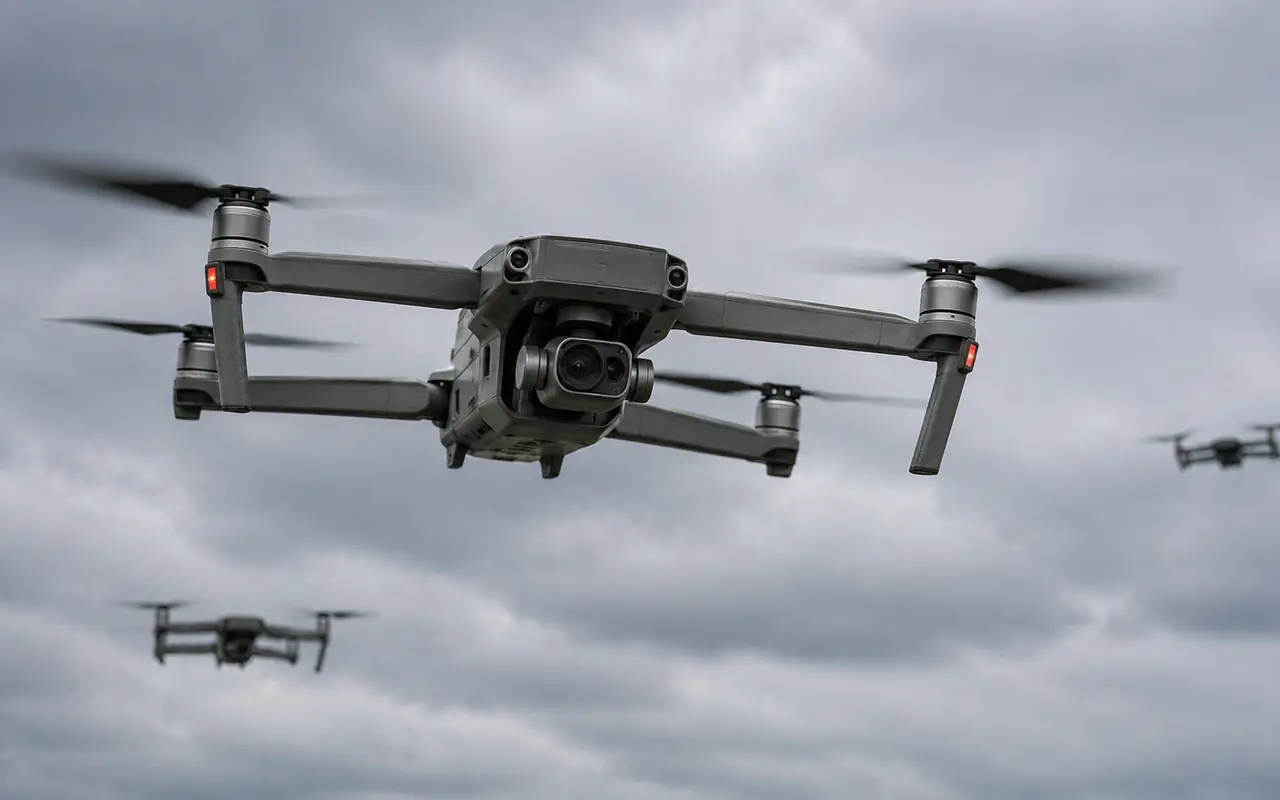
Article contents01 / 10
- European navies moving into the Indo-Pacific is a fact (the UK's CSG25, coordinated UK-France-Italy carrier deployments, the Netherlands' Pacific Archer), but their 'direct military deterrent value for the Taiwan Strait is limited' — they are mainly symbolic and normative signals, not a military guarantee.
- Beijing's countermeasures have escalated into a 'double play of electronic warfare and information warfare': on 2026-05-27 it used electronic warfare against the Dutch frigate De Ruyter and claimed to have 'driven it off,' which the Netherlands denies — this is gray-zone conflict, not a hot war.
- Taiwan's real, actively usable leverage lies in drones and 'de-risking from red supply chains': exports rose 749% year-on-year in 2025 (January–July), 2026 Q1 export value already surpassed all of 2025, and Taiwan and Poland signed an MOU on China-free components — don't wait for warships to protect Taiwan; get Taiwan locked into Europe's supply chain instead.
“The European Warships Have Arrived — Taiwan's Real Leverage Is in Its Drones” reports that Taiwan's Drone Exports to Europe Surge in 2025 (Jan.–July)(+749%)。 Year-on-year; 2026 Q1 export value already surpassed all of 2025 [26][18]。
“The European Warships Have Arrived — Taiwan's Real Leverage Is in Its Drones” reports that 2025: Taiwan Exported 70,372 Drones to Czechia, 31,711 to Poland(70,000 Units)。 Europe's 'de-risking from China' supply chain is binding itself to Taiwan [26]。
“The European Warships Have Arrived — Taiwan's Real Leverage Is in Its Drones” reports that China Uses Electronic Warfare to 'Drive Off' Dutch Frigate De Ruyter Near the Paracels(May 27)。 Gray-zone countermeasures escalate; the Netherlands denies being driven off [4][6]。
“The European Warships Have Arrived — Taiwan's Real Leverage Is in Its Drones” reports that The UK's CSG25: An Eight-Month, 7–13-Nation Indo-Pacific Deployment(30,000–40,000 Nautical Miles)。 A symbolic and normative signal, not a military guarantee for Taiwan [11][21]。
On May 27, 2026, the Dutch frigate HNLMS De Ruyter, sailing near the Paracel Islands in the South China Sea, became embroiled in a dispute over electronic-warfare interference with the PLA [4][6].
China said its Southern Theater Command used naval, air, and electronic-warfare means to "drive off" the Dutch ship and its NH90 helicopter from the disputed waters. The Netherlands' State Secretary for Defense, Boswijk, pushed back the next day, saying the ship had stayed on its planned course and had not been interfered with [23][24]. The same standoff produced two declarations of victory.
This episode compresses the central contradiction of "Indo-Pacific multipolarization" into a single event: European warships really have arrived, and China's countermeasures have really escalated too, but both sides are avoiding letting the confrontation turn into a hot war. For Taiwan, the question is not "has Europe arrived" — it is the cooler question that follows: what good are these warships actually doing for Taiwan?
The European Fleets Really Have Shown Up
Start with the facts. Since around 2020–2021, the UK, France, the Netherlands, Italy, and Germany have been sending warships into the South China Sea and the Taiwan Strait with growing frequency [9][8]. By 2026, this is no longer a matter of occasional visits:
- The United Kingdom: CSG25, "Operation Highmast," set out in April 2025 with the carrier HMS Prince of Wales as flagship, an eight-month deployment covering roughly 30,000–40,000 nautical miles (accounts vary; CIMSEC puts the figure at 40,000), with 7 to 13 nations coordinating at different stages — the lineup shifted phase by phase, and media reports differ on the exact count [11][21]. On September 12, 2025, its frigate HMS Richmond transited the Taiwan Strait alongside the US destroyer USS Higgins, drawing condemnation as "provocative" from the PLA's Eastern Theater Command [3].
- The UK, France, and Italy: coordinated a sequenced deployment of three carriers (Prince of Wales, Charles de Gaulle, ITS Cavour), and are pushing the "European Carrier Group Interoperability Initiative" (ECGII), aiming to turn occasional visits into a standing rotational presence [12][22].
- The Netherlands: announced its five-month "Pacific Archer" deployment in February 2026 — this is the same voyage De Ruyter was on — routed via India and Manila, originally bound for Hawaii to take part in RIMPAC 2026 [23].
“The European Warships Have Arrived — Taiwan's Real Leverage Is in Its Drones” reports that The UK's CSG25: An Eight-Month, 7–13-Nation Indo-Pacific Deployment(30,000–40,000 Nautical Miles)。 A symbolic and normative signal, not a military guarantee for Taiwan [11][21]。
Europe's flag really has been planted inside the sphere of influence Beijing claims. The question is: does planting a flag amount to protection?
Warships Are a Symbol, Not a Guarantee
Honesty is required here, or this becomes mistaking romance for strategy.
An analysis from the Australian Institute of International Affairs (AIIA) put it sharply in its headline: "All Dressed Up and Somewhere to Go?" [7]. European carriers have relatively limited combat power — in terms of the number of embarked aircraft, endurance, and wartime resupply, set against the PLA's home-turf advantage in the near seas. Weighing [13][10] together, our assessment is that the symbolic significance outweighs the military significance.
Even the deployment itself is constrained by diplomatic maneuvering. There have even been reports that after the UK's Chief of the Defence Staff held talks with Chinese counterparts for the first time in a decade, China demanded that the CSG "stay out of the Taiwan Strait" [11].
Red Team East puts it bluntly: framing European carriers as "the free world rushing to Taiwan's rescue" is a cognitive projection. Europe's real motive for coming to the Indo-Pacific is trade interests and demonstrating its usefulness to Washington, not fighting for Taiwan; the fact that De Ruyter, after being pressured electronically, quietly completed its planned route proves exactly that "flag-flying is just flag-flying." If Taiwan mistakes this for a security guarantee, it is mistaking romance for strategy.
But Red Team West's counterpunch also holds up — one should not swing to the other extreme and say "it's all just theater." A normalized presence, in itself, imposes a cumulative political cost on Beijing's unilateral claims. In recent years, transits of the Taiwan Strait by non-US "extra-regional" countries have clearly increased [14][20], gradually rewriting the contest over the narrative of "whether the Taiwan Strait counts as international waters." The European Parliament, moreover, passed a resolution in January 2026 calling for deeper security cooperation with Indo-Pacific partners, Taiwan included [15] ([25] documents a separate resolution passed that same March).
Where the two sides overlap is a sentence worth putting in a frame: European warships are, for Taiwan, a "normative signal," not a "military commitment." The former is real and carries cumulative value; the latter simply does not exist. Conflating the two is the mistake Taiwan most needs to avoid.
Beijing's New Tool: Electronic Warfare Plus Information Warfare
The De Ruyter incident deserves to be looked at on its own, because it reveals an "upgraded" version of Beijing's countermeasures.
In the past, China's response to US and UK ships transiting the Taiwan Strait was mostly verbal condemnation plus air and sea shadowing [5][3]. This time, against a Dutch ship, it deployed electronic warfare — interference and pressure, but no shots fired [4]. More critically, what happened afterward: China publicly claimed it had "driven the ship off," constructing a narrative of a fait accompli, while the Dutch side denied it, leaving each side telling its own story [6][24].
This is a double play of electronic warfare and information warfare: externally, constructing a victory narrative of "we drove off the intruder"; internally, reinforcing a sovereignty claim; all while avoiding direct military escalation throughout. This is the maturing of gray-zone conflict — for Taiwan, this is more worth studying than "will European carriers come or not," because this is exactly what happens around the Taiwan Strait every single day (see "Gray Zone Full Field Guide").
“The European Warships Have Arrived — Taiwan's Real Leverage Is in Its Drones” reports that China Uses Electronic Warfare to 'Drive Off' Dutch Frigate De Ruyter Near the Paracels(May 27)。 Gray-zone countermeasures escalate; the Netherlands denies being driven off [4][6]。
Why Is Europe Coming? Three Motives That Don't All Point the Same Way
Understanding what Europe's "flag-flying" really means requires first seeing the three motives that coexist behind it. The first is trade: the Indo-Pacific is a lifeline for the global economy and shipping, and the EU's Indo-Pacific strategy identifies protecting maritime critical infrastructure — undersea cables, ports — and upholding a "rules-based" regional order as key priorities [1][2]. The second is showing Washington it's useful: under repeated pressure from Trump for allies to "share more of the burden," sending ships to the Indo-Pacific is a low-cost way for Europe to prove its worth to Washington. Only the third is normative value: opposing any unilateral attempt by either side to change the status quo by force.
Understanding these three motives makes clear why "European warships ≠ a promise to protect Taiwan": they are here for their own trade, their own relationship with Washington, and an abstract international norm — not to fight for Taiwan's survival on some future day. Understanding this is exactly what lets Taiwan make pragmatic use of this "normative signal" — treating it as diplomatic and public-opinion leverage, not as reinforcements to call on in wartime (our analysis).
Taiwan's Real Leverage Is in Its Drones
If warships are only a symbol, does Taiwan have any substantive leverage it can actually operate on its own in this wave of multipolarization?
Yes — and it is already happening. It just isn't on a flight deck. It's on a drone production line.
Taiwan's drone exports surged 749% in 2025 (January–July) compared with the same period a year earlier [26][18]; heading into the first quarter of 2026, export value has already broken past $100 million, surpassing the full-year total for 2025 [18]. Monthly exports to Czechia went from near zero in mid-2025 to tens of thousands of units by late 2025 and early 2026 [18].
“The European Warships Have Arrived — Taiwan's Real Leverage Is in Its Drones” reports that Taiwan's Drone Exports to Europe Surge in 2025 (Jan.–July)(+749%)。 Year-on-year; 2026 Q1 export value already surpassed all of 2025 [26][18]。
Across the full year of 2025, Taiwan exported 70,372 drones to Czechia and 31,711 to Poland [26]. Taiwan's drone industry alliance, TEDIBOA, has already signed cooperation memorandums with the US, Poland, Czechia, Lithuania, Latvia, Estonia, Japan, and Ukraine [27][19].
Behind this lies a structural shift: after the war in Ukraine, Europe urgently needs a "de-China" drone supply chain — one that cannot use Chinese components that could be weaponized.
In December 2025, Taiwan's Minister of Economic Affairs visited Prague and Warsaw, and Taiwan and Poland signed a "secure supply chain" MOU [16]. Taiwanese manufacturers are now accelerating efforts to build local production capacity in Lithuania and Poland (including talks on joint ventures and plans for new plants). China, for its part, has already used sanctions to strike back at this emerging supply chain [18] — the fact that China has targeted this supply chain for retaliation is itself proof that it has hit a real pressure point.
“The European Warships Have Arrived — Taiwan's Real Leverage Is in Its Drones” reports that 2025: Taiwan Exported 70,372 Drones to Czechia, 31,711 to Poland(70,000 Units)。 Europe's 'de-risking from China' supply chain is binding itself to Taiwan [26]。
This is the key divergence: warships are someone else's symbol; drones are Taiwan's own substance. One is beyond Taiwan's control; the other is already in Taiwan's own hands.
De-China Components: The Lesson Ukraine Taught Europe
Why does Europe suddenly need Taiwan's drones so badly? The answer lies in Ukraine's trenches. The Russia-Ukraine war drove a brutal lesson into Europe's collective mind: on a modern, drone-dominated battlefield, you cannot use components that "an adversary can remotely disable, read data from, or has embedded a backdoor into." And the world's largest supplier of commercial drones and drone components happens to be China — Europe suddenly realized that many of the key components in the very drones it depends on for its own military buildup come from a potential adversary's hands.
"De-China components" thus became an urgent priority for European defense. What Europe wants is not just "being able to buy a drone" — it's "being able to buy a trustworthy drone, from chip to motor, with no Chinese content." This is exactly Taiwan's opening: Taiwan has the technology, the production capacity, and is politically just as wary of China — it happens to fill this position of being "trustworthy, de-China, and yet not China." This is also why Taiwan's drone exports to Europe surged 749% in a single year — what it is selling is not just a product, but a kind of "geopolitical peace of mind" [18][19].
Multipolarization Has Opened a Window — But the Window Will Close
Pulling the camera back, this wave of European engagement belongs to a larger trend: the repositioning of middle powers.
The Global Taiwan Institute (GTI) argues that India and ASEAN are repositioning themselves [15]; add Europe's warship deployments and supply-chain shifts (as detailed earlier [7][8][9][10][11]), and together the three are opening a "strategic window" for Taiwan from 2026 to 2030. The areas where Taiwan can find an opening include semiconductors, maritime domain awareness, de-risking from red supply chains, and critical minerals [15]. At the 2026 Yushan Forum, Lai Ching-te also framed "New Southbound Policy 2.0" as a larger Indo-Pacific strategy linking trade realignment, technology cooperation, and regional deterrence [17].
But multipolarization also means more variables. Europe's trade dependence on China remains deep, individual countries move at different paces, and "de-risking" is not the same as "decoupling" — at a critical moment, Europe could well retreat (our analysis). The window is open, but it will not stay open forever, and it will not open itself automatically for Taiwan.
Turning "Being Needed" Into "Impossible to Do Without"
What is most valuable about this window is that it is partially flipping Taiwan from "an object needing protection" into "a partner other countries need." Drones, semiconductors, maritime domain awareness, critical minerals (see "The Three-Layer Dividend of De-Risking from China") — these are all areas where middle powers, in the middle of restructuring their supply chains, genuinely need Taiwan.
But there is still a distance between "being needed" and "impossible to do without," and Taiwan has to weld that distance shut itself. Being needed is when someone else happens to be short of something and you happen to have it; being impossible to do without is when you have built yourself into someone else's specifications, certifications, and long-term contracts, so that even if they wanted to switch, they couldn't. What Taiwan needs to do, while this 2026-to-2030 window stays open, is weld every moment of "being needed" into a structure of "impossible to do without" — because the window will close, but once something is welded into the structure, that irreplaceability stays.
Don't Put All the Eggs in Europe's Basket Either
That said, Taiwan also should not slide from "putting blind faith in America" to "putting blind faith in Europe." Europe's trade dependence on China runs extremely deep — German automakers, French luxury brands, and the EU's entire green-energy and consumer markets are all still deeply entangled with China. That means, at a critical moment, Europe is quite likely to choose interests over values; it is willing to send ships to fly the flag and willing to buy de-China drones, but the bar for it to actually confront China over the Taiwan Strait is much higher.
So the correct posture for Taiwan toward Europe is "pragmatic diversified betting": cultivate the normative signal of the warships while also welding down the substantive ties in drones and the supply chain — but never treat any single partner as the only hope. What is truly reliable was never "which great power will come to the rescue," but rather "how many great powers, out of their own self-interest, cannot do without Taiwan." Spreading the bet across the United States, Europe, Japan, and Indo-Pacific partners, and building every one of those links on the substance of "they need Taiwan" — that is the steadiest way for a small state to live inside a game played by giants.
Three Positions: Keeping the Leverage in Taiwan's Own Hands
The state: Don't treat European carriers' transits as a military guarantee (they are mainly symbolic), but do actively cultivate their "normative signal" and diplomatic leverage. Where full effort should go is locking Taiwan into Europe's "de-risking from red supply chains" and drone ecosystem — the European Parliament's resolution and the Taiwan-Poland MOU already provide the policy foundation; the posts need to be driven deep while the window stays open.
The drone and defense-tech industry: The 749% export surge is a real window, but the bottleneck lies in "intermediary flows, scaling up, and de-Sinicizing components." Local production capacity in Poland, Czechia, and Lithuania is the key to securing a position in the European market — what's needed is not a single order, but a long-term seat in Europe's defense supply chain.
Supply-chain SMEs: The restructuring around "de-China, weaponizable components" is an opportunity for component makers to break into Europe's defense supply chain. Doing the groundwork now on component-origin traceability and certification, to become part of the "trusted supplier" list, is far more substantive than waiting for any warship to sail in from afar.
That Dutch warship eventually sailed quietly out of the waters off the Paracels, leaving behind two contradictory declarations of victory. For Taiwan, the real lesson is not who won that round of electronic warfare — it is a cooler judgment: don't wait for someone else's ship to come protect you; make the world's supply chains unable to do without you. Warships leave; orders stay. Flag-flying is someone else's posture; being needed is the structure Taiwan can weld together itself — and Taiwan's security is hidden in the latter.
Sources
- EEAS (European External Action Service) — EU Indo-Pacific Strategy
- EEAS — Working Together to Protect Critical Maritime Infrastructure in the Indo-Pacific
- USNI News (2025-09-16) — U.S., U.K. Warships Transit Taiwan Strait
- USNI News (2026-05-27) — Chinese Use Electronic Warfare Attacks on Dutch Warship in South China Sea
- USNI News (2026-01-17) — U.S. Destroyer, Survey Vessel Transit Taiwan Strait
- Bloomberg (2026-05-28) — China Says It Drove Off Dutch Frigate Sailing in South China Sea
- AIIA — All Dressed Up and Somewhere to Go? European Naval Deployments to the Indo-Pacific
- CEIAS — Bolstering European naval presence in the Indo-Pacific
- China-US Focus (Giulio Pugliese) — Europe's Naval Engagement in the South China Sea
- LSE IR — European naval deployments in the Indo-Pacific: why are they there?
- CIMSEC — Operation Highmast: UK Deployment for a "Two-Carrier Navy"
- Newsweek — US Allies in Europe Project Aircraft Carrier Power Near China
- Militarnyi — Aircraft Carriers of European States: Capabilities in War with China
- International Crisis Group — Taiwan Strait: Managing Europe's Risk in a Global Hotspot
- Global Taiwan Institute (2026-05) — The Reorientation of Middle Powers and Taiwan's Strategic Window
- Global Taiwan Institute (2026-05) — Eroding Taboos in Security Cooperation Between Taiwan and Europe
- The Diplomat (2026-03) — Taiwan's New Southbound 2.0: Rewiring the Indo-Pacific Beyond China
- The Diplomat (2026-04) — China's Sanctions Hit Europe's Emerging Drone Doctrine
- DSET — Drone Superpower: Ukraine's UAV Success and Taiwan-Ukraine Cooperation
- USNI News — Top Stories 2025: International Operations in the Western Pacific
- Forces News — Home after eight months: CSG25
- UK Defence Journal — UK, France and Italy align carriers for Indo-Pacific mission
- Army Recognition (2026) — Netherlands rejects China's claims of forcing away frigate De Ruyter
- SCMP — China says it drove away Dutch warship near disputed Paracel Islands
- Taipei Times (2026-03-29) — EU urges closer cooperation with Taiwan, partners
- CommonWealth English (2025-09-26) — Taiwan–Europe Non-China Drone Partnership Surges
- Focus Taiwan (2026-04-23) — Experts highlight potential of Taiwan-Ukraine drone cooperation

September 11: The Loophole Clock Starts Ticking — How the EU CRA's 24/72-Hour Rule Rewrites Taiwan's Hardware Exports
The reporting obligations of the EU's Cyber Resilience Act take effect early, on September 11, 2026. They do not require every vulnerability to be disclosed within a day — they require the legal manufacturer of a product to issue a 24-hour early warning, a 72-hour notification, and a follow-up final report once it becomes aware of an actively exploited vulnerability or a severe security incident. The real impact on Taiwan is that brand owners will push that statutory clock backward onto their ODMs, component suppliers, and software supply chains.

Viral Data Goes In — Do Vaccines Come Out? Taiwan's Gap in the PABS Negotiations
The WHO Pandemic Agreement was adopted by the World Health Assembly in 2025, but its core annex on pathogen access and benefit-sharing is still under negotiation; the seventh round did not conclude, and the eighth round is set for September. Taiwan's real risk is not whether it can upload a sequence — it is that there is no single, publicly verifiable, end-to-end pathway linking data contribution, notification of use, manufacturer contracts, and actual access to vaccines and diagnostics.