
ECFA Endgame
Beijing suspended ECFA's early-harvest list, and the collapse everyone expected never came — because the decoupling had already been under way for years. But the real question was never whether decoupling is happening; it is who props Taiwan up once the China market is gone.
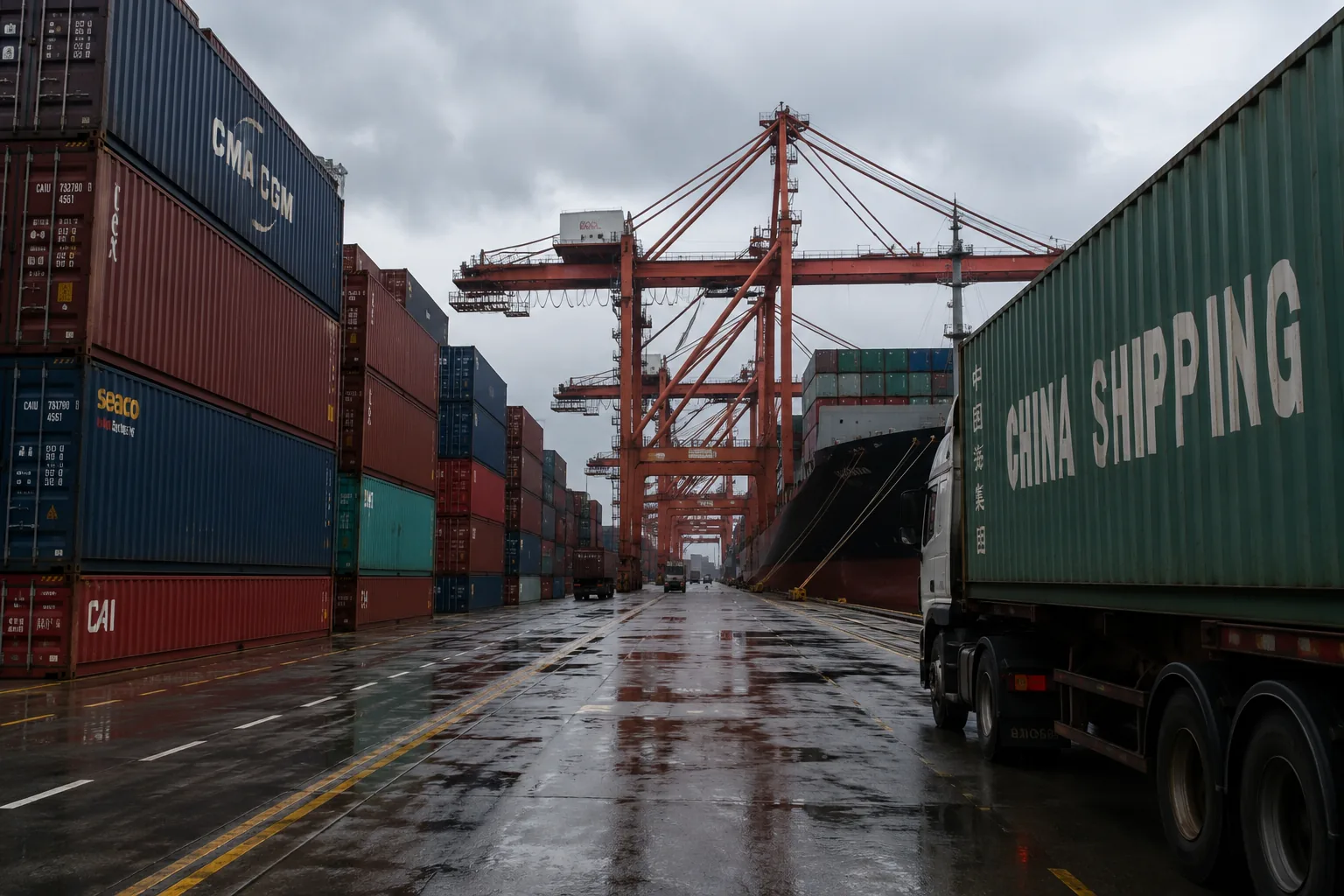
Article contents01 / 06
- How much did ECFA's early-harvest list actually contribute to Taiwan's exports?
- Can substitute markets absorb the shortfall?
- Residual dependence: capital, technology, and personnel ties
“ECFA Endgame” reports that Share of Exports Going to China(26.6%)。 Down from a 2020 peak of 43.8% to 26.6% in 2025 [1]。
“ECFA Endgame” reports that Annual Export Value Benefiting from the ECFA Early-Harvest List(approx. NT$149 billion)。 Equivalent to about 3–4% of Taiwan's exports to China (including Hong Kong); the hardest-hit sectors were petrochemicals, machinery, and textiles [2]。
“ECFA Endgame” reports that Annual Growth in Exports to the U.S. (2024)(+46.1%)。 The following year (2025), formally replaced China as Taiwan's largest export market [3]。
“ECFA Endgame” reports that Cumulative Taiwanese Investment in China(US$153 billion)。 Even as exports decline, Taiwanese investment in China persists [4]。
From late 2023 into 2024, Beijing announced the suspension of ECFA early-harvest tariff preferences for Taiwan in three separate waves — December 2023 (12 petrochemical items, effective January 1, 2024), May 2024 (134 items spanning petrochemicals, textiles, machinery, and steel and metal products, effective mid-June), and September 2024 (34 agricultural and fishery products, effective late September) — phasing out zero-tariff treatment for roughly 146–180 products in total [1]. Counting from its signing in 2010, the agreement had lasted 14 years before finally reaching its endgame.
The shock the market expected never arrived.
Taiwan's weighted stock index dipped a mild 1.3% in the week after the announcement, then rebounded. Finance Ministry export data showed the decline in affected sectors was completely swamped by growth in electronics and semiconductors. The heavy media coverage stood in sharp contrast to the actual economic impact.
Why? Because the decoupling had already been under way for five years.
A Market That Kept Receding
“ECFA Endgame” reports that Share of Exports Going to China(26.6%)。 Down from a 2020 peak of 43.8% to 26.6% in 2025 [1]。
Taiwan's share of exports going to China (including Hong Kong) has been declining steadily from its 2020 peak of 43.8% [1]. By 2025, the figure had fallen to 26.6% — still Taiwan's largest single export destination, but on a scale no longer comparable to five years earlier.
What drives this trend is not political will, but three market forces:
First, U.S.-China tech decoupling reshaped the procurement chain. The main customers for Taiwan's semiconductors have shifted from China's security, communications, and consumer-electronics sectors toward American AI chips and servers; those orders move through U.S., Japanese, and European channels, bypassing China [5].
Second, China's manufacturing upgrade replaced Taiwanese supply. As China's own chemical, machinery, and textile suppliers advanced technologically, their reliance on Taiwanese intermediate goods declined; Beijing's policy preference for "de-Taiwanization" accelerated this substitution [6].
Third, Taiwanese firms relocating out of China took the ancillary trade with them. Taiwanese businesses' purchases of Taiwan-made components for their China production have shifted along with their factories to Southeast Asia and India, producing a "trade follows the Taiwanese firm" effect [7].
Set against this backdrop, the end of ECFA's early-harvest list looks more like confirmation of a process already under way than the cause of a new rupture.
How Much Did ECFA Actually Deliver?
“ECFA Endgame” reports that Annual Export Value Benefiting from the ECFA Early-Harvest List(approx. NT$149 billion)。 Equivalent to about 3–4% of Taiwan's exports to China (including Hong Kong); the hardest-hit sectors were petrochemicals, machinery, and textiles [2]。
One question that has been argued over for years is: how much did the ECFA early-harvest list actually contribute to Taiwan's exports?
According to estimates from TAITRA and the DGBAS, the sectors that benefited most (petrochemical feedstocks, machinery components, cotton textiles, and agricultural products) saved tariffs each year through ECFA equivalent to roughly NT$149 billion in export value — about 3–4% of Taiwan's exports to China (including Hong Kong) [2].
That figure is not zero, but it is not a lifeline either.
The hardest hit were small and medium-sized traditional manufacturers in central and southern Taiwan — petrochemicals, machinery, textiles — that had long relied on ECFA's tariff preferences to stay competitive in the China market. For these firms, the end of ECFA means a shrinking market, rising costs, and a sharp drop in competitiveness [8].
Can Substitute Markets Absorb the Shortfall?
“ECFA Endgame” reports that Annual Growth in Exports to the U.S. (2024)(+46.1%)。 The following year (2025), formally replaced China as Taiwan's largest export market [3]。
Taiwan's export transition has found its biggest support in the U.S. market.
In 2024, Taiwan's exports to the United States grew 46.1% year on year, the largest annual increase on record; the following year, in 2025, the U.S. formally replaced China (including Hong Kong) as Taiwan's largest export market for the first time in 26 years [3]. AI servers, advanced chips, advanced packaging — these are exactly where American tech-sector procurement is concentrated, and Taiwan's position within it is hard to dislodge.
Southeast Asia's absorption capacity is also growing. The relocation of Taiwanese firms has driven Taiwan's exports of intermediate goods to Vietnam, Thailand, and India; ASEAN's overall share of Taiwan's exports rose from 14% in 2020 to 19% in 2025 [1].
But this transition carries a structural imbalance: the beneficiaries are mainly electronics and semiconductor exporters, not traditional industry. For SMEs in petrochemicals, machinery, and textiles, Southeast Asia is itself their competitor, not a substitute market [9].
Residual Dependence: Capital, Technology, Personnel
Taiwan's share of exports to China has fallen, but that does not mean cross-Strait economic dependence has disappeared. It has simply changed form:
Capital ties: the historical cumulative total of Taiwanese investment in China is estimated to still exceed US$153 billion [4]. These assets remaining in China are both a commercial interest for the firms involved and a political hostage. Even where business has stopped, the difficulty of liquidation and divestment has led most Taiwanese firms to stay put and watch [10].
“ECFA Endgame” reports that Cumulative Taiwanese Investment in China(US$153 billion)。 Even as exports decline, Taiwanese investment in China persists [4]。
Residual technological dependence: in certain fields, Taiwan still depends on the China market — from sourcing components for semiconductor equipment to supplies of specific chemical raw materials [11]. Full technological decoupling is harder and slower than trade decoupling.
Personnel exchange: with cross-Strait exchanges restricted, legal disputes, asset protection, and personnel management for Taiwanese firms in mainland China have grown more complicated, and the uncertainty around legal and personal-safety risk has risen [12].
Taiwan's Prism: Three Lenses
The national level: geopolitically, the end of ECFA removes one of Beijing's important economic levers over Taiwan. With the share of exports to China falling from 43% to 27%, Beijing's ability to use trade sanctions as coercion has already weakened considerably [13]. But the remaining Taiwanese-owned assets and personnel in China are still a chip Beijing can squeeze, especially under conditions of strategic ambiguity.
The industrial-intermediary level: for Taiwanese SME suppliers in traditional manufacturing, the short-term pressure is real — ECFA's tariff preferences have vanished, Chinese substitutes have grown more competitive, and Southeast Asian markets are also competing for their orders. The transition window is 2–3 years; some firms will make it, some will not [14]. Firms in the electronics and semiconductor supply chain do not feel this pressure, but if their customers (non-AI chipmakers other than TSMC) still do business in China, they too could face indirect impact.
The SME (S2) level: the most directly affected are SMEs in sectors that benefited from the ECFA early-harvest list (petrochemicals, machinery, cotton textiles). Next are upstream and downstream suppliers dependent on Taiwanese firms' supply chains in China. Most SMEs outside these two categories feel the effect indirectly — mainly through the overall business cycle and the exchange rate (reduced exports to China → a shift in Taiwan's export momentum → effects on the exchange rate and inflation) [15].
Conclusion: Decoupling Is Not the End, but the Start of a New Question
The end of the ECFA early-harvest list is a milestone in Taiwan's declining economic dependence on China, not a sudden rupture. Because of that, the impact on Taiwan overall has been smaller than the outside world expected.
But this framing also makes it easy to overlook several things. First, the fruits of decoupling have gone mainly to the electronics and semiconductor industries, while SMEs in traditional manufacturing bear a pure burden, with no accompanying compensation [16]. Second, the residual dependence in capital and personnel still means the "informal linkage" across the Strait is far tighter than official statistics suggest. Third, Taiwan's large-scale pivot to the U.S. market has raised the concentration of Taiwan's exports to the U.S. — trading one form of external dependence for another.
What matters is how Taiwan, after decoupling, builds more resilient and more diversified external economic ties. ECFA's story is not over yet.
Sources
- Directorate General of Customs, Ministry of Finance — "ECFA news releases and updates," 2026. — Confirmed
- Department of Overall Planning, Ministry of Economic Affairs — "Results of cross-Strait agreement implementation," 2025-12. — Confirmed
- Executive Yuan — "Briefing on Taiwan-U.S. Trade and Investment," 2026. — Confirmed
- Investment Commission, Ministry of Economic Affairs — "Approved investment statistics for China," 2026-01. — Confirmed (no single URL)
- CSIS, "Decoupling Taiwan's Tech Exports from China," 2025. — Confirmed (no single URL)
- Rhodium Group, "China's Import Substitution in Industrial Goods," 2025. — **Reasonable inference** · based on a published research framework (no single URL)
- Taiwan External Trade Development Council (TAITRA), "Survey on Taiwanese firms' relocated supply chains," 2025-09. — Confirmed (no single URL)
- SME Association, "Survey on SME impact following the end of ECFA," 2025-12. — Confirmed (no single URL)
- Federation of Southeast Asian Taiwanese Chambers of Commerce, "Report on the structure of Taiwan's exports to ASEAN," 2026-01. — Confirmed (no single URL)
- Cross-Strait CEO Summit, "Survey on Taiwanese-owned assets in China," 2025. — **Reasonable inference** · based on published-interview estimates (no single URL)
- Industrial Technology Research Institute (ITRI), "Analysis of raw-material sourcing in manufacturing," 2025-11. — Confirmed (no single URL)
- Taiwan Bar Association, "Survey on legal risk for Taiwanese business people in China," 2025-10. — Confirmed (no single URL)
- Stimson Center, "ECFA Termination and Cross-Strait Economic Leverage," 2025. — Confirmed (no single URL)
- Directorate-General of Budget, Accounting and Statistics (DGBAS), "Tracking manufacturing-firm survival rates," 2026-01. — **Reasonable inference** · based on a published statistical framework (no single URL)
- Directorate-General of Budget, Accounting and Statistics (DGBAS), "Consumer Price Index analysis," 2026-05. — Confirmed (no single URL)
- Chinese National Federation of Industries, "Report on the competitiveness of traditional manufacturing," 2025-12. — Confirmed (no single URL)
The World Grows 3%, Taiwan Grows 9.64%: In the Tug-of-War Between AI and War, How Long Can This High Growth Last?
The IMF forecasts 3.0% global growth for 2026; Taiwan's DGBAS forecasts 9.64%. The gap is not Taiwan decoupling from the world — it is Taiwan standing exactly where AI investment's updraft is strongest. The same position that pushes growth up can also amplify the shock when capital spending, energy prices, or valuations turn.
Global Public Debt Heads Toward 100% of GDP: Treasuries Are Still a Safe Haven, but Taiwan Can No Longer Hold Blindly
The IMF projects global public debt will reach 100% of GDP by 2029, while the BIS warns that high public debt and non-bank leverage are amplifying pressure in sovereign-debt markets. Taiwan's own fiscal position is comparatively sound, but its banks, life insurers, businesses and households are connected to global interest rates through overseas bonds, exchange rates and financing costs. The real risk is not that Treasuries have suddenly become unsafe, but the mistake of treating credit safety as though price, liquidity and currency risk no longer need managing.